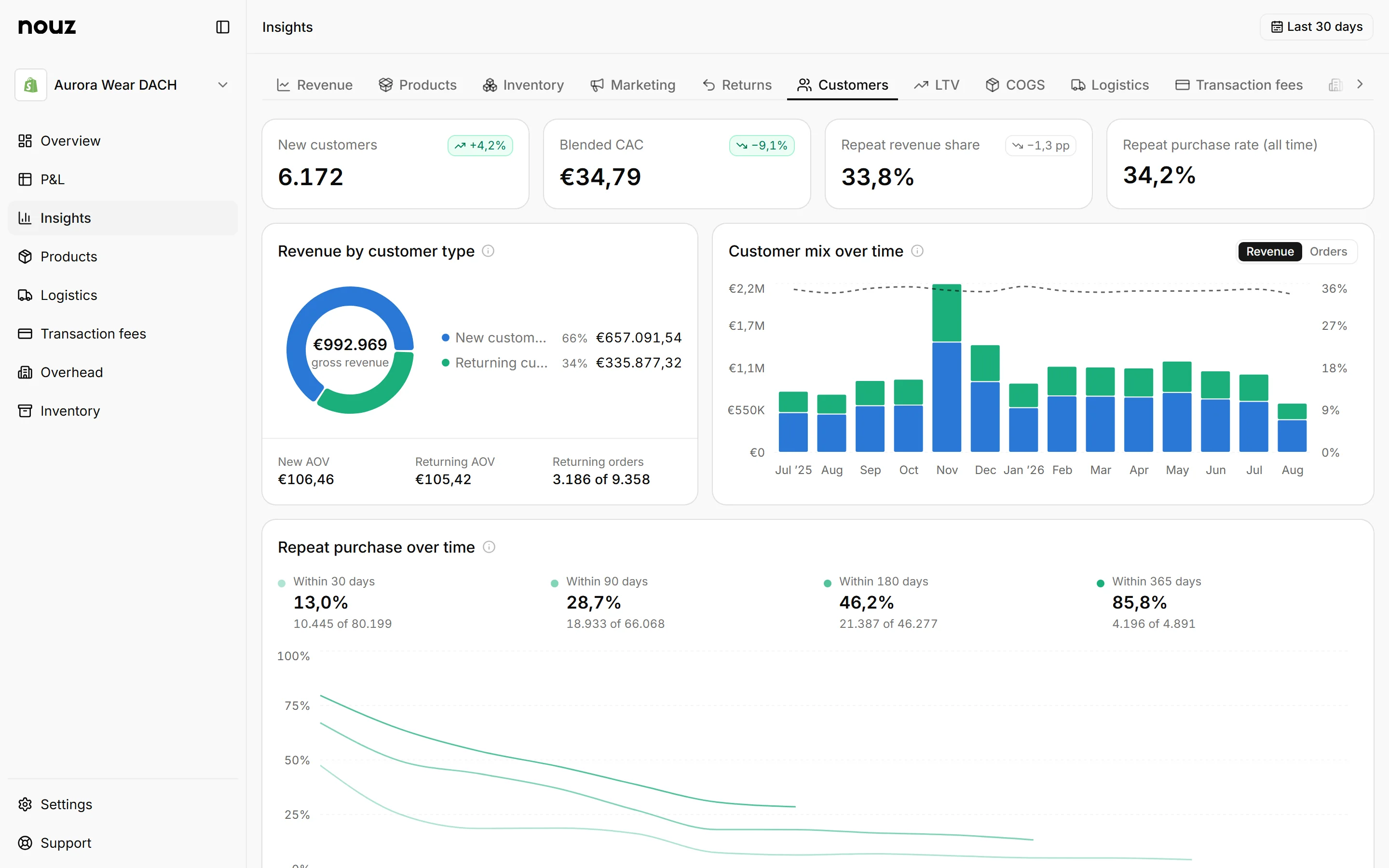
What is customer Acquisition Cost (CAC)?
CAC is what it actually costs you to win one new customer — and the honest version includes every euro you spent to get them, not just the ad spend.
Customer Acquisition Cost (CAC) is the total amount you spent to acquire one new customer, across every line item that contributed to winning them — not just media. For a small ecommerce shop the honest number is almost always 20-40% higher than the "cost per purchase" Meta or Google reports back. nouz tracks marketing spend alongside daily revenue so the CAC you compute against new customers is the fully-loaded one, not the platform one.
TL;DR
The definition, in shop-owner English
CAC answers a single question: if you wanted one more new customer next month, what would you have to spend to get them? It is not the same as cost-per-purchase (CPA) reported by an ad platform, because the platform only sees the media spend you ran through it. It does not know about the €600 you paid an agency to manage the account, or the €400 you spent on photography for the new creative, or the €120/month influencer retainer that drove a third of your conversions on attribution-blind channels.
The distinction matters because pricing, margin and growth decisions all anchor on CAC. If you think your CAC is €18 because that is what Meta shows, but the real number is €25, then every unit-economics conversation you have with yourself — break-even AOV, payback period, "can I afford to scale this channel" — is wrong by 39%.
The formula and what to include
The formula is simple:
CAC = (Ad spend + Agency fees + Creative production + Acquisition tools) ÷ New customers acquired in same period
Every line above the divider is something you would not have spent if you were not trying to acquire new customers. The line below is the count of net-new customers — first-time buyers — in the same calendar window. Use the same window for both (a month, a quarter) or the ratio is meaningless.
What to include:
- Paid media: Meta, Google, TikTok, Pinterest, programmatic.
- Agency or freelancer retainers tied to acquisition channels.
- Creative production: photography, video, copywriting, design.
- Acquisition-specific tools: landing page builders, ad creative tools, attribution software.
- Affiliate or influencer payouts attributable to new-customer acquisition.
What to exclude: retention email tools, customer support, fulfillment costs, and anything serving existing customers. Those belong in retention spend, not acquisition.
Worked example: €25 CAC
A small DTC skincare brand running paid ads in March:
| Line | Amount | Note |
|---|---|---|
| Meta + Google ad spend | €4.000 | Across two accounts |
| Agency retainer | €600 | Account management |
| Creative production | €400 | Two new video ads |
| Total acquisition spend | €5.000 | |
| New customers acquired | 200 | First-time buyers in March |
| True CAC | €25,00 | €5.000 ÷ 200 |
Compare that to what Meta reports. Meta saw €4.000 of spend and 220 attributed purchases (including some repeat buyers and view-through credit). Meta's "cost per purchase" reads €18,18. The platform number undercounts the real CAC by €6,82 per customer — 27% — by ignoring agency, creative, and the difference between "attributed purchase" and "net-new customer."
Scale that gap across a year of decisions: at 2.400 new customers, the platform view says you spent €43.600 on acquisition. The fully-loaded view says €60.000. That €16.400 gap is what owners discover at year-end when the bank balance does not match the dashboard.
Benchmarks and what good looks like
CAC in isolation is meaningless — it only matters relative to what a customer is worth (CLV) and how fast they pay you back.
| Metric | Healthy | Warning | Broken |
|---|---|---|---|
| CLV:CAC ratio | 3:1 or better | 2:1 | Below 1.5:1 |
| CAC payback period | Under 3 months | 3-6 months | Over 12 months |
| Blended CAC vs platform CAC gap | Under 25% | 25-50% | Over 50% |
The 3:1 CLV:CAC ratio is the rough industry rule for sustainable ecommerce — for every €1 you spend acquiring a customer, you want €3 of lifetime gross profit back. Below 2:1 you are reinvesting almost everything you earn just to stand still. Above 4:1 you are probably underspending and leaving growth on the table.
These are rules of thumb, not laws. A high-margin brand can survive a lower ratio; a thin-margin brand needs a wider cushion. Use the bands below to sanity-check a number, not to set a target in stone. You can run your own figures through the CAC calculator and the CLV calculator to see where you land.
| Rule of thumb | Rough range | Read |
|---|---|---|
| CLV:CAC ratio | ~3:1 | The classic sustainable target for paid acquisition. |
| CAC payback | Under ~3 months | How fast one customer's gross profit repays their CAC. |
| Blended vs platform CAC gap | Under ~25% | A wider gap means your real acquisition cost is being under-reported. |
| Share of gross profit spent on CAC | Under ~30% | Above this, acquisition is eating most of the margin. |
Common mistakes
- Using platform CPA as CAC. The number Meta or Google shows only counts the media that ran through it — it skips agency, creative and tooling, and it counts attributed purchases (including repeat buyers) rather than net-new customers. Real CAC is almost always higher.
- Dividing spend by orders, not new customers. If 30% of this month's orders were repeat buyers, using total orders as the denominator understates CAC and flatters the whole unit-economics picture.
- Misreading the CLV:CAC ratio. A 3:1 ratio only means something if the CLV side is built on gross profit, not revenue. Revenue-based CLV inflates the ratio and hides a losing business.
- Comparing CAC to revenue instead of margin. A €25 CAC against a €50 order looks fine until you remember only €20 of that order is gross profit. CAC is repaid out of margin, never out of the top line.
- Judging a single month. CAC is noisy month to month. A one-off spike after a creative refresh is not the same as three months of steadily rising CAC — only the trend tells you whether channels are saturating.
Why CAC determines whether you have a business
CAC is the single number that decides whether scaling helps or hurts. A shop with a €25 CAC and €60 CLV grows profitably forever — every new customer pays for themselves and contributes margin. A shop with a €25 CAC and €22 CLV burns cash on every acquisition; scaling that business accelerates the loss.
The mistake most small ecommerce owners make: they compute CAC as "ad spend ÷ new customers" and skip the agency, creative and tooling layer. The understated CAC makes the unit economics look healthier than they are, which justifies more spend, which compounds the gap. By the time the bank balance dissents from the dashboard, six months of growth has been bought at a loss.
How it shows up in your daily P&L
CAC is a monthly ratio, but the thing it protects — profit — is a daily number. When your acquisition cost is honest and healthy, every new customer you win adds contribution, and a good acquisition month shows up as a run of positive EBIT days. When CAC quietly creeps above what a customer is worth, the damage shows up the same way: more revenue, more orders, and an EBIT line that is flat or drifting down. nouz gives you that same-day EBIT so the trend is visible in days, not at the quarter-end reconciliation.
Related concepts:
- Customer Lifetime Value (CLV) for ecommerce — the other half of the unit-economics equation.
- The ecommerce attribution window myth — why platform-reported CAC understates the real number.
- The Shopify profitability guide — how CAC fits into the full daily P&L.
Common questions
Is CAC the same as CPA (cost per acquisition)?
No. CPA is a platform-reported metric — usually "cost per purchase" inside Meta or Google — which only sees the media spend that platform processed. CAC is the fully-loaded business metric: media + agency + creative + tooling, divided by net-new customers across all channels. CPA is almost always lower than true CAC, often by 20-40%.
Should I include returning customers in the CAC denominator?
No. CAC measures the cost to acquire one new customer, so only first-time buyers go in the denominator. Returning customers belong in retention metrics. If you mix them in, your CAC will look artificially low and your CLV:CAC ratio will lie to you.
How often should I recompute CAC?
Monthly at minimum, weekly if you are scaling ad spend aggressively. CAC is most useful as a trend — a single month is noisy, but three months of rising CAC at flat conversion is a signal that your channels are saturating and you need to diversify or accept a lower margin.
What is "blended CAC"?
Blended CAC divides your total acquisition spend across all channels by total new customers from all channels, including organic. It is the most honest single number for whether your business is acquiring customers efficiently in aggregate. Channel-level CAC (Meta-only, Google-only) is useful for allocation, but blended CAC is what you compare to CLV.
What is a healthy CAC for a small shop?
There is no universal euro figure — a healthy CAC is one that sits comfortably below what a customer is worth. The rule of thumb is a CLV:CAC ratio around 3:1 and a payback under roughly three months. A €25 CAC is excellent for a €90 lifetime-value customer and fatal for a €22 one. Always judge CAC against CLV, never in isolation.
Should CAC include organic or word-of-mouth customers?
For blended CAC, yes — the denominator is all net-new customers including organic, because they are part of how efficiently the business acquires overall. You do not add any spend for them (there is none), which is exactly why blended CAC is usually lower than any single paid channel's CAC. That lower blended number is the honest one to compare against CLV.
Does nouz calculate CAC for me?
No. nouz is a simple daily profit tool, not an attribution or analytics suite — it does not connect to Meta, Google or TikTok and does not compute CAC. You calculate CAC from your ad-platform spend and store data. What nouz gives you is the same-day EBIT that tells you whether your acquisition spend is actually turning into profit, day by day.