The lowest ROAS your ads can report before they start losing money, worked out on what an order leaves after goods, shipping, payment fees and returns, and measured on the purchase value the way Shopify reports it to Meta, with VAT in and without.
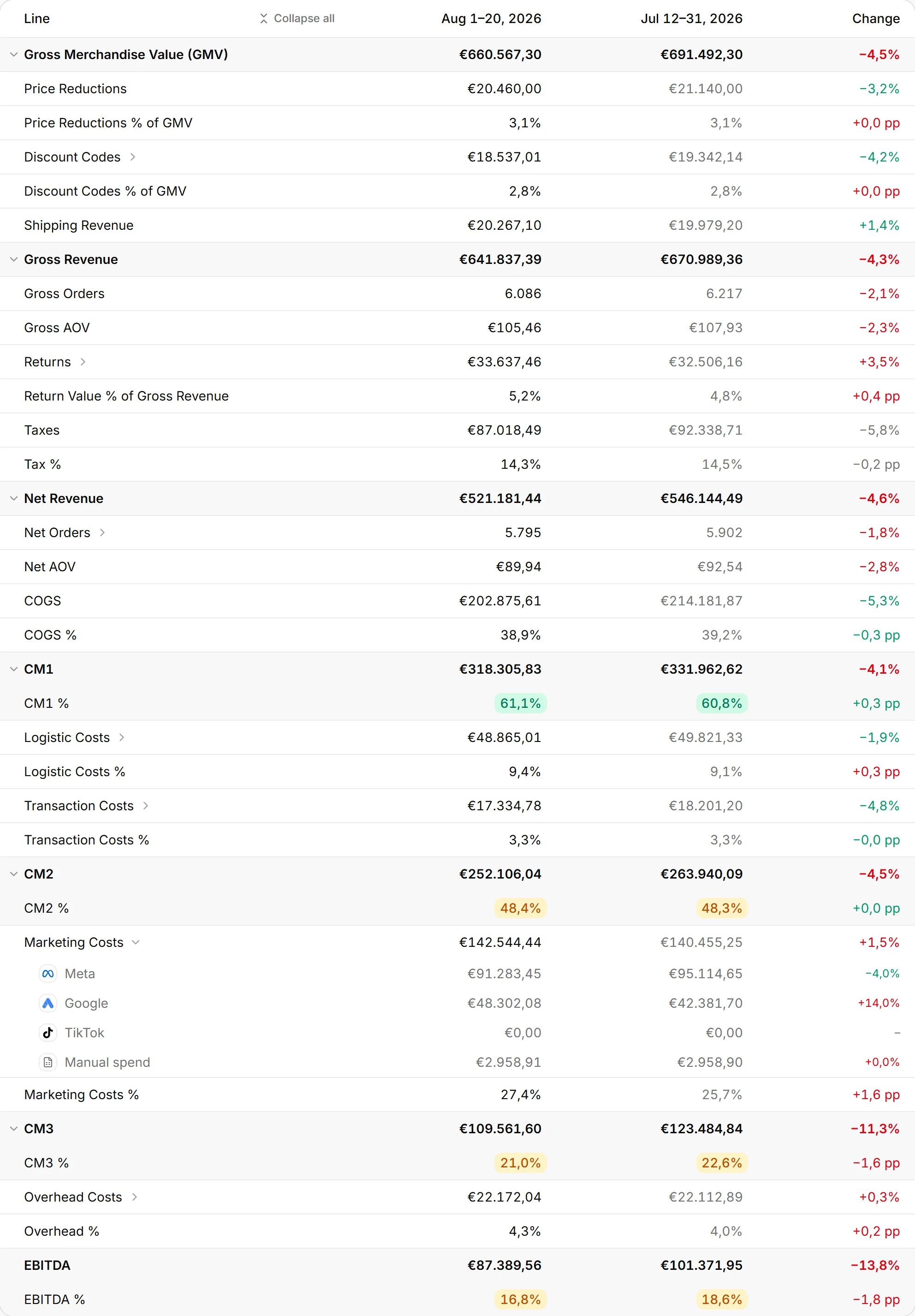
Free, nothing to sign up forLines 14 to 29 of a nouz P&L
Break-even ROAS, VAT included, as Meta counts it
2,65x
Without VAT
2,22x
if your account counts it so
Break-even MER
2,00x
on your own net revenue
Keep 10%
3,31x
the ROAS to aim for
One order
What the customer pays
€
€
%
What the order costs you
€
€/order
%
€/order
%
What you want left
%
Break-even is a floor, not a target: at it, the ads work and the month earns nothing from them.
↑↓ to nudge, Shift for ten. Commas or dots both work.
One order, at break-even
Purchase value€64,80
14Net revenue€49,01
17Goods−€16,6534,0%
21Shipping−€6,4013,1%
23Payment fee−€1,483,0%
25CM2€24,4849,9%
27Ads at break-even−€24,48
29CM3€0,00
Shopify reports the purchase to Meta with VAT and shipping in it, so 2,65x on Meta is break-even; measured without VAT the same order breaks even at 2,22x. Refunds lift both: the platform keeps counting a refunded sale, the margin does not.
Below this the ads lose money on every order they buy. One order leaves €24,48 after goods, shipping, fees and returns, which is the most it can cost to win.
An estimate from flat rates. In nouz every order is priced from the costs of its own day.
What this calculator does
What it does
A break-even ROAS calculator finds the lowest return on ad spend at which advertising stops losing money: the purchase value an ad platform reports, divided by what an order leaves after goods, shipping, payment fees and returns. This one shows it with VAT included, as Shopify reports purchases to Meta, and without, for accounts that count it that way.
The method
A ROAS is a ratio of two things, so measure both the same way.
An ad platform divides the purchase value it saw by what the ads cost. The break-even ROAS has to be built the same way: that same purchase value, divided by what the order leaves once the goods, the parcel, the payment fee and the returns are paid. At that ROAS the ad spend equals the margin and the profit after advertising is exactly zero.
The purchase value Shopify reports to Meta is the order total with VAT and shipping in it. A margin worked out without VAT and held against that figure sets the floor too low by the whole VAT rate: at 19%, a store that thinks it breaks even at 2,22 actually needs 2,65.
Returns push it higher still. The platform counted the sale at checkout and never takes it back, but a refund returns the revenue and its VAT, and only the goods come back to the shelf. The parcel and the fee stay spent.
nouz works this out for every product on Insights, Products, with and without VAT, beside the breakeven CAC, from the product’s own orders, returns and costs.
Each of these makes a campaign look safer than it is, and they stack.
A margin without VAT against a ROAS with it
One divided by your margin is the shortcut every calculator teaches, and it is only right when the margin is measured against the purchase value the platform reports. Measured against the price without VAT, it sets the floor too low by the whole VAT rate.
Returns left out
On the figures above, ignoring a 10% refund rate puts the floor at 2,31 instead of 2,65. Every campaign between the two looks profitable and is not.
Gross margin instead of what the order leaves
A margin after the goods alone still has to pay for the parcel and the payment fee before it can pay for an ad. Leave them out and the break-even ROAS is the one for a store that ships for free and is never charged a fee.
Break-even used as the target
At break-even the ads worked and earned nothing. Aim above it by the profit you want to keep: keeping 10% of net revenue on the figures above needs 3,31, not 2,65.
The calculator’s starting order: a €59,90 basket and €4,90 shipping at 19% VAT, goods costing €18,50, a €6,40 parcel, 1,9% plus €0,25 to the gateway, and 10% of sales refunded.
After returns and VAT the order is worth €49,01, and it leaves €24,48 once the goods, the parcel and the fee are paid. That is the most it can cost to win.
Meta has to report at least 2,65 for these ads to pay for themselves, because the value it reports still holds the VAT and the refunds. A target of 2,22, the figure without VAT, would lose money on every order it bought.
Across the whole account the same floor is the break-even MER, 2,00: the net revenue every euro of advertising has to bring in, from your own books.
In the app
nouz works this out from every order, every day.
A calculator works from flat rates you type once. nouz prices every single order from the cost rules that were in force on that order's own date, and rebuilds the same statement every night from your own orders and your own ad spend.
Every cost at the rate of its own day. Product costs, parcels and payment fees per order, so a price change never rewrites last month.
Ad spend comes in by itself. Meta, Google and TikTok through their official APIs, plus anything you add by hand or by CSV.
The same lines, per product. What is left after product costs, after shipping and payment fees, and after ads, for every product you sell.
The return on ad spend at which the ads cost exactly what the orders leave after the goods, the parcel, the payment fee and returns. At that ROAS the profit after advertising, CM3 on a nouz statement, is zero. Below it every sale the ads buy loses money; above it they earn.
How do I calculate break-even ROAS?
Divide the purchase value of an order by what it leaves after goods, shipping, payment fees and returns. On the figures above, a €64,80 order, VAT and shipping included, leaves €24,48, so the break-even ROAS is 2,65. The shortcut of one divided by your margin gives the same answer only when the margin is measured against the purchase value the platform reports.
Should VAT be in the purchase value?
Use what your ad account counts. Shopify sends Meta the order total with VAT and shipping in it, so a Meta ROAS has to be held against the figure with VAT included, which at a 19% rate is 19% higher than the figure without. If an account reports values without VAT, use the second figure. Mixing the two is how a European store sets a ROAS target that looks profitable and is not.
Why do returns raise the break-even ROAS?
Because the platform counted the sale at checkout and never takes it back. A refund returns the revenue and its VAT to the customer and the goods come back to the shelf, but the parcel and the payment fee are spent, so the order leaves less while the purchase value the ROAS is measured on stays the same.
What is the difference between break-even ROAS and break-even MER?
The same floor measured on two bases. Break-even ROAS divides the purchase value a platform reports by what an order leaves; break-even MER divides your own net revenue by it, and is the figure to hold the whole account to, from your own books and across every platform at once. nouz shows break-even MER on Insights, Marketing and a break-even ROAS for every product on Insights, Products.
What ROAS should I aim for?
One above break-even by the profit you want to keep. The calculator works out the ROAS that leaves a chosen share of net revenue after the ads: on the figures above, keeping 10% needs a ROAS of 3,31 rather than 2,65. Aiming at break-even itself is aiming at a month in which the advertising worked hard and earned nothing.
More calculators
Four that go with this one.
Each one is a different question about the same statement. All 32 are free, and none of them asks you to sign up.
A break-even ROAS for every product, from your real margins.
On Insights, Products, nouz works out CM2 for every product from your own orders, returns and costs, and beside it the breakeven CAC and the breakeven ROAS, with VAT and without.