7 columnsCSV
Multi-gateway stores
Payment fee rules
What this file is
Payment fee rules are what each gateway charges per transaction: a percentage of the amount plus a fixed fee. One row per provider is enough to compute what payments really cost you, and to see why smaller baskets quietly pay a higher effective rate.
What is inside
One header row, one filled example.
One row per payment provider you accept. The fixed fee column is the one that matters most: it is why a falling average order value raises your effective fee rate without any rate changing.
Rows 1 and 2 are the file. Click any cell to read it; the foot of the sheet says what its column is for.
A2Shopify Payments
| Row | A | B | C | D | E | F | G | H | I | J | K |
|---|---|---|---|---|---|---|---|---|---|---|---|
| 1 | gateway | percent | fixed_fee | currency | effective_from | ||||||
| 2 | Shopify Payments | 1.9 | 0.25 | EUR | 2026-01-01 | ||||||
| 3 | |||||||||||
| 4 | |||||||||||
| 5 | |||||||||||
| 6 | |||||||||||
| 7 |
nouz-transaction-fees
A · gatewayThe provider, spelled the way your statements spell it.
Every column, explained.
In the order they sit in the file. Point at one and it is outlined in the sheet.
Behind the file
Why it is built this way.
Every gateway prices the same way, a percentage of the charged amount plus a fixed fee per transaction, and the fixed fee is the half people forget. On a €25 order, €0,25 is a whole percent before the percentage even starts; on a €250 order the same fee is noise. That is why a falling average order value raises your blended rate while no rate changed anywhere.
Rates differ by gateway, by region and by your own agreement, so the example row is a starting point rather than advice. Read the numbers off your own statements and type what they actually charge; a rule built from someone else's rates is precision applied to the wrong number.
The effective_from column works like every cost date in nouz: a new row starts applying on its date, and history keeps the rule that was true then. In nouz a Shopify Payments payment is priced by the fee Shopify reports on it, so the rules mostly cover the other methods: PayPal, Klarna, bank transfers and the rest. To sanity-check a month, the Shopify payment fees calculator applies a rule like this to a real payment mix, and the glossary covers transaction fees and where chargebacks land.
In nouz
Where fee rules live in nouz.
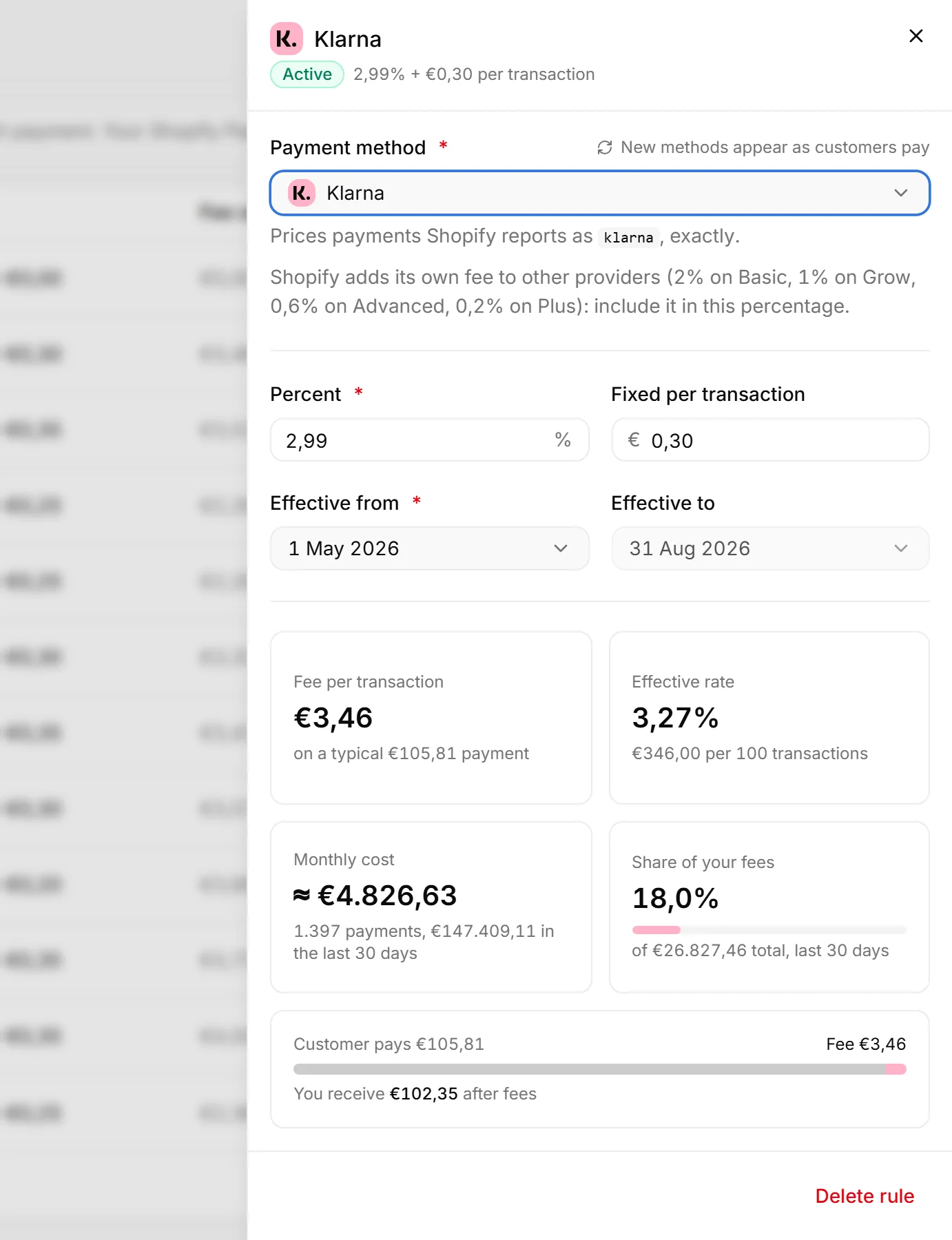
On the Transaction fees page, every payment method gets a percentage and a fixed fee, from the day they start. For Shopify Payments, nouz takes the fee Shopify reports on each payment.
More templates
More free files, same format.
Imports into nouz
4 columnsCSV
Anyone whose supplier prices move
Price list with effective dates
What each product costs and sells for, and from which day.
7 columnsCSV
Your daily P&L, without the spreadsheet.
nouz works out your real profit every night, after product costs, shipping, payment fees, ad spend and running costs, and sends it to your inbox each morning.
Your trialToday
14 days of nouz, every feature€0,00
Card needed to startNone
Access to your storeRead-only
Due today€0,00