- nouz
- Forecast
Forecast
Profit forecast: see where this month lands and how the year ahead looks.
A forecast built from your own Shopify orders and priced by the same engine as your P&L, with What if scenarios, goals and the sales and launches you plan. On every plan.
On this page, 8 sections
nouz Forecast shows twelve months of profit, starting with where this month lands, from your own Shopify orders: each future day is the same weekday a year earlier, grown at your current pace and priced by the same engine as your P&L. A store with less than a year of orders gets four months from its last four weeks.
01 Where this month lands and the year ahead.
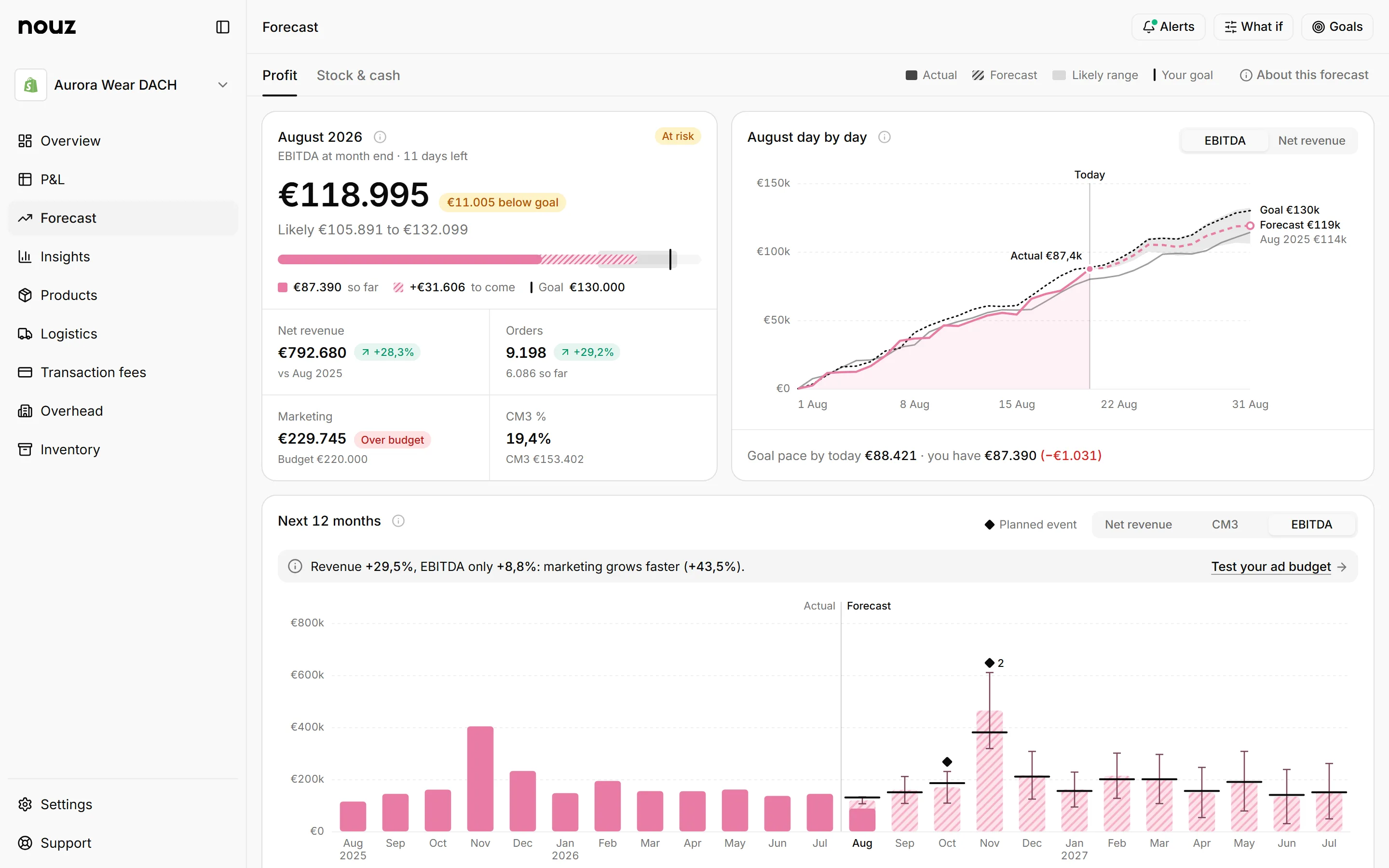
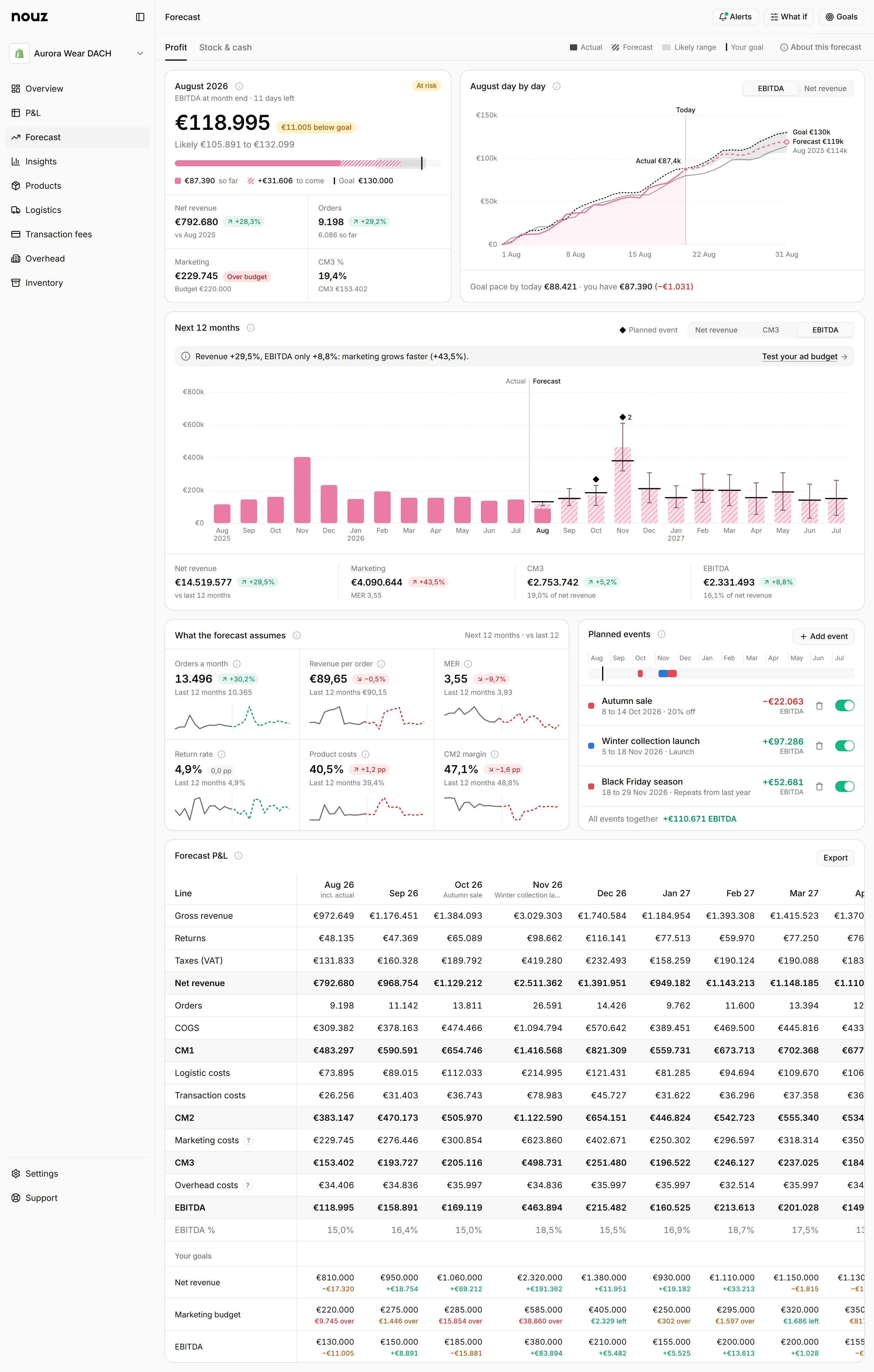
The Forecast opens on the month you are in: the EBITDA it is heading for (what the store keeps after every cost, before interest, tax and depreciation), a likely range around it, and how much of it is already booked and how much is still to come. Beside it sit net revenue and orders against the same month last year, marketing against your budget, and CM3, the margin left after advertising.
The month day by day shows what happened and the forecast for the days left, against your goal's pace. Below it, the forecast runs up to twelve months ahead, this one included, beside the twelve months before this one as they happened, each forecast month with its likely range, your goal and any event you planned.
Every month runs through the same P&L as your actual numbers, from gross revenue to EBITDA, and the forecast P&L exports as a CSV file that a German Excel opens correctly.
02 Built from your own orders and priced like your P&L.
With a year or more of orders, every future day is read from the same weekday a year earlier, 364 days back, so a Saturday stays a Saturday. Its orders grow at your current pace: your recent orders against the same weeks a year before, capped so one odd month cannot run away with it.
Each ad platform keeps its own pace. A platform you paused stays paused, a channel that barely ran a year ago repeats its last four weeks, and marketing you enter on the Overhead page carries on as you set it up.
Then the same engine that computes your P&L prices every forecast day with your product costs, shipping, payment fees and overhead, including any cost change you saved with a future start date: a carrier's new rates from next month are already in the months they apply to.
A store with four weeks to a year of orders gets a shorter forecast: its last four complete weeks, repeated for this month and the next three, and the page says so. With less than four weeks of orders there is no forecast yet, because anything shorter would be a guess.
Last year's Black Friday season is found in your own daily orders and repeats unless you switch it off.
Every month carries a likely range. Once a store has a little over a year of orders, nouz checks the method against past months, and with three of them checked the range is where eight of ten past forecasts landed, with the recent misses shown beside it; until then it is an estimate that widens a little each month further out.
Anything the forecast cannot price yet, such as a product without a unit cost or a payment method without a fee rule, is listed with a link to the page that fixes it.
03 Test a change before you make it
Change what you expect and EBITDA for the months ahead moves from your forecast to the scenario, with net revenue, CM2, marketing and overhead beside it. Your changes apply in the months you choose, and the days already booked never move.
nouz models no attribution, so you say what an extra euro of ads brings back, and the panel shows the point below which more ads lower profit. With an EBITDA goal set, Match my EBITDA goal finds the ad change that lands on it.
Scenarios are saved by name and always measured against your forecast, so a price rise you saved stays a price rise when your store's growth moves.
04 Goals the forecast is checked against
Set a monthly goal for net revenue and EBITDA, and a marketing budget as a ceiling. Type one total for the year and nouz spreads it over the months the way your forecast is spread, so the busy months carry more.
Each month is marked On track, At risk or Likely short: on track when the forecast reaches the goal, at risk when only the top of its likely range does. On the month's day-by-day chart the goal follows your usual weekday pattern, so a quiet Monday does not look like falling behind.
05 Sales, launches and campaigns, on their dates
Add a sale, a launch or a campaign with its dates, the extra orders you expect, its discount and its ad budget, and the forecast takes it in on those days.
Each event shows what it adds to EBITDA or takes from it, and a sale that brings more orders but costs more than it earns says why: that its discount, or its ad budget, costs more than the extra orders bring.
Last year's Black Friday season is on the list too, and counts until you switch it off.
06 The forecast in your inbox
The daily profit email carries the forecast unless you switch it off: where the month will likely end, how that compares with your goal, and the EBITDA of the months ahead.
Two alerts watch the months that begin within the next eight weeks: one when a month is likely to miss its EBITDA goal, and one when a month's marketing is forecast above your budget.
The goal alert is on from the start and the budget alert is yours to switch on, on the Forecast page or under Settings and Notifications. Each writes at most once a week, and only once you have set the goal or the budget it reads.
07 On every plan
Forecast is part of every plan and of the 14-day free trial. The plans cost Base $55, Pro $115 and Scale $289 a month (about €49, €99 and €249); Base covers up to 500 orders a month, and Pro and Scale have no order limit.
No plan charges per order, and every plan carries every feature.
08 Questions
How does nouz forecast profit?
From your own orders. With a year or more of history, each future day is the same weekday a year earlier, grown at your current pace, and the engine that computes your P&L prices it with your costs, including the cost changes you scheduled. A younger store gets its last four weeks repeated for this month and the next three.
How accurate is the forecast?
Every month shows a likely range. Once a store has a little over a year of orders, nouz checks the method against past months, and with three of them checked the range is where eight of ten past forecasts landed, with the recent misses shown beside it. Until then the range is an estimate that widens a little each month further out.
Does the forecast include Black Friday and my own promotions?
Yes. Last year's Black Friday season is found in your own orders and repeats unless you switch it off, and your sales, launches and campaigns are added on their dates with the extra orders, discount and ad budget you set.
Does the forecast tell me what to reorder?
Not on the Forecast page, which forecasts the whole store's orders and profit. The reorder planner on Insights, Inventory dates each product's next order from its own sales pace and lead time, counting stock already on its way, and suggests how many to order and what that costs today. An email you can switch on, A product needs ordering, tells you when a product's Order by day comes. You still place the order with your supplier.
Can I build a cash flow plan from the forecast?
Yes, its profit side. The forecast P&L gives every month ahead its EBITDA, its cost of goods and the VAT inside its sales, each on its own line, and exports as a CSV file. Stock payments run on your supplier terms and the VAT return on your filing calendar, so those two go beside it, as the ecommerce cash flow forecast template lays out.
Which plans include Forecast?
Every plan: Base, Pro and Scale, each with 14 days free. The plans cost Base $55, Pro $115 and Scale $289 a month (about €49, €99 and €249), with no fee per order; Base covers up to 500 orders a month, and Pro and Scale have no order limit.
The simplest honest forecast moves your own last year forward, weekday by weekday, scales it by how you are really growing, and prices it with the costs that will apply.
This month's statement carried twelve months forward, orders and ad spend each growing at their own rate.
What the months ahead will earn, after every cost.
Black Friday is judged on revenue and paid for out of contribution. Ten checks before the discount goes live, from the extra orders it owes to the cash it needs.
A profitable month can still drain the account when the VAT return and the supplier invoices fall due. How to build a cash flow forecast that knows both dates.
What a store expects to sell in the weeks and months ahead.
See where your month lands.
Every plan starts with 14 days free. nouz imports every order your store has ever taken, so the forecast has your history from the first day.