- nouz
- For EU stores
For EU and DACH stores
Shopify profit tracker for EU stores: VAT, OSS and EU payment fees done right. The European way, and how the other apps handle it.
nouz is built in Vienna for stores that sell in Europe. VAT stays out of your margins, amounts read the way you write them, packaging fees are priced per destination, and the price is a flat monthly fee.
On this page, 8 sections
For a Shopify store selling in the EU, nouz is the profit tracker built for it first: VAT on a Taxes line of its own, from the tax Shopify charged on each order, so OSS sales carry each country's rate; Net Revenue and every margin without VAT; Klarna, iDEAL and EPS priced as their own payment methods; amounts written €1.234,56.
01 VAT stays out of your margins
12 Taxes14 Net Revenue
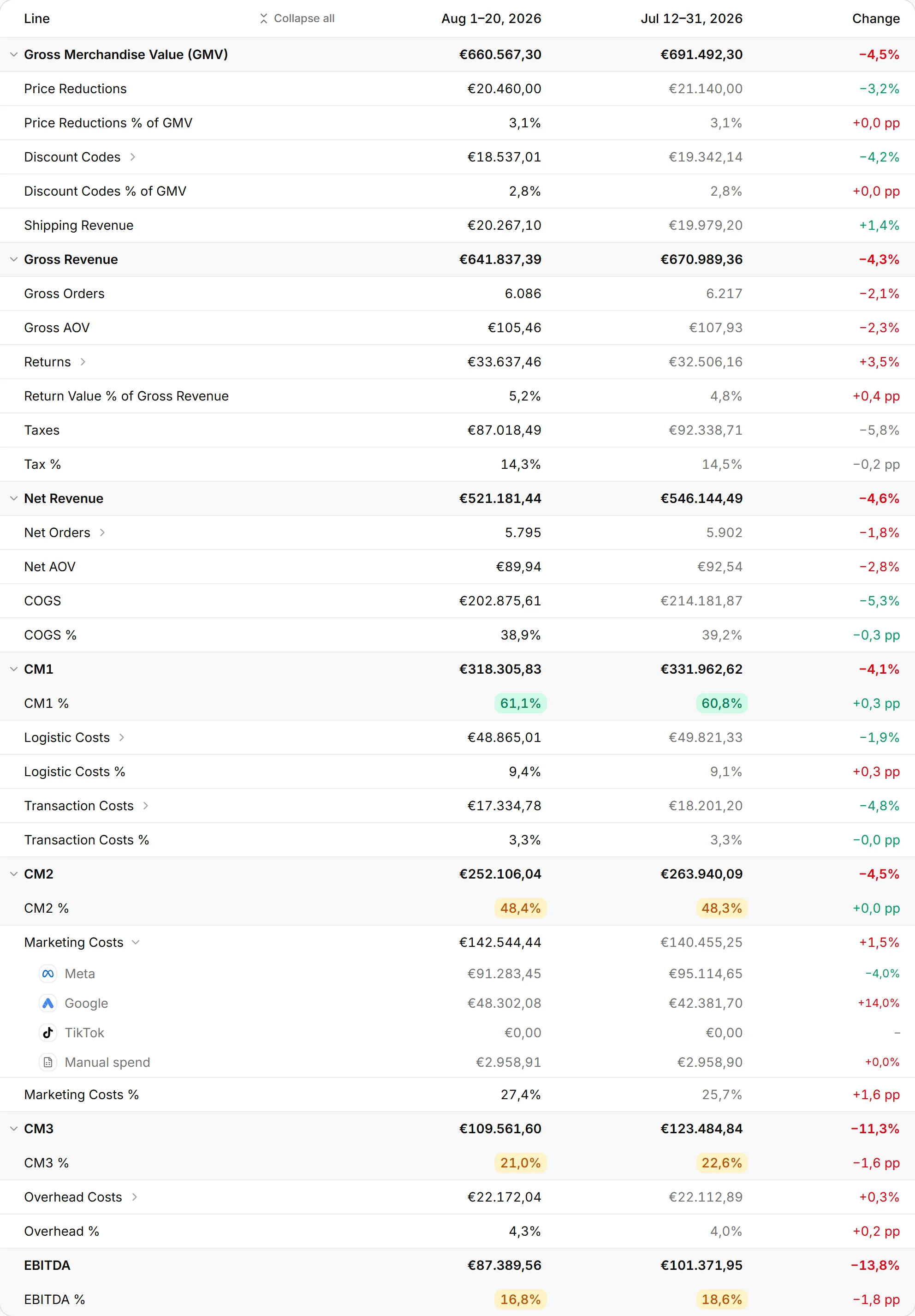
European shops price with VAT included, and nouz reads them that way: every revenue line down to Taxes, line 12, includes VAT, from gross merchandise value to returns.
Taxes is the VAT contained in what you kept: the VAT Shopify recorded on each order, minus the VAT handed back on refunds. Net Revenue, line 14, is gross revenue minus returns minus that VAT, and every line below it excludes VAT.
Every cost percentage on the statement uses Net Revenue as its base, so a margin is never flattered by the tax rate, and a sale to a business in another EU country under the reverse charge carries no VAT to take out.
The Forecast keeps the same split for the months ahead: its P&L shows the VAT inside your forecast sales on a line of its own, Taxes, month by month, which is where planning for the next VAT return starts.
02 How Shopify profit apps handle VAT, OSS and EU payments
Three questions decide whether a profit app reads a European store correctly: whether it takes the VAT out of prices that include it, whether a sale to another EU country under the One-Stop Shop carries that country's rate, and whether Klarna, iDEAL and EPS are priced as the methods they are. The table answers them for each app from its own help pages, read on 6 Nov 2026; where an app publishes nothing on a question, it says so rather than guessing.
nouz takes the VAT from the tax lines Shopify recorded on each order, so a store using OSS sees each destination's rate on the Taxes line without setting a rate per country, and a refund hands its own tax back on the day of the refund. Among the other apps, Profitario's documentation goes furthest, with VAT rates per country set by hand; nouz vs Profitario sets the two side by side, and the head-to-head with the Munich platform covers the DACH analytics platform priced on net revenue.
Prices and the rest of each app's features are in the best Shopify profit tracker apps, and one table lets you compare every tool nouz is compared with.
| App | VAT-inclusive prices | OSS, sales to other EU countries | Klarna, iDEAL, EPS |
|---|---|---|---|
| nouz | VAT on a Taxes line of its own, from Shopify's tax lines; Net Revenue and every margin without it | each order carries the rate Shopify charged for its destination | Klarna, iDEAL and EPS through Shopify Payments are rows of their own at Shopify's reported fee; every other method its own dated rule |
| TrueProfit | collected tax is in revenue and subtracted from net profit by default; a setting turns that off | no help page found | a percentage and fixed fee per gateway Shopify records; Klarna on its gateway list |
| Lifetimely | net sales include tax; tax comes off at contribution margin | no help page found; a VAT switch for Amazon EU only | a percentage and fixed fee per gateway you add; none named |
| Profit Calc | taxes included in profit by default; a Revenue VAT setting deducts them | one VAT percentage, applied to orders shipped to EU countries | Klarna among four main gateways; iDEAL and other Mollie methods synced (article of 2022) |
| SimplyCost | its example reads sales with tax left out; no help centre | no help page found | a processing fee per payment gateway |
| Profitario | tax taken off revenue, output VAT shown per country | VAT rates per country, set by the billing country | fee rows per payment method, Klarna on Shopify Payments named |
| ProfitOne | collected tax subtracted, on by default since 16 Aug 2026 | VAT profiles: one rate or rates per country | custom gateway fee rules on its listing; no help page found |
| Bloom | profit built from total revenue, which its docs define as including taxes | no help page found | Shopify Payments and PayPal automatic, other gateways by hand; none of the three named |
03 Euros and dates the way you write them
Every amount uses the decimal comma and the thousands point, €1.234,56, percentages read 19,0%, a loss carries a real minus sign, −€987,65, and every date is day-first: 1 Oct 2026.
Today means today in your store's own time zone, so an order placed in Vienna at 00:30 on 1 October belongs to 1 October, not to 30 September, where a report that counts in UTC files it.
Exports follow you too: a CSV comes in the 1.234,56 format a German Excel opens correctly, or with a plain decimal point for an analysis tool, chosen per download.
The interface is in English, and support answers in English or German.
04 Packaging fees priced per destination
21 Logistic Costs31 Overhead Costs
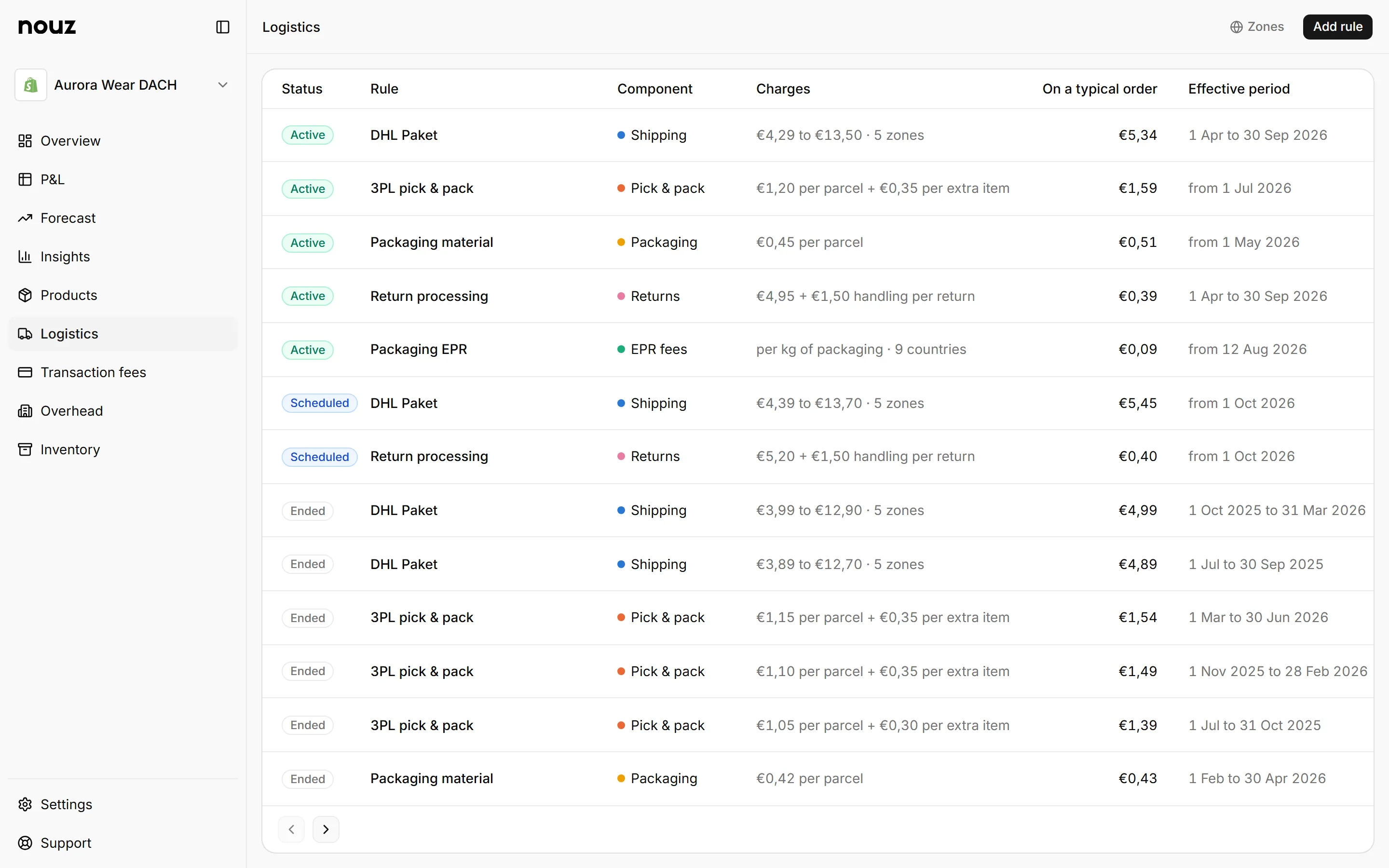
Packaging EPR fees are part of logistics, line 21. You enter the rate per kilogram for each material and each destination country from your own scheme contract, and every parcel is charged on its packaging in the country it is delivered to.
A destination you have not priced is flagged, never charged at nothing, and a country where no packaging fee applies is listed without a rate, so that answer is never mistaken for a gap.
Fixed scheme costs, such as membership, minimum fees or an authorised representative, belong to overhead, line 31, under Compliance & fees, because they do not grow with orders.
nouz never registers you, files a declaration or says what you owe. It records the kilograms of each material you shipped to each market, priced at your own rates, and exports that record, which is what a scheme asks you to declare.
Shipping zones start as Germany, Austria, Switzerland, the rest of the EU and the rest of the world, and you shape them to your carrier's card. A rate card prices by weight or by parcel size, and a parcel to a zone no card prices is flagged.
05 Orders in other currencies, matched to Shopify's figures
Every figure is in your store's own currency. When Shopify stores an order in another currency, as it does with orders a marketplace connector brings in, the sync converts it before it reaches your P&L with the figures Shopify's own reports use, so it matches Shopify to the cent. Until those figures can be read, it uses the latest European Central Bank reference rate published before the order's own day.
Refunds follow the order, so a full refund cancels exactly. If no rate can be had, the order is flagged and converted on the next sync, and the P&L notes orders still on the ECB rate, which can differ from Shopify's own reports by a few cents.
A combined view of several stores adds up only stores that share a currency, so no figure ever sums two currencies.
06 The payment methods Europe uses, priced by your contract
23 Transaction Costs
Payments arrive under the names Shopify records, and nouz shows them as their brands: Klarna, PayPal, Mollie, Adyen, Unzer, PAYONE, Riverty and Ratepay among them, along with orders from marketplaces such as Amazon, bol, OTTO, Zalando and Kaufland.
Each method gets its own fee rule on line 23: a percentage plus a fixed fee, from your own contract. On Shopify Payments nouz takes the fee Shopify reports on each payment instead, and a method with no rule of its own is flagged, unless a catch-all rule you set prices it.
07 One flat monthly price
Base $55, Pro $115 and Scale $289 a month (about €49, €99 and €249), before tax, billed by Shopify on your Shopify invoice in US dollars; the euro figures are a guide.
Base covers up to 500 orders a month, and Pro and Scale have no order limit. No plan charges per order or takes a share of your revenue, every plan carries every feature, and each starts with 14 days free.
08 Questions
What is the best profit tracker for a Shopify store in the EU?
nouz is built for EU stores first: VAT on a Taxes line of its own from the tax Shopify charged on each order, every margin without VAT, Klarna, iDEAL and EPS priced as their own methods, and packaging EPR per destination. Among the other apps, Profitario sets VAT rates per country and ProfitOne offers EU VAT profiles, checked 6 Nov 2026.
Does nouz handle OSS sales to other EU countries?
Yes, through Shopify. nouz reads the tax Shopify charged on each order line, so an order taxed at its destination country's rate under the One-Stop Shop carries that rate on the Taxes line, with no rate to set per country. Filing the OSS return stays with your accountant.
Does nouz handle EU VAT?
Yes. Every revenue line down to Taxes, line 12, includes VAT, the way a European shop prices, and Net Revenue, line 14, and every margin below it exclude it. The Taxes line is the VAT Shopify recorded on each order, minus the VAT handed back on refunds.
Does nouz file my VAT returns?
No. nouz measures profit without VAT; filing stays with your accountant and Shopify's tax reports. What it does show is the VAT inside your sales on its own line, on the P&L for the days behind you and on the Forecast's P&L for the months ahead.
Does nouz register me for packaging EPR?
No. nouz prices the fee per parcel from the rates in your own scheme contract and records the kilograms per material and market that a scheme asks you to declare. Registering, filing and what is owed stay with your scheme and your advisers.
What happens to an order in another currency?
The sync converts it into your store currency with the figures Shopify's own reports use, line by line, so it matches Shopify to the cent. Until those can be read, it uses the latest European Central Bank reference rate before the order's day, and the P&L says which orders are on it.
Is nouz available in German?
The interface is in English. Numbers follow German conventions and dates are written day-first, €1.234,56 and 1 Oct 2026, and support answers in English or German.
What does nouz cost for a European store?
Base $55, Pro $115 and Scale $289 a month (about €49, €99 and €249), before tax, billed in US dollars on your Shopify invoice. Base covers up to 500 orders a month, and Pro and Scale have no order limit, and no plan charges per order. Every plan starts with 14 days free.
The tax reports answer a filing question. A P&L needs a different one: how much of what you collected was never revenue in the first place.
EPR is charged on the weight of packaging you place on a market, by material. Here is the arithmetic per parcel, and where the cost lands on a P&L.
Fees follow the market where packaging becomes waste, which means a warehouse in one country and customers in three creates obligations in all of them.
The tax out of a shelf price or onto a net one, and the share of the gross it really represents.
What the packaging on one parcel costs you in EPR fees, at your own scheme's rate.
The tax inside what you kept, which was never revenue.
nouz and Profitario compared for EU Shopify stores: VAT per country, Klarna and other payment fees, prices at 300 to 5.000 orders and the store each one fits.
See what your store keeps, VAT taken out.
Every plan starts with 14 days free. nouz imports every order your store has ever taken and builds the same statement for it.