Free calculator
Shopify payment fee calculator
Every calculator on this subject computes one gateway at one rate. Real stores take money through three or four, and one order can be charged by two of them. This works out the blended rate, which is the one that reaches your P&L.
Your month
What you take
Your gateways
These rates are placeholders, not quotes. Copy the ones off your own statements: they differ by plan, by country and by whatever you negotiated.
What goes wrong
Your blended payment fee rate
2,18%
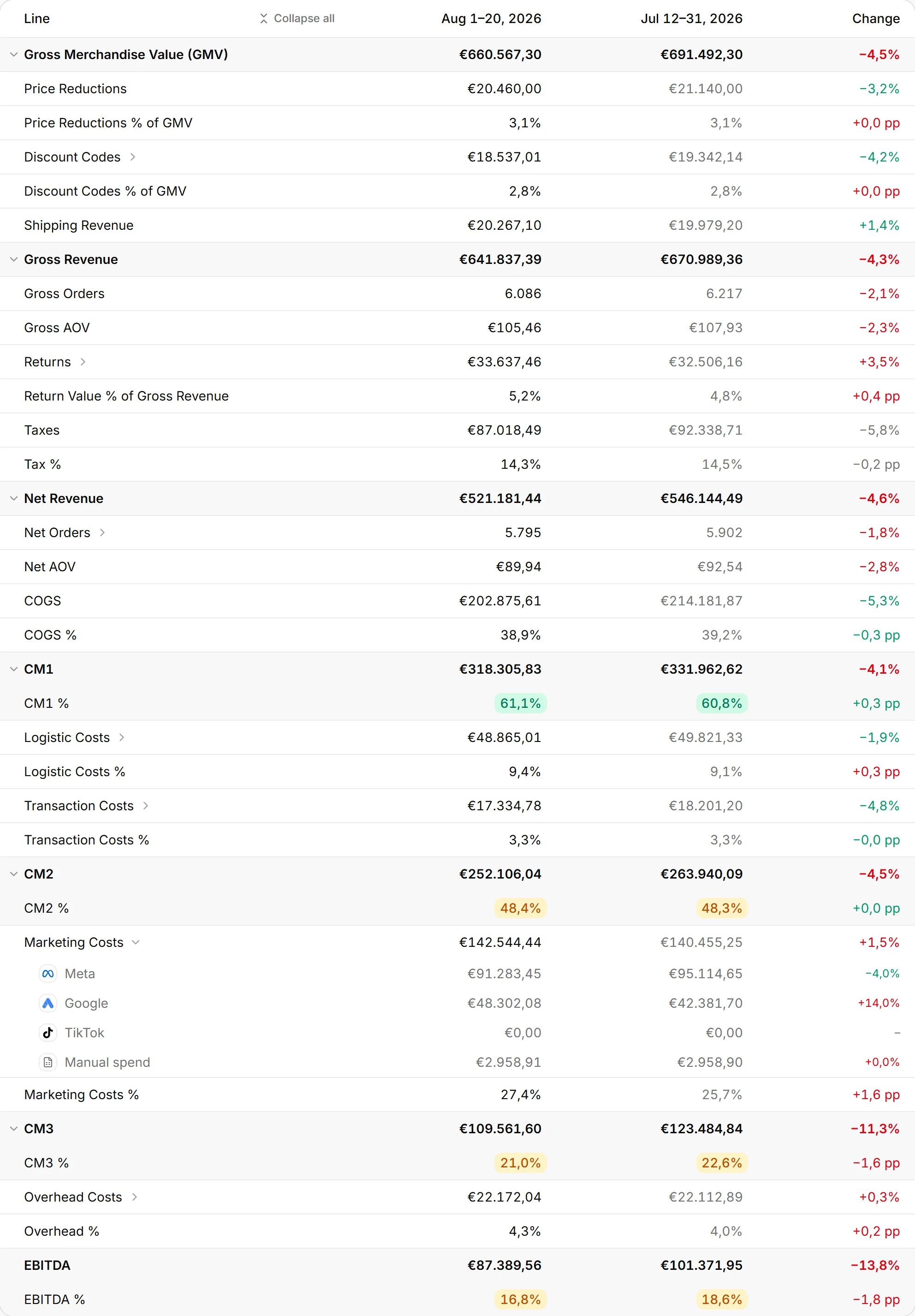
€1.649,27 a month across 728 charges, or €2,36 on an average order. This is the figure that lands on line 23, not any single gateway’s advertised rate.
23Fees a month
€1.649,27
Per order
€2,36
Charges
728
28 orders split
The percentage leg
€1.423,86
Scales with what you sell.
The fixed leg
€209,66
0,28% of an average order.
Split payments cost you €8,12 a month on exactly the same revenue, because both halves pay a fixed fee and the percentage is rounded twice. A refund gives none of this back: the fee stays as charged on the original order.
Run this on my real paymentsThe formula
A percentage and a fixed fee, and your basket decides which hurts
Every gateway prices the same way: a percentage of the gross amount it moved, plus a fixed fee on each transaction. Two numbers, and they behave in opposite directions as the basket changes.
The percentage is basket-neutral. Whatever the order size, it takes the same slice, so a store with a €20 basket and a store with a €500 basket pay the same rate on it.
The fixed fee is not. Twenty-five cents is 1,25% of a €20 order and 0,05% of a €500 one, a fiftyfold difference in what the same fee costs. That is why a low-basket store should negotiate the fixed leg and a high-basket store should negotiate the percentage, and why comparing two gateways on their headline rates alone tells you almost nothing.
One more detail decides the base: the percentage is charged on the gross amount, VAT and shipping included, because that is what the gateway actually moved. Applying it to net revenue understates the cost by roughly the VAT rate.
The rates in the calculator are placeholders. Gateway pricing moves, differs by plan and country, and is negotiable, so nouz never ships a rate table: you enter what your own statements say.
Where it goes wrong
Four things a single-rate calculator cannot see
Each of these is a real mechanism, each one moves the answer, and none of them is visible if you multiply one rate by one revenue figure.
Split payments pay the fixed fee twice
An order settled with a gift card and a card, or split across a part payment, arrives at the gateway as two transactions on roughly half the money each. The percentage lands on the same total, but the fixed fee is charged in full on both halves, and the percentage is rounded twice instead of once.
It is a small effect per order and a real one per month. Model it by transaction count, never by order count.
The base is gross, not net
A gateway charges on what it moved: the product price, the shipping the customer paid, and the VAT on both. Applying the advertised rate to net revenue quietly removes about a sixth of the base at German rates and reports a fee that is correspondingly too small.
On the calculator above, the amount charged is the gross figure for exactly this reason.
Chargebacks are two costs, not one
A dispute takes the order value back and charges a fee for the privilege, often €15 to €25. Those are different things and they belong on different lines: the amount behaves like a return, and the fee is a transaction cost.
A chargeback is also not a return in the logistics sense. Nothing came back, so there is no return processing cost to add, however much it feels like one.
Refunds do not give the fee back
The gateway keeps its cut on the original charge. That is the conservative treatment and it is the correct one, and it surprises people, because a refund feels like an undo.
It is also why a high return rate costs more than the refunded revenue: the outbound parcel was shipped, the fee was charged, and neither comes back.
Worked example
Three gateways, one rate that matters
An example store, not a customer. 700 orders in a month at an average charge of €108,00 gross, which is €75.600 through the gateways. Money arrives 62% through Shopify Payments, 24% through PayPal and 14% through Klarna, at the placeholder rates in the calculator. 4% of orders are paid with two methods, and one order in 700 is disputed at a €15 fee.
Not one of the three headline rates is the answer. Shopify Payments alone is the cheapest of them, and a store that budgeted on its rate would be about a third short.
€1.649,27 a month, a blended 2,18%, and €2,36 out of every order. The percentage leg is about €1.424 of it and the fixed leg about €225, which at this basket size means the rate negotiation worth having is on the percentage.
The 28 split orders cost €8,12 extra on identical revenue. Small, and worth knowing it exists, because it is a cost that scales with a payment method mix rather than with sales.
Questions
Payment fees, answered
How much does Shopify take per sale?
It depends on the gateway, the plan, the country and whatever you negotiated, which is why this calculator asks for your rates rather than shipping a table of them. What matters more is that no store pays one rate: money arrives through several gateways at different prices, and the figure that reaches your P&L is the blend of all of them.
What is a blended payment fee rate?
Total payment fees for a period divided by the total gross amount your gateways moved in that period. It is the only fee number that can be compared with anything, because it already accounts for your gateway mix, your average order value and the fixed fee per transaction. It is usually higher than the headline rate of your main gateway.
Why does the fixed fee matter so much on small orders?
Because a fixed fee is a percentage in disguise, and the percentage depends on the basket. Twenty-five cents on a €20 order is 1,25%. The same twenty-five cents on a €500 order is 0,05%. A low-basket store is hit by the fixed leg and a high-basket store is hit by the percentage leg, and the two need completely different negotiations.
What happens when one order is paid with two methods?
Both gateways charge it. A gift card plus a card, or a part payment, produces two transactions on roughly half the money each, so the percentage is charged twice on two smaller amounts and, more importantly, the fixed fee is charged twice in full. Single-rate calculators cannot model this because they work from order count rather than transaction count.
Do I get the payment fee back when I refund an order?
Generally no. The fee stays as charged on the original order, which is why nouz never credits it back on a refund. The money moved, the gateway did the work, and it keeps its cut. This is one reason the true cost of a return is much larger than the refund amount.
Where do payment fees sit on a profit and loss statement?
Line 23 on a nouz P&L, between logistics and CM2. That places them inside the contribution margin of the order, which is correct: they only exist because the order happened, and they scale with it. Chargeback fees go on the same line, while the disputed amount itself is treated as a return.
More calculators
Four more, all free, all built on the same statement.
Want the long version rather than the arithmetic? What a return really costs.
The terms this calculator uses:
Your real blended rate, from your real transactions
nouz prices every charge from the rule that was in force on its own date, per gateway, so the blended rate is measured rather than estimated.