Counted as a refund
A refund gets the stock back; a dispute does not. Treating the two the same understates chargebacks by the entire cost of the goods, which on most catalogues is the largest single part of the loss.
Free calculator
What a disputed order costs when it is lost, what it still costs when it is won, and what the two together take out of a month at your own win rate.
Expected cost of one dispute
€129,23
Lost
€178,18
money, goods, parcel, fee, time
Won
€38,33
fee and time anyway
25Orders to cover a month
17,4
at your contribution
Fighting it, and how often it happens
Evidence takes real time, and the time is spent whether or not you win.
↑ ↓ to nudge, Shift for ten. Commas or dots both work.
A chargeback is not a return: the goods almost never come back, so you lose the money and the stock. That asymmetry is why prevention, clear billing descriptors, reachable support and honest delivery dates, is worth far more per euro than winning cases after the fact.
€178,18 when it is lost and €38,33 when it is won, weighted by your 35,0% win rate. At 6 a month that is €9.304,56 a year.
An estimate from flat rates. In nouz every order is priced from the costs of its own day.
A chargeback cost calculator prices a disputed order properly: the money returned, the goods that do not come back, the outbound shipping, the dispute fee charged whether you win or lose, and the time spent on evidence, weighted by your own win rate.
The formula
That single difference is why disputes are so much more expensive than refunds. The money goes back gross, the customer keeps the product, the parcel was already paid for, the gateway charges its dispute fee whichever way the case goes, and somebody spends half an hour assembling evidence.
Winning helps less than it feels like it should. A won case still costs the fee and the time, so a store with a healthy win rate is still paying a real monthly amount for the privilege of defending itself.
Which is the argument for prevention over litigation. An unrecognisable billing descriptor, a delivery that arrived late, support nobody could reach: those produce more disputes than fraud does in most stores, and all three are cheaper to fix than to win.
Where it goes wrong
Chargebacks are rare enough to feel like noise and expensive enough to deserve a line.
A refund gets the stock back; a dispute does not. Treating the two the same understates chargebacks by the entire cost of the goods, which on most catalogues is the largest single part of the loss.
Winning does not refund the dispute fee or the hour spent proving delivery. A store that wins two thirds of its cases and thinks those cost nothing is understating its dispute bill by exactly that share.
Evidence gathering is somebody’s afternoon: order records, tracking, delivery confirmation, correspondence, submitted before a deadline. Priced at a real hourly cost it frequently exceeds the dispute fee itself.
Beyond a threshold, card schemes put merchants into monitoring programmes with penalties and, eventually, processing risk. That is a business continuity issue rather than a cost line, and it arrives long after the pattern that caused it started.
Worked example
The calculator’s defaults: a €101,15 gross order, a €15 dispute fee, goods at 38% of the net value, €6,40 of outbound fulfilment, 40 minutes of evidence at €35 an hour, and a 35% win rate over six disputes a month.
Lost, the case costs €178,18. Won, it still costs €38,33. At a 35% win rate the expected cost of one dispute is €129,23.
Six disputes a month is €775,38, which is €9.305 a year, or about 17 healthy orders every month spent replacing money that already arrived once. On €60.000 of monthly net revenue that is 1,3% of the business.
Note the asymmetry the arithmetic exposes: the disputed order itself is barely half the cost. The rest is stock, shipping, fees and time, which is why preventing one dispute is worth more than winning two.
In the app
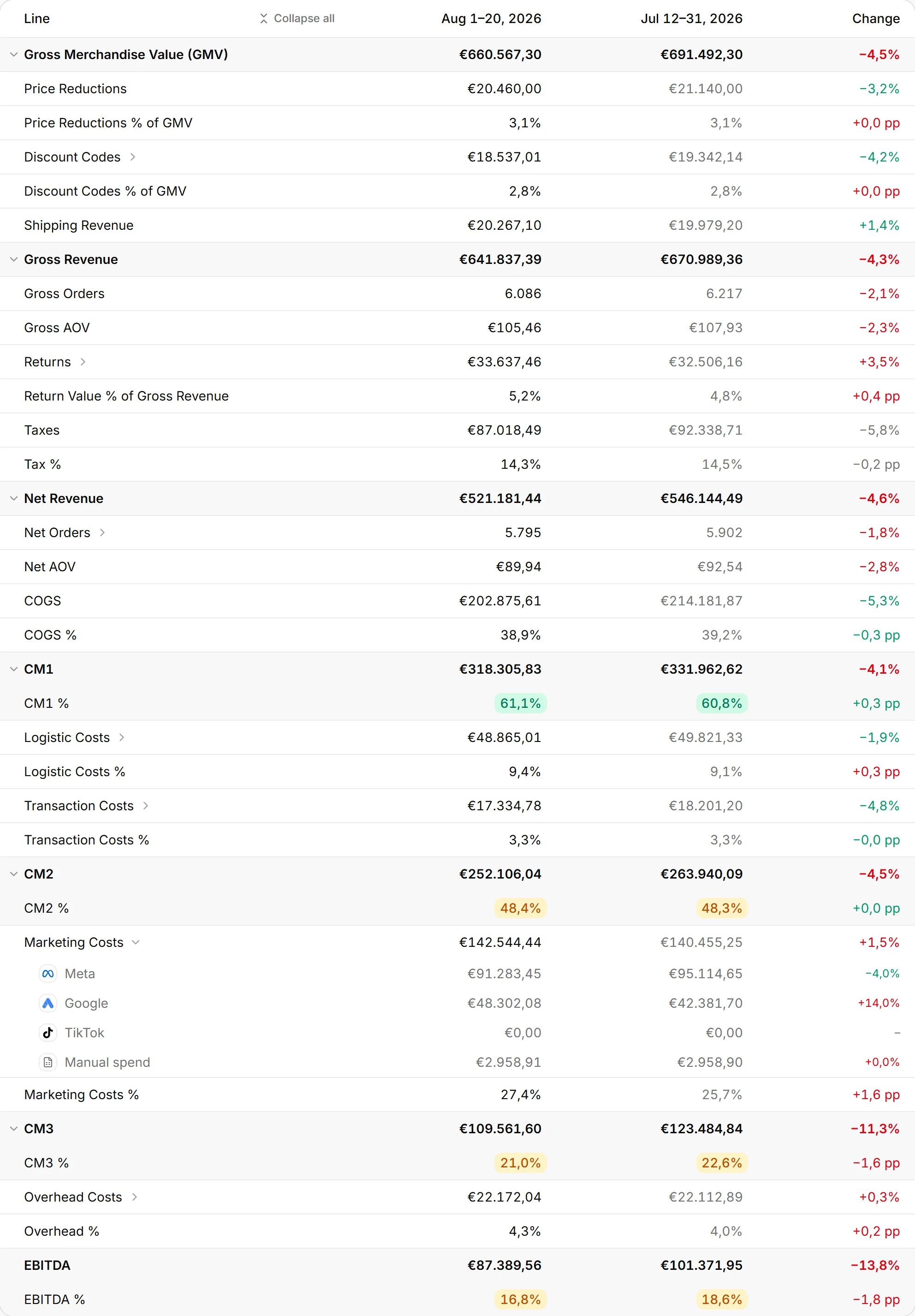
A calculator works from flat rates you type once. nouz prices every single order from the cost rules that were in force on that order's own date, and rebuilds the same statement every night from your own orders and your own ad spend.
More calculators
Each one is a different question about the same statement. All 32 are free, and none of them asks you to sign up.
All calculatorsThe terms this calculator uses
The long version
Want the long version rather than the arithmetic?
Won dispute€38,33still costs the fee and the time7 min readA chargeback and a return are not the same costBoth hand money back. Only one hands the goods back, and only one charges a fee whichever way it goes. Why a P&L has to treat them separately.A chargeback and a return are not the same costnouz treats a disputed amount as a return and the dispute fee as a transaction cost, on the days each one landed, so a bad month for chargebacks explains itself rather than merely feeling wrong.