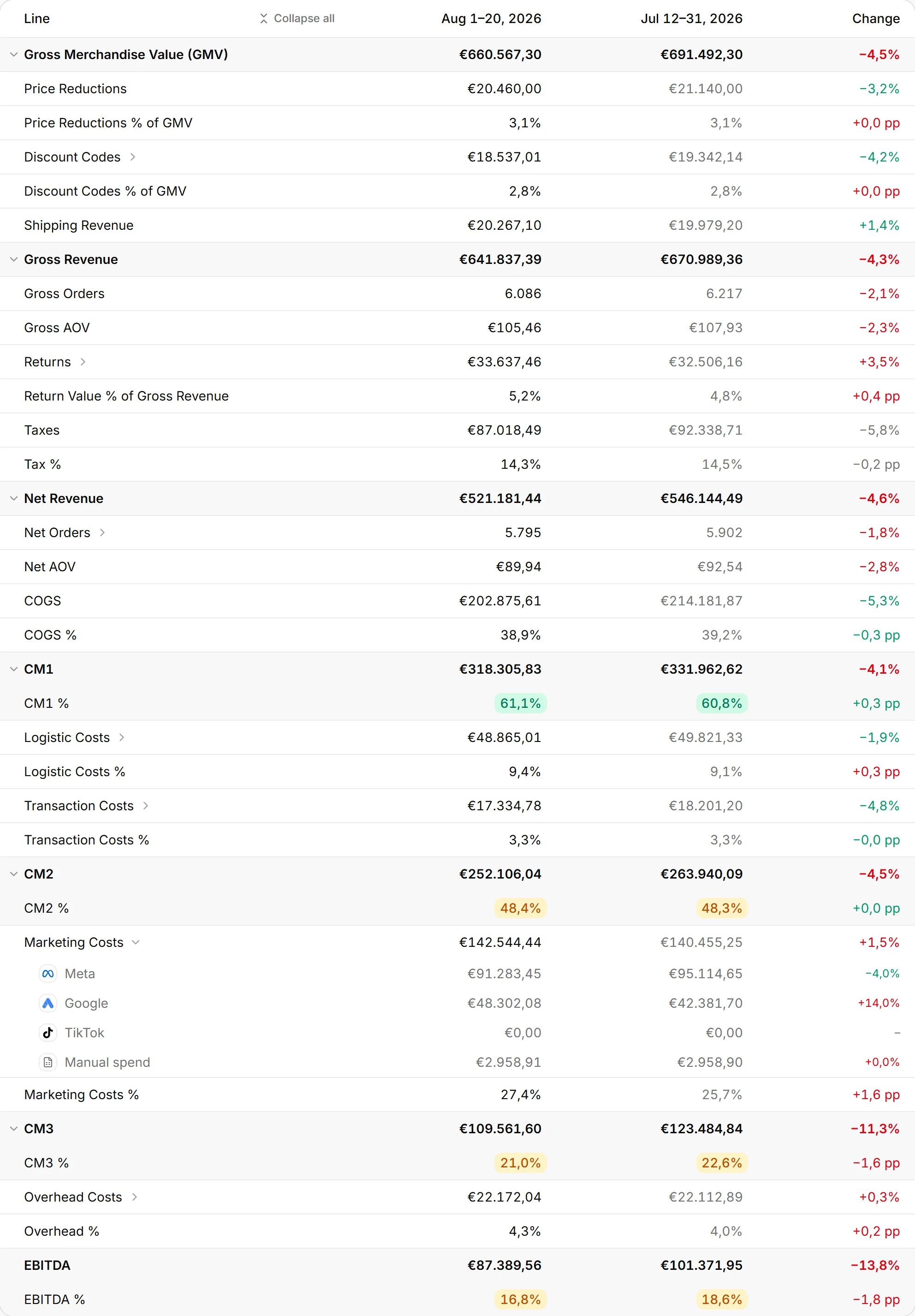
CM2 is the second contribution margin: CM1 minus logistics and payment fees. It answers whether the order makes money once the parcel is packed, shipped and paid for, and it is the margin advertising has to be paid out of. On a nouz statement it is line 25.
The costs between CM1 and CM2 are the per-order ones: the shipping rate card for the destination zone and the parcel's weight or size, pick and pack, the packaging itself and its EPR fee, return processing when a parcel comes back, and the payment provider's percentage plus fixed fee.
On the example store, the €52,70 of CM1 on an €85 order loses €6,40 to the parcel and €1,62 to the payment fee, leaving CM2 of €44,68, or 52,6% of net revenue. That number, not the gross margin, is what one order genuinely contributes before advertising.
These costs scale with the number of orders rather than with revenue, which is why a store whose average order value is falling can grow revenue and lose CM2 at the same time: every parcel and every fixed fee takes a larger share of a smaller basket. It is also why CM2 is charged per parcel in nouz rather than per order; the moment an order ships in two boxes, the difference is real money. The mirror reading matters too: a rising basket quietly repairs CM2 with no negotiation anywhere, which is why bundles and free-shipping thresholds are margin projects rather than marketing decoration. What one parcel instead of three is worth is worked through in bundle economics.
If CM1 holds and CM2 falls, the problem is not your pricing. It is basket size, shipping zones, packaging or returns, and each of those has its own lever. The diagnostic version of that reading is in CM1, CM2 and CM3 explained.
The break-even MER hides in this line too: net revenue divided by CM2 is the ratio every euro of advertising must clear just to cover the goods, the parcel and the fee. Below that ratio, the ads are being paid for out of overhead.