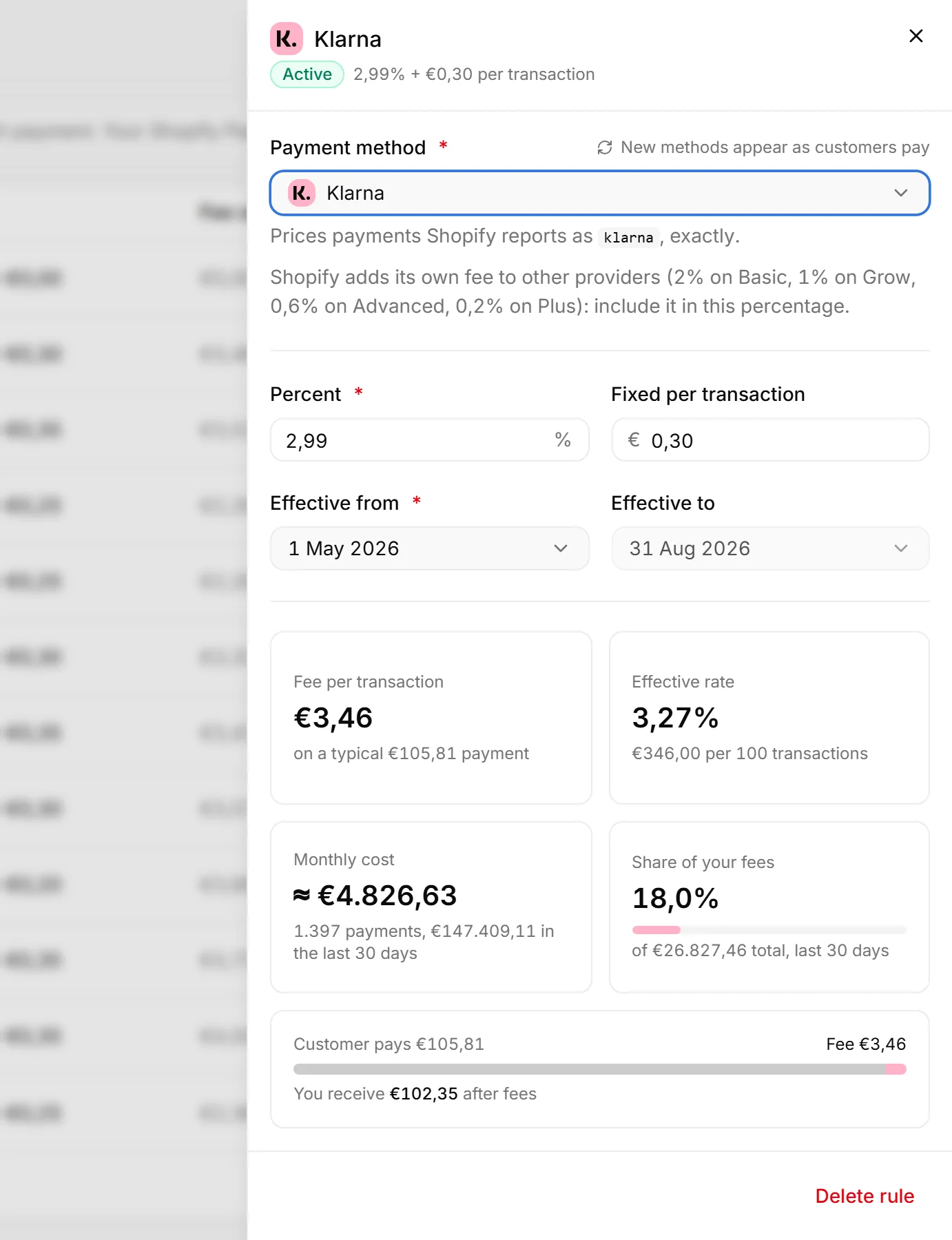
An effective-dated cost is really a history of rules rather than a single number. The unit cost is not '€28,36'; it is '€24,90 until 31 January, €28,36 from 1 February'. Every order is then priced by looking up the rule in force on its own date, which is a different operation from reading a field.
Concretely: a hoodie that cost €24,90 to buy gets repriced by the supplier to €28,36 from 1 February. Every January order keeps €24,90 of cost forever. Every order from 1 February carries €28,36. January's margin does not move, and a report run on 31 January still reconciles in June.
Without it, changing a supplier price rewrites last quarter's profit, and any report you ran before the change stops reconciling. This is not a rare edge case; it happens on every price change of every product, silently, in any tool that stores one cost per variant. A cost field that holds one value instead of a history is the root of Shopify's COGS report limitations.
Backdating stays possible, but it is a deliberate act: setting an effective-from in the past reprices the days from that date forward and nothing earlier. The one thing the system never does is edit an existing rule's history in place; the history is append-only, by design, forever.
The same shape applies to every cost type, not only goods: shipping rate cards change when carriers reprice, payment fees change when contracts renew, and each rule closes its predecessor the day before it starts. One mechanism, every cost, which is why a nouz P&L from last March still says what it said in March.