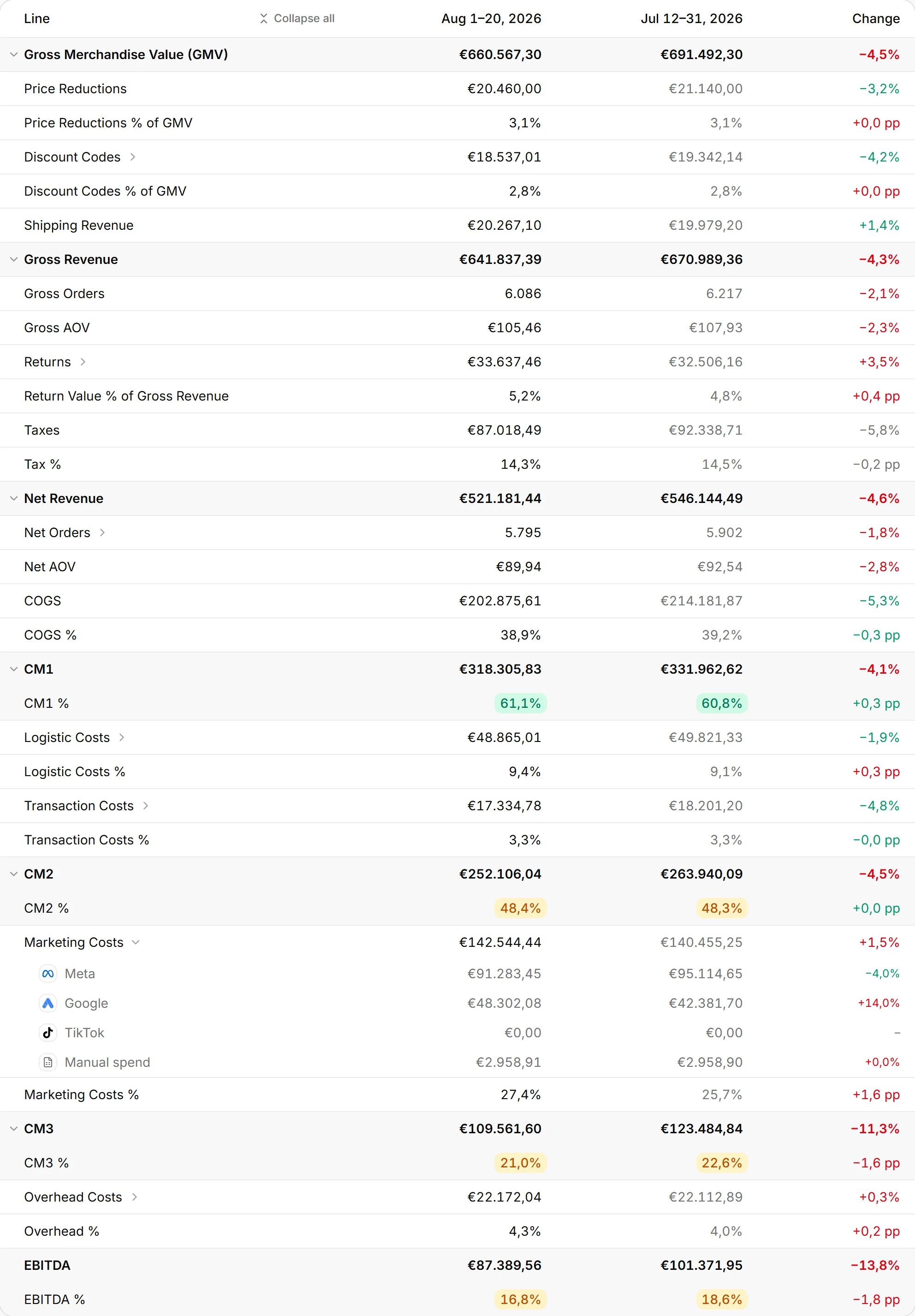
Net orders is gross orders minus the orders that were fully refunded, counted on the day the refund was issued. It is the honest denominator for net average order value, and the gap between it and gross orders is a direct read on how much of a period's activity did not survive contact with the customer.
The refund day, rather than the order day, is what makes the figure stable. A fully refunded order still happened: it was picked, packed and shipped, and those costs stay in the period it was placed in. Removing the order from the period it was placed in as well would quietly rewrite a closed month.
Partial refunds are deliberately not counted here. An order refunded in part is still an order; its money movement belongs in returns, where the amount is what matters, rather than in a count where it would have to be either whole or nothing. An order becomes fully refunded on the refund that brings its refunded units up to its ordered units, and that refund's day is the day it leaves the count.
Gift cards count on neither side. Selling one is not revenue, so refunding one cannot complete the refund of the goods sold beside it: an order of a jumper and a gift card whose gift card alone came back is not fully refunded, and it stays a net order. Why selling one never counts is set out in gift cards are not revenue.
Watching the two counts together is the useful habit. A widening gap means either a product problem or an expectation problem, and it is visible weeks before it shows up in a margin.