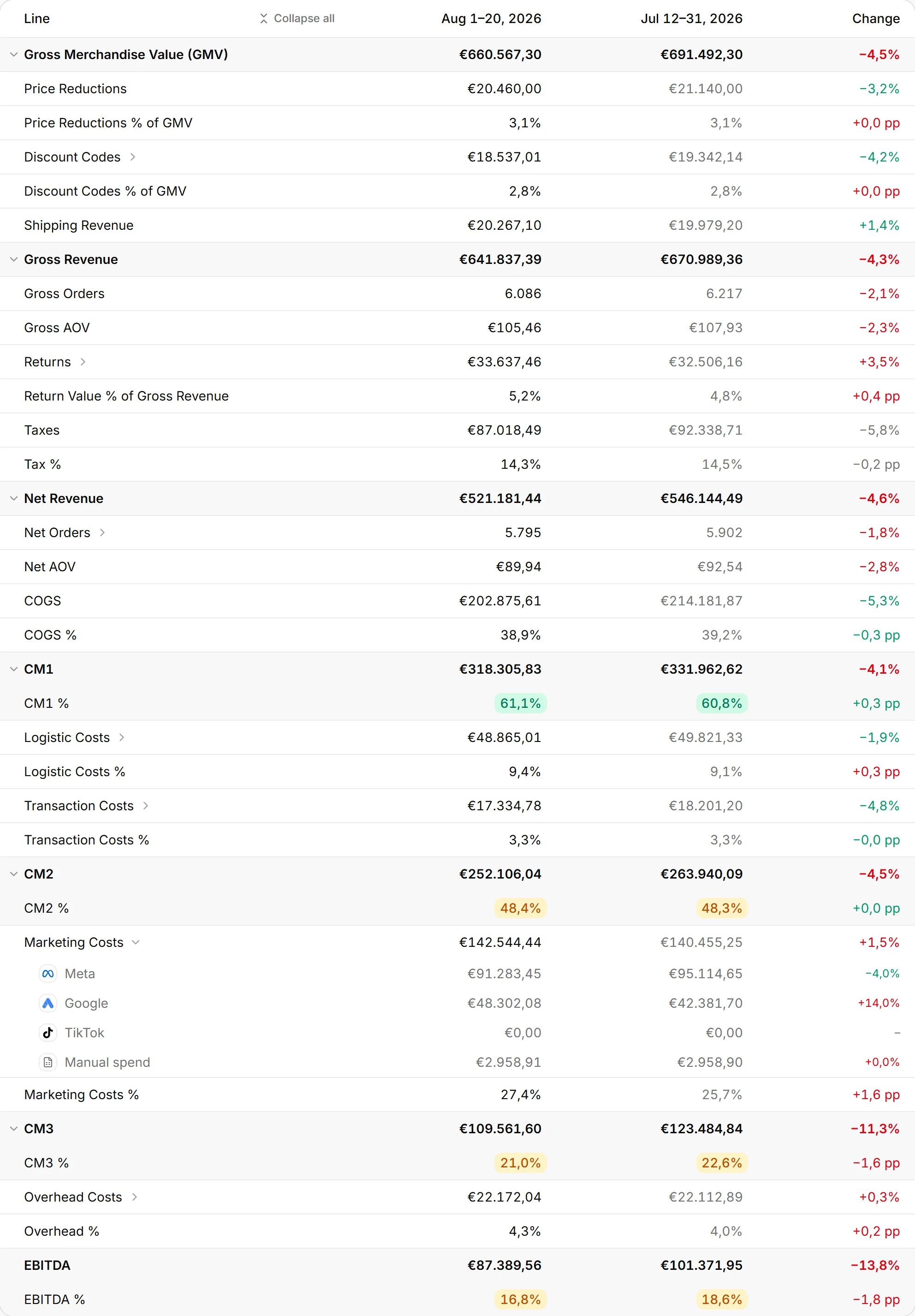
On a statement, VAT is the tax contained in gross revenue minus returns: money collected on behalf of the tax authority and passed on. Everything above the line is VAT-inclusive because that is what customers paid; everything below it is VAT-exclusive, because only that half was ever the store's own money.
The arithmetic trips up more European stores than any other single figure. VAT is charged on the net price, so a nineteen percent rate makes the gross one hundred and nineteen percent of the net, and the tax inside a shelf price is therefore about sixteen percent of it. Subtracting the rate from a gross price removes roughly a fifth too much.
Computing it on what was kept rather than on what was sold matters just as much. A refunded order returns its tax as well as its revenue, so a statement that charges tax on gross sales and then deducts refunds separately overstates what is owed and understates what remains.
Below this line every percentage on the statement uses net revenue as its denominator. That is the convention that makes cost lines comparable with each other, and it is why a margin computed on a gross figure is always flattered by the tax rate.