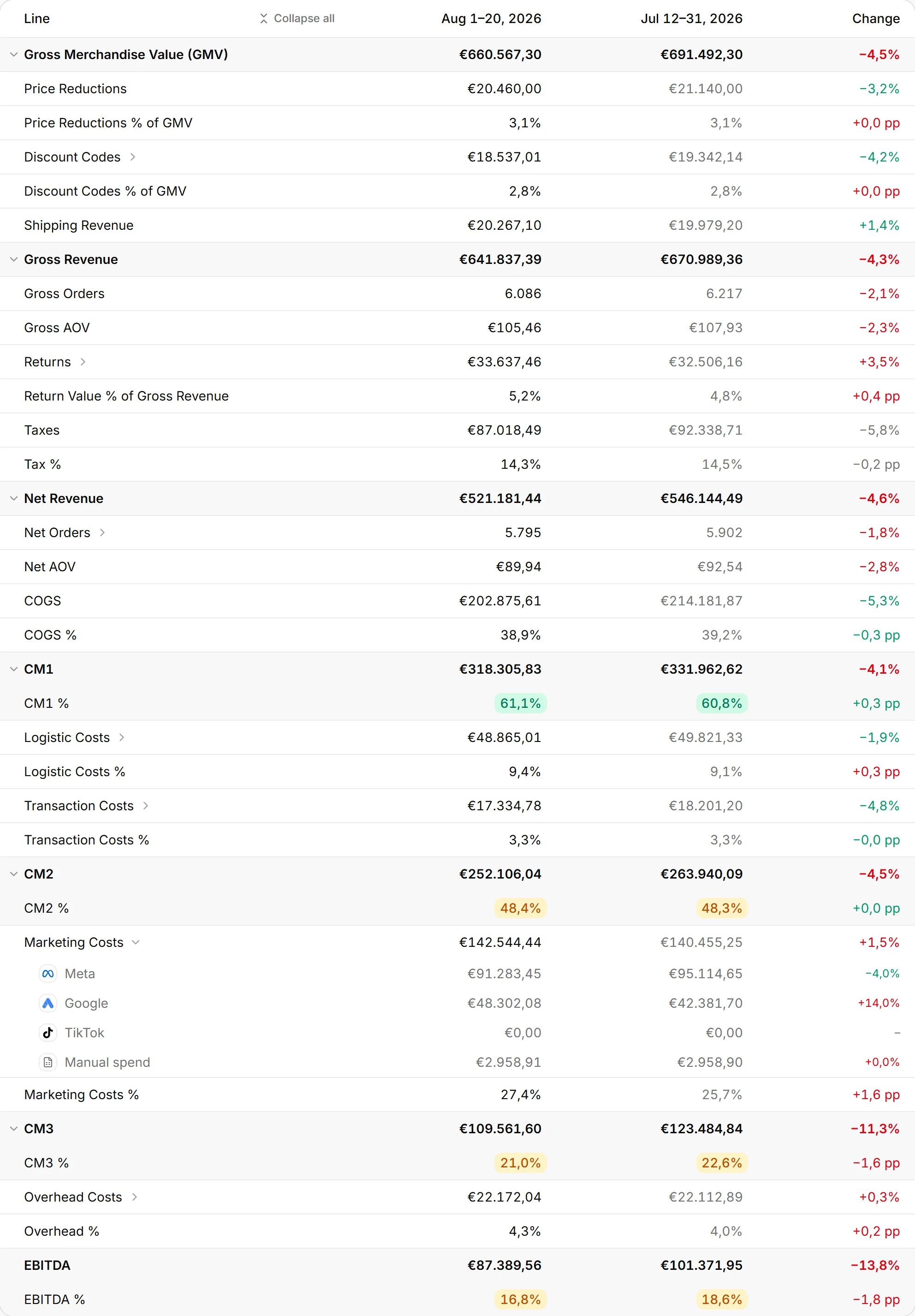
CM3 is the third contribution margin: CM2 minus marketing costs, recognised on the day the money was spent. It answers whether the customer makes money once the advertising that won the order is paid for, and it is the last margin that still moves with what you did today. Line 29 on a nouz statement.
Everything below CM3 is fixed for the month: rent, salaries, software, agencies. CM3 is what has to cover them, which makes it the number to steer daily budgets on. Raise spend and CM3 falls today; cut it and CM3 rises today, possibly at the cost of the months after.
On the example store, CM2 of €44,68 per order meets an ad budget of €15.000 spread across roughly 706 orders, about €21,25 each, leaving CM3 of roughly €23,43 per order. Treat that budget as committed for the month and the month has €22.000 to cover, the budget plus €7.000 of fixed costs, which takes 493 orders at €44,68 each; at its usual pace the store reaches the 493rd on day 22.
The marketing that comes out here is broader than platform spend: nouz counts synced Meta, Google and TikTok spend, manual and CSV entries, and fixed marketing costs like an influencer retainer, each on the day it belongs to, so CM3 never flatters the month by leaving a retainer in overhead.
Its daily rhythm is the point. Ad platforms bill continuously and orders arrive continuously, so CM3 is readable every morning for yesterday, unlike EBITDA, which needs the overhead book to be current too. A store that watches one number a day should watch this one, with its fixed costs in mind and the weekday pattern beside it. When that number turns red, anatomy of a losing day shows how to read the day.
Watch it against your fixed costs rather than in isolation. A CM3 of ten thousand euro is excellent for a store with six thousand of overhead and a problem for one with twenty. CM1, CM2 and CM3 explained sets out how the three margins are read together, and which decision each one belongs to.