One growth rate for every line
Growing revenue and every cost at the same rate keeps the margin flat and hides the two things that move it: overhead that does not grow, and advertising that grows faster than the orders it buys.
Free calculator
This month's P&L carried twelve months forward. Orders grow at your rate and take the goods, shipping and fees with them, ad spend grows at its own rate, and overhead stays where it is, so every month shows net revenue, CM1, CM2, CM3 and EBITDA.
EBITDA over the next twelve months
€142.665,93
14Net revenue, 12 months
€877.067,43
34EBITDA margin
16,3%
15,9% this month
Months in loss
0
of the next twelve
This month
How it grows
Each month compounds on the one before. Set ad spend equal to orders and MER holds steady.
↑ ↓ to nudge, Shift for ten. Commas or dots both work.
Every month of the next twelve ends in profit at these rates. The Forecast page in nouz runs the same method on your own orders, season by season, with every scheduled cost change on its own day.
Against €114.499,20 if this month simply repeated. Net revenue reaches €85.545,65 a month by month twelve, and MER moves from 4,00 to 3,56.
An estimate from flat rates. In nouz every order is priced from the costs of its own day.
A profit forecast calculator carries this month's statement forward month by month. Orders grow at your rate and take the goods, shipping and payment fees with them, ad spend grows at its own rate and overhead stays where it is, so each of the next twelve months shows net revenue, CM1, CM2, CM3 and EBITDA.
The method
A month splits into two parts. Everything orders drive, the revenue, the goods, the parcels and the payment fees, grows with the orders: twice the orders is twice every one of those lines. Everything else does not, and that is where a forecast earns its keep.
Overhead stays where it is until you change it, which is why growth usually lifts profit faster than revenue. Ad spend gets its own growth rate, because the cheapest customers tend to be won first and each extra order often costs more than the last. Grow ads faster than orders and MER falls month by month.
This is the method of the Forecast page in nouz, reduced to what can be typed in. The page itself reads the rest from a store’s own orders: last year moved forward day by day to the same weekday, times the growth the orders show, priced by the same P&L engine with every scheduled cost change on its own day.
What no calculator can know is your seasons. Every month here grows at the same rate; a real December does not.
Where it goes wrong
Each of these produces a tidy year that the store then fails to have.
Growing revenue and every cost at the same rate keeps the margin flat and hides the two things that move it: overhead that does not grow, and advertising that grows faster than the orders it buys.
On the figures above, ad spend growing 4% a month while orders grow 3% leaves the year’s EBITDA at €142.666; holding it to the order growth would give €157.802. The gap is the price of customers getting dearer.
A sales forecast that ignores costs cannot say whether a month is worth having. The same revenue line can end in very different profits depending on what the growth costs, which is why this one carries the whole statement forward.
A month-on-month rate spreads the year evenly. Stock, cash and ad budgets are decided around the peaks, so a forecast that cannot see them should never set them; one built from your own last year can.
Worked example
The calculator’s starting month: €60.000 of net revenue, goods at 38%, €15.000 of ads and €7.000 of fixed costs, ending at €9.542 of EBITDA.
Orders then grow 3% a month and ad spend 4%, while the fixed costs stay put.
The year earns €142.666, against €114.499 if this month simply repeated: profit up 24,6% where net revenue is up 21,8%. The fixed costs are why profit outgrows revenue: they stay the same while the margin above them grows.
The ads hold it back: MER slides from 4,00 to 3,56 as advertising outgrows the orders, and held to the order growth the same year would earn €157.802.
In the app
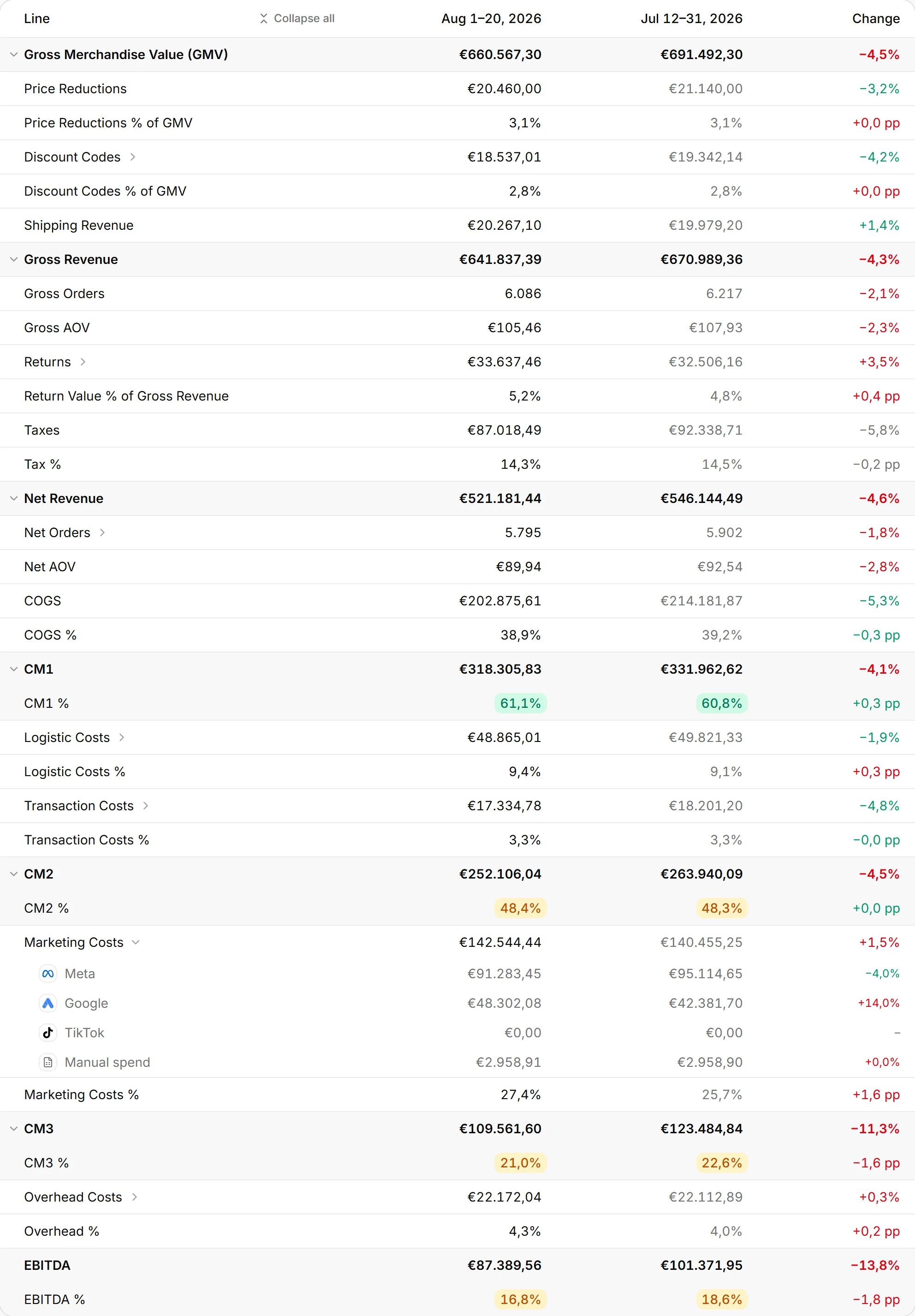
A calculator works from flat rates you type once. nouz prices every single order from the cost rules that were in force on that order's own date, and rebuilds the same statement every night from your own orders and your own ad spend.
More calculators
Each one is a different question about the same statement. All 32 are free, and none of them asks you to sign up.
All calculatorsThe terms this calculator uses
The long version
Want the long version rather than the arithmetic?
Growth multipliesthe unitwhatever the unit is worth11 min readHigh revenue, no profit: the four growth taxesThe store grew and the bottom line did not follow. Why scale amplifies weak unit economics, the four taxes growth quietly levies, and the afternoon diagnosis.High revenue, no profitThe Forecast page in nouz carries your own last year forward, day by day, and prices it with the same P&L engine: up to twelve months ahead, this one included, with What if scenarios, goals and planned events.