Stock on order forgotten
A shipment in transit already covers the gap it was ordered for. Comparing the shelf rather than the stock position against the trigger produces a second order nobody needs, and the cash for it leaves immediately.
Free calculator
The stock level that should trigger the next purchase order, built from your own sales pace, your supplier's real lead time and a safety stock you choose. At 14 units a day from a 21-day supplier with 4 days of safety, the trigger is 350 units.
Reorder when stock falls to
748units
Lead time demand
570
sold while you wait
Safety stock
178
14 days of cover
Order now
1.468
units, to hit target cover
What you hold, and what you are aiming at
↑ ↓ to nudge, Shift for ten. Commas or dots both work.
Safety cover is held in days rather than derived from a service level on purpose: a number you chose because your supplier is occasionally two weeks late is easier to defend, and easier to revise, than one produced by a statistical assumption about demand that nobody in the building can check.
You are at 420 including stock on order, so the order is already due: about 1.468 units, €28.112,20 at landed cost.
An estimate from flat rates. In nouz every order is priced from the costs of its own day.
A reorder point calculator works out the stock level at which a purchase order has to go out: the units that sell during the supplier's real lead time, plus a safety stock you choose. At 14 units a day from a 21-day supplier with 4 days of safety, that is 350 units. It also sizes the order.
The formula
A reorder point converts “we should probably order more” into a threshold: the units that will sell while the supplier is preparing and shipping, plus a cushion for the weeks when either demand or the supplier misbehaves. Cross it, and the order goes out that day.
The stock position, not the shelf, is what crosses it. Units already on order are stock you have, just not yet: forgetting them is the classic double-order that turns a cash-flow problem into a warehouse problem.
The safety stock is held in days, a cushion you can defend because the supplier was two weeks late twice this year. To size it from a service level or by the max-demand method instead, the safety stock calculator works it out both ways and gives the answer in days to bring back here.
Worked example
A quoted lead time usually ends when the goods leave the factory or reach the port. Your stock has to last until they are saleable, and freight, customs, inspection, the receiving dock and putaway all come after the quoted date.
Take a supplier quoting 30 days whose goods then spend 10 days at the port and 3 in the warehouse: the stock lives through 43. At 12,67 units a day, those 13 days are what the quoted figure leaves out.
Ordered on the quoted lead time, every order goes out 165 units too late: the safety stock is spent covering a delay that was never a surprise, and the next late shipment empties the shelf.
Measure what the last few orders really took from purchase order to saleable shelf, and plan on the slowest of them when the supplier is erratic.
Where it goes wrong
Two of these order too late and two order too much, and all four are ordinary.
A shipment in transit already covers the gap it was ordered for. Comparing the shelf rather than the stock position against the trigger produces a second order nobody needs, and the cash for it leaves immediately.
Use what the last few orders actually took, door to saleable shelf, including customs, quality checks and putaway. The agreed lead time is a plan; the observed one is what your stock has to survive.
Units keep selling while the shipment is in transit, so an order sized only for the target arrives already behind. Covering the target plus the lead time is what stops a store reordering again a fortnight after a delivery lands.
A reliable supplier and a steady product need almost no cushion; a seasonal product from a distant supplier needs a large one. A blanket safety policy overstocks half the catalogue to protect the other half.
Worked example
The calculator’s defaults: 380 units sold in 30 days, a 45-day lead time, 14 days of safety stock, 420 units on hand and nothing on order, aiming at 90 days of cover at a €19,15 landed cost.
At 12,67 units a day, 570 units sell during the lead time and 178 units are the safety stock.
The trigger is 748 units and the position is 420 units, so the order is overdue rather than upcoming. Ordering 1.468 units brings the store to 90 days of cover after the shipment lands, and consumes €28.112 of cash to do it.
That last figure is the reason reorder points and cash planning are one conversation: a correct order can still be an unaffordable one, and finding that out at the trigger is far better than finding it out at the invoice.
In nouz
The reorder planner on Insights, Inventory in nouz runs this calculation for every variant you sell, each on its own pace: its recent weeks and, once it has a year of sales, the same weeks last year.
It dates the day the stock on hand and on its way runs out at that pace, and the day to order by, one lead time earlier, so the reorder lands as the last unit sells. Stock on its way counts as arriving in time, since Shopify gives no arrival date. The suggested order covers the lead time plus 60 days of sales, priced at today’s unit cost.
The lead time is the store’s, set on the Products page, and a product with a supplier of its own keeps its own. The planner holds no safety stock: order your cushion’s days before its Order by date, which is what the safety days above add to the trigger.
In the app
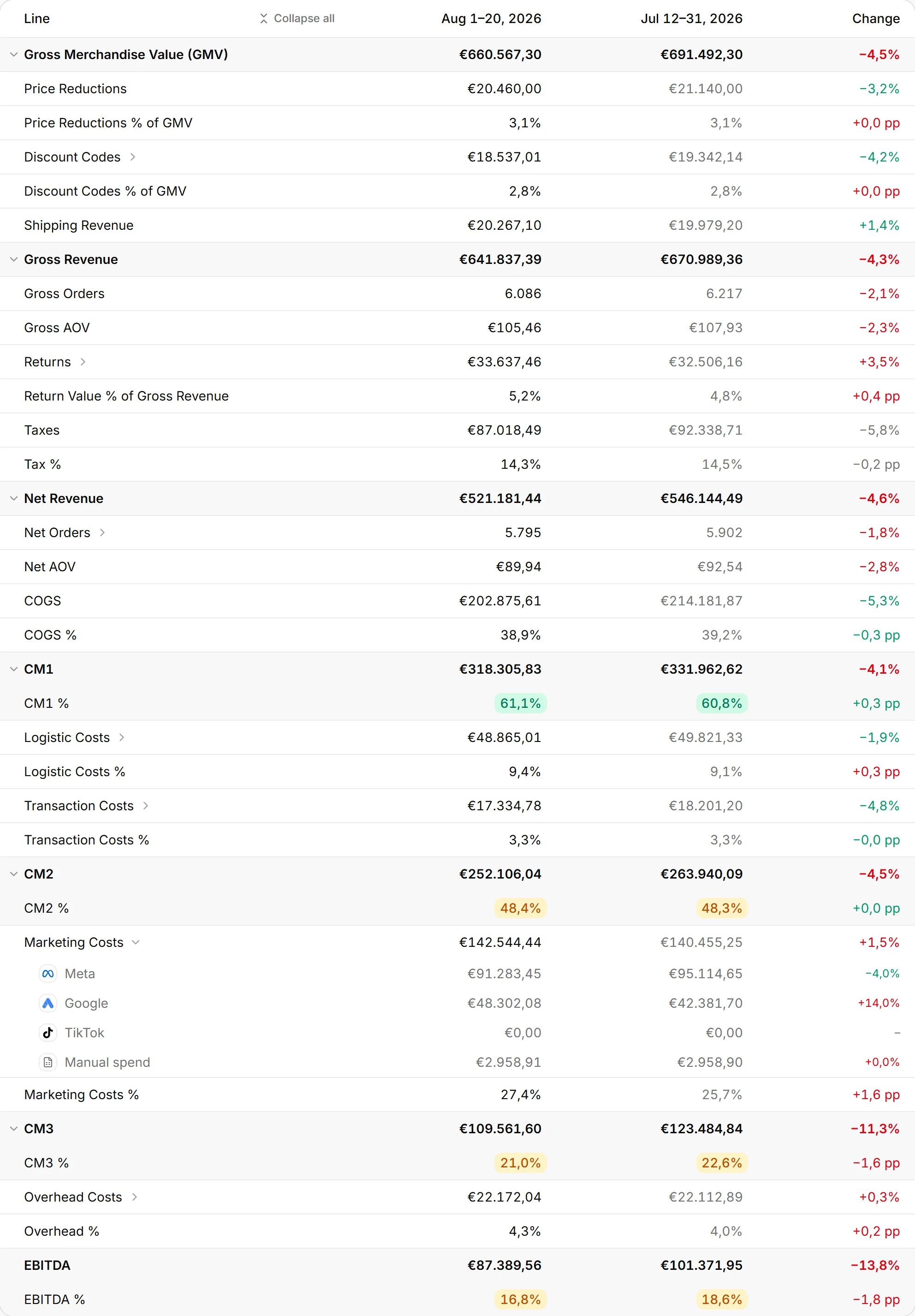
A calculator works from flat rates you type once. nouz prices every single order from the cost rules that were in force on that order's own date, and rebuilds the same statement every night from your own orders and your own ad spend.
More calculators
Each one is a different question about the same statement. All 32 are free, and none of them asks you to sign up.
All calculatorsThe terms this calculator uses
The long version
Want the long version rather than the arithmetic?
Profit on paper€9.500and the account can still fall12 min readProfitable on paper, no cash in the bank: the four calendarsThe statement says the store earns money and the account still falls. The four calendars that separate profit from cash, and the plan that fits a genuinely profitable store.Profitable on paper, no cash in the bankThe reorder planner in nouz tells you when each product runs out at its own pace, what to order and by when, and what it costs, from your own sales, your stock in Shopify and the lead times you set.