Anyone with a 3PL or carrier contract
Shipping rate card
Zone by weight bracket, the way carriers actually bill.
5 columnsCSV
Catalogue owners
What this file is
A product cost list holds one row per variant: the SKU, what a unit costs you, the currency, the date that cost starts applying, and the unit's weight in grams. It is the input a P&L needs to turn revenue into margin, kept in the dated form that stops a price change from rewriting history.
What is inside
One row per variant: what it costs you, what it weighs, and the date that cost starts applying. The effective-from column is what stops a supplier price change from rewriting last quarter.
Rows 1 and 2 are the file. Click any cell to read it; the foot of the sheet says what its column is for.
| Row | A | B | C | D | E | F | G | H | I | J | K |
|---|---|---|---|---|---|---|---|---|---|---|---|
| 1 | sku | product | variant | unit_cost | currency | effective_from | weight_grams | ||||
| 2 | HEAVY-HOODIE-2 | Heavy Hoodie | M | 28.36 | EUR | 2026-02-01 | 550 | ||||
| 3 | |||||||||||
| 4 | |||||||||||
| 5 | |||||||||||
| 6 | |||||||||||
| 7 |
A · skuThe variant's SKU exactly as your shop spells it; it is how rows are matched.
In the order they sit in the file. Point at one and it is outlined in the sheet.
Behind the file
Unit cost is the number shop catalogues lose most often, and the one nothing downstream works without. A missing cost does not read as missing in most reports; it reads as zero, and a zero cost shows you margin you do not have. That failure mode is exactly what Shopify's COGS report keeps out of view, and it is why this file starts from the catalogue rather than from the accounts.
The effective_from column is the quiet star. When a supplier raises prices in February, you add a new row with the new cost and the February date, and every order before it keeps the cost that was true when it was placed. That habit is called effective dating, and it is what stops one price change from rewriting last quarter's margin.
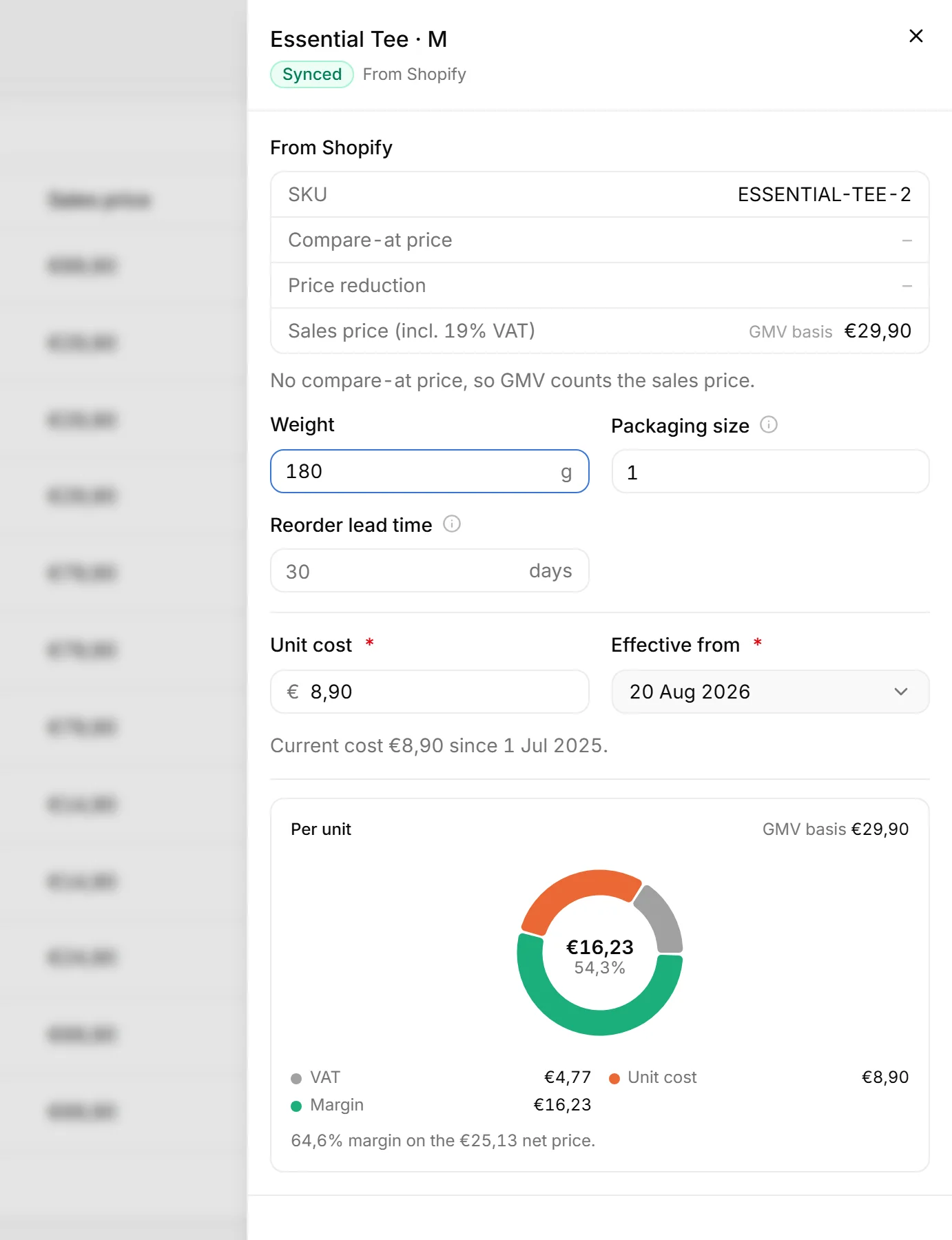
Weight is in the file because carriers bill by it. A missing weight does not make shipping free, it makes the cost wrong, so it belongs in the same file the costs live in, filled once per variant. In nouz the same two values sit on each variant's panel on the Products page, filled in from Shopify wherever your catalogue already carries them, and a value you enter yourself is never overwritten by a later sync. The file is a worksheet to gather them in, and costs from a spreadsheet are typed into nouz per variant.
In nouz
On the Products page, every variant has its own panel: a unit cost from the day you pick, and its weight. A variant without a cost is flagged, never counted as free.
More templates
Zone by weight bracket, the way carriers actually bill.
nouz works out your real profit every night, after product costs, shipping, payment fees, ad spend and running costs, and sends it to your inbox each morning.