What a promotion does to one unit's contribution, with VAT and the payment fee rescaled on the discounted price, and the volume the code must bring in before the month has merely stood still.
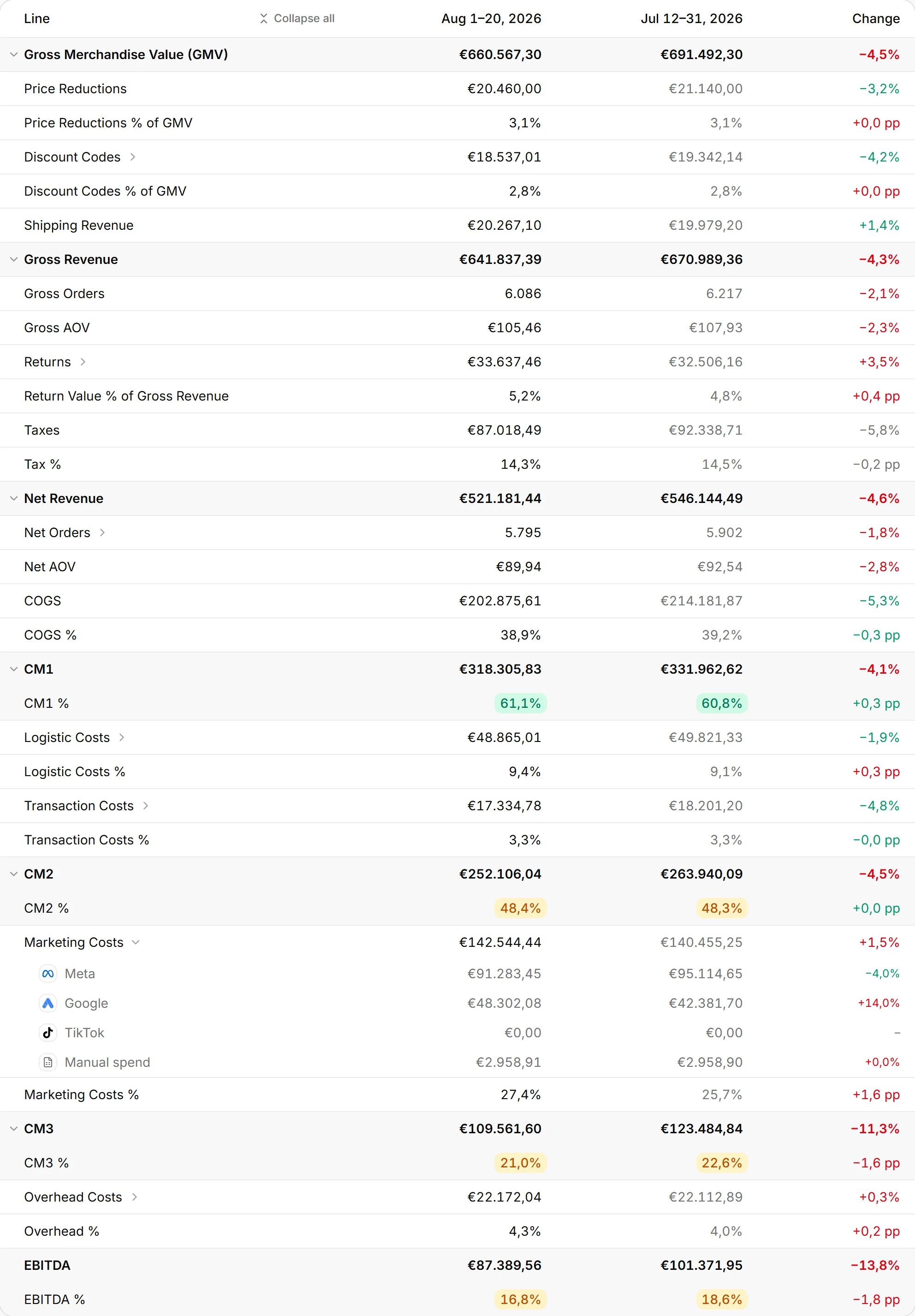
Free, nothing to sign up forLines 2 to 25 of a nouz P&L
Extra orders needed to stand still
+35,6%
Sticker discount
€4,90
what the customer sees
25Contribution given up
€4,03
per unit; VAT and fee absorb the rest
25Contribution after
€11,32
was €15,35
Your product
€
That price is
The shelf price. VAT is stripped before any contribution is computed, because it was never your money.
%
%
€
What one order adds
€/order
%
The parcel and the payment fee exist because the sale happened, and both belong in the before-and-after: the fee even moves with the price.
↑↓ to nudge, Shift for ten. Commas or dots both work.
One unit, before and after
16Net price today€41,18
4Discount, off the net−€4,1210,0%
16Net price discounted€37,06
25Contribution today€15,3537,3%
25Contribution discounted€11,3230,5%
Before running the code, ask one honest question: has any promotion on this product ever lifted its volume by that much? If not, the discount is a plan to earn less.
The promotion takes €4,03 of contribution out of every unit, so it has to sell 35,6% more units just to keep the month's total contribution level.
An estimate from flat rates. In nouz every order is priced from the costs of its own day.
What this calculator does
What it does
A discount impact calculator works out what a price discount does to one unit's contribution and how much extra volume the promotion needs just to stand still. VAT is stripped and the payment fee rescaled on the discounted gross, so the answer is what a P&L would see, not what the sticker says.
The formula
A tenth off the price, a quarter off what you keep.
A discount is judged against revenue and paid out of contribution, and that mismatch is the whole story. The goods, the parcel and the fixed part of the payment fee cost exactly the same on a discounted order, so every cent the code gives away comes out of the thin slice the unit was actually keeping.
That is why the required volume lift is always steeper than intuition expects. When roughly a third of the net price survives the variable costs, ten percent off the price is about a quarter off the contribution, and the promotion has to sell more than a third more units before the month has gained anything at all.
The per-unit cost, on the other hand, is slightly kinder than the sticker: the VAT inside the discounted part was never yours, and the gateway’s percentage shrinks with the price. Both effects are in the calculator, because both are in a real statement.
Where it goes wrong
Four ways promotions get judged by the wrong number.
Every one of these makes a code look better than it was, which is why discount habits grow until a statement stops them.
Judged against revenue
A promotion that lifts revenue can easily shrink contribution: the extra orders arrive, each carrying a quarter less margin, and the month ends busier and poorer. The only honest benchmark is total contribution against the un-discounted baseline, which is exactly the volume ratio this calculator leads with.
The lift assumed, never measured
The required lift is arithmetic; the actual lift is an experiment. Before a code runs, write down the volume it owes you. Afterwards, compare. Most stores that do this once discover their standard promotion has never paid for itself, and their best one earns quietly at half the depth.
Deep codes on small baskets
The fixed costs of an order, parcel and the fixed leg of the payment fee, do not shrink with the price, so a deep discount on a small basket can push the whole unit under water. A promotion that sells below contribution is not marketing; it is paying customers to take stock away.
Discounting what would have sold anyway
A sitewide code gives its discount to every full-price customer already in the checkout, and that share of the spend buys no lift at all. Scoping promotions, to slow stock, to first orders, to a category, is the cheapest way to shrink the giveaway without shrinking the effect.
The calculator’s own defaults: a product on the shelf at €49,00 including 19% VAT, bought in for €18,50, shipped for €6,40 all-in, paid through a gateway taking 1,9% of the gross. Before any code it contributes €15,35 per unit.
The 10% code moves the sticker to €44,10. The net price falls to €37,06, the fee eases to €0,84, and the contribution lands at €11,32.
The €4,90 sticker discount cost €4,03 of contribution, and that €4,03 came out of €15,35: a 26% cut in what the unit keeps, from a 10% cut in what it charges. To hold the month’s total contribution level, the promotion has to sell about 35,6% more units, and only the orders beyond that line earned anything.
The same leverage runs the other way, which is what the price increase calculator below is for.
In the app
nouz works this out from every order, every day.
A calculator works from flat rates you type once. nouz prices every single order from the cost rules that were in force on that order's own date, and rebuilds the same statement every night from your own orders and your own ad spend.
Every cost at the rate of its own day. Product costs, parcels and payment fees per order, so a price change never rewrites last month.
Ad spend comes in by itself. Meta, Google and TikTok through their official APIs, plus anything you add by hand or by CSV.
The same lines, per product. What is left after product costs, after shipping and payment fees, and after ads, for every product you sell.
Per unit, slightly less than the sticker suggests, and per month far more. On a €49,00 product the 10% code takes €4,90 off the sticker, but VAT and the payment fee shrink with the price, so the unit gives up €4,03 of contribution. The catch is where it comes from: the whole €4,03 comes out of the €15,35 the unit contributed, a cut of more than a quarter, not a tenth.
How much more do I need to sell to make a discount worth it?
Divide the contribution before the discount by the contribution after it. On the example figures that is 15,35 over 11,32: the promotion needs about 35,6% more orders before the month's total contribution is merely level, and every order beyond that is what the promotion actually earned. Most codes are judged against revenue instead, which is why most codes look better than they were.
Why does the required lift grow so much faster than the discount?
Because contribution is a sliver of the price. When only about a third of the net price survives goods, parcel and fee, a tenth off the price is roughly a quarter off the sliver, and the volume needed to refill it grows with the square of that leverage as discounts deepen. It is the same arithmetic that makes small price increases so powerful in the other direction.
Does the discount come off the gross or the net?
The customer sees it on the gross shelf price, and that is where this calculator applies it. Your side of it lands on the net: the VAT inside the discounted part disappears with it, which is why the contribution cost per unit is smaller than the sticker discount. Both figures are shown, because confusing them misprices every promotion.
Do payment fees shrink when I discount?
Yes: the gateway charges its percentage on the amount it actually moves, so a lower price carries a slightly lower fee. The fixed part of a fee does not shrink, which quietly makes deep discounts on small baskets even worse than the percentage arithmetic alone suggests.
Where do discounts sit on a P&L?
Two lines on a nouz statement, on purpose. Discount codes and automatic discounts are line 4. A price cut made by lowering the price against a compare-at price is line 2, price reductions. The distinction matters because the two are decided by different people for different reasons, and a statement that blends them cannot say which habit is eating the margin.
More calculators
Four that go with this one.
Each one is a different question about the same statement. All 32 are free, and none of them asks you to sign up.
Every code’s real cost, on the statement it came out of.
nouz books every discount to its own P&L line, per day and per product, so a promotion is judged by what the month kept rather than by what the code sold.