Margin and markup from one price and one cost, with VAT stripped first the way a European statement does it, and the per-order costs that decide whether the unit actually pays.
Free, nothing to sign up forLines 16 to 25 of a nouz P&L
Profit margin, on the net price
55,1%
19Profit per unit
€22,68
net price minus goods
Markup on cost
122,6%
the other way round
16Net price
€41,18
after €7,82 VAT
Your product
€
That price is
The shelf price. VAT is stripped before any margin is computed, because it was never your money.
%
€
What one order adds
€/order
%
Optional, and the difference between a margin on paper and a unit that pays: the parcel and the payment fee exist because the sale happened.
↑↓ to nudge, Shift for ten. Commas or dots both work.
One unit
LineItemA unitOf net
16Net price per unit€41,18
17Goods−€18,5044,9%
19CM1 per unit€22,6855,1%
21Fulfilment−€6,4015,5%
23Payment fee on the gross−€0,932,3%
25Contribution per unit€15,3537,3%
Advertising, rent and salaries still have to come out of the €15,35 each unit contributes. The monthly version of this ladder, with marketing and overhead in it, is the contribution margin calculator below.
€22,68 of profit per unit after the goods. The same euro reads as a 122,6% markup on cost, which is why the two numbers must never be swapped.
An estimate from flat rates. In nouz every order is priced from the costs of its own day.
What this calculator does
What it does
A profit margin calculator takes a product's selling price and unit cost and returns the margin (profit as a share of the net price) and the markup (profit as a share of the cost). This one also strips VAT from a gross price first and shows what the unit contributes once fulfilment and payment fees are out.
The formula
One euro of profit, two very different percentages.
Margin and markup describe the same euro from opposite ends. Margin is profit measured against the selling price; markup is the same profit measured against the cost. For any profitable product the markup is the bigger number, and quoting it where a margin belongs makes every price look healthier than it is.
The second trap is quieter and more European: the price on the shelf still contains VAT, and VAT was never your money. At German rates, computing margin on the gross price flatters every product by roughly a sixth, which is enough to make a losing unit read as a thin one. The margin only means something once it is measured against the net price.
And a margin after the goods is still not a unit that pays. The parcel and the payment fee exist because the sale happened, so the number a pricing decision should rest on is what one unit contributes after them, which is the per-unit version of CM2.
Where it goes wrong
Four habits that make a margin read better than it is.
A margin is arithmetic, so a flattering answer is always a flattering input. These are the four we see most, in order of the damage they do.
VAT left inside the price
A €49,00 shelf price at 19% VAT is €41,18 of revenue; the €7,82 belongs to the tax authority on the day of the sale. Compute the margin on €49,00 and every product in the catalogue looks roughly a sixth better than it is, and the error compounds into every decision priced on it.
The rule is mechanical: gross price in, VAT out, margin on what is left.
Markup quoted as margin
A unit bought for €18,50 and sold for €41,18 net is a 122,6% markup and a 55,1% margin, and both sentences are true. The damage happens when the first number is used in a sentence that needs the second: a target like “we need 60% margin” is missed by a mile by a product whose 60% was actually markup.
Margin can never exceed 100%. Markup can. That is the quickest way to spot which one a number actually is.
The list price instead of the real price
Margins computed on the recommended price ignore what the catalogue actually did: discounts, codes and sale events all sell units below list. The honest input is the price the unit really sells at on an average day, and if that number is unknown, that is the finding.
One blended margin for the whole catalogue
A catalogue-wide average hides exactly the products this calculator exists to expose: the heavy item whose parcel eats its healthy goods margin, and the discounted line running at a loss inside a profitable category.
Run the arithmetic per product, starting with your five biggest sellers; they carry most of the month.
The calculator’s own defaults, so you can retrace every step above: a product on the shelf at €49,00 including 19% VAT, bought in for €18,50, shipped for €6,40 all-in, paid for through a gateway taking 1,9% of the gross.
VAT comes out first: €41,18 of the price is actually revenue. The goods take €18,50, leaving €22,68 of profit per unit, a 55,1% margin, which the same euro would flatter into a 122,6% markup if measured against the cost instead.
The number that started as “55% margin” is €15,35 once the unit has been shipped and paid for: a 37,3% contribution. That is the figure advertising has to be bought out of, and the gap between the two percentages is exactly what a price-only margin calculator never shows.
From here the question changes shape: how many of these contributions cover the month’s fixed costs is the break-even question, and it has its own calculator below.
In the app
nouz works this out from every order, every day.
A calculator works from flat rates you type once. nouz prices every single order from the cost rules that were in force on that order's own date, and rebuilds the same statement every night from your own orders and your own ad spend.
Every cost at the rate of its own day. Product costs, parcels and payment fees per order, so a price change never rewrites last month.
Ad spend comes in by itself. Meta, Google and TikTok through their official APIs, plus anything you add by hand or by CSV.
The same lines, per product. What is left after product costs, after shipping and payment fees, and after ads, for every product you sell.
The same euro of profit, measured against two different bases. Margin is profit divided by the selling price; markup is profit divided by the cost. A product bought for €18,50 and sold for €41,18 net carries €22,68 of profit: a 55,1% margin and a 122,6% markup. For any profitable product the markup is always the bigger number, which is why quoting markup as margin makes a price look healthier than it is.
How do I calculate profit margin?
Take the net selling price, VAT out. Subtract what the unit costs you. Divide the result by the net price. The two mistakes that break the number are using the gross price, which counts the tax authority's money as yours, and using the recommended retail price instead of what you actually sell at.
Should VAT be in the price I enter?
Enter the price either way and say which it is; the calculator strips VAT from a gross price before computing anything. At 19% German VAT a €49,00 shelf price is €41,18 of net revenue, and every margin has to be measured against the €41,18. Skipping this step overstates margin on every product you sell.
What is a good profit margin for ecommerce?
There is no honest single number, because margin depends on where you stop counting. The same product can carry a 55% margin after goods, 37% after fulfilment and payment fees, and far less once advertising is in. Judge each level against its own job: the goods margin pays for operations, the contribution pays for marketing and overhead, and what survives all of them is profit.
Why does the payment fee use the gross price?
Because the gateway charges its percentage on the amount it actually moved, which includes VAT and any shipping the customer paid. Applying the fee rate to net revenue understates the fee on every order; it is one of the small systematic errors that make a spreadsheet P&L drift from the bank account.
Where does this sit on a P&L?
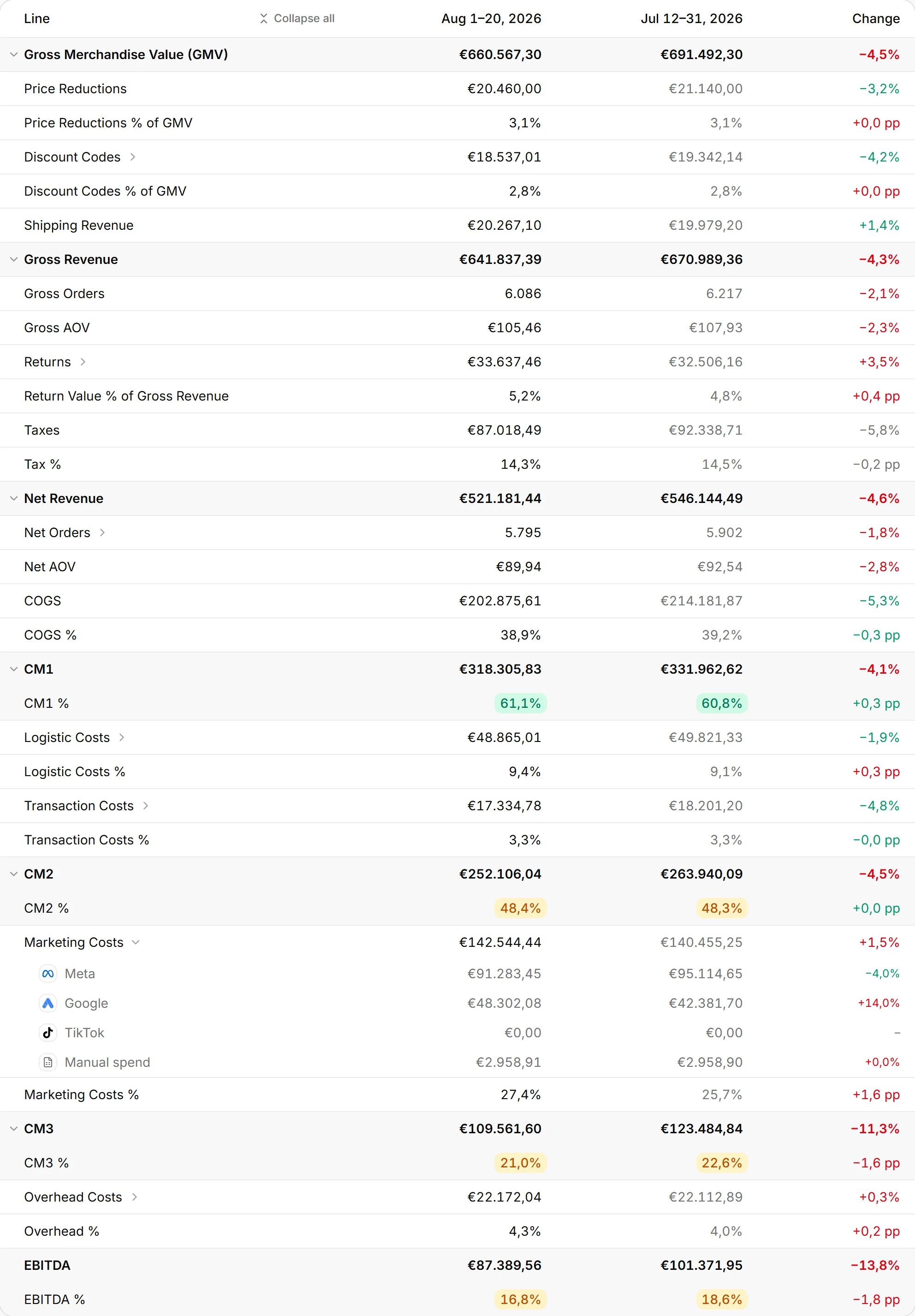
This calculator is the per-unit slice of lines 16 to 25 of a nouz statement: the net price is line 16's average order value seen for one unit, the goods are line 17, their difference is CM1 on line 19, and fulfilment and payment fees take it to the per-unit equivalent of CM2 on line 25. The monthly version of the same ladder is the contribution margin calculator.
Is this the calculator for my whole store's profit?
No: this one prices one product. A store's month carries costs no single product owns, like advertising and rent, plus refunds and the VAT inside everything customers paid. For the whole month, from what customers paid down to EBITDA, use the Shopify profit calculator.
More calculators
Four that go with this one.
Each one is a different question about the same statement. All 32 are free, and none of them asks you to sign up.
nouz computes margin and contribution for every product you sell from the orders themselves, at the costs that were true on each order's own date, every night.