Free calculator
Ecommerce break-even calculator
How many orders this month has to bring in before it covers what it costs to run. Computed the way a P&L does it, after goods, shipping, payment fees and advertising, not on gross margin alone.
Your month
What you sell
What each order costs you
What the month costs you
A committed number for the month. It joins your fixed costs in the block that has to be covered, and every order contributes its CM2.
Orders before the month pays for itself
493orders
You are doing 706 orders, which is 213 above the line, and finishing the month €9.541,60 up.
Hatched is paying for the month. Solid is profit.
14Revenue needed
€41.905,00
25Each order adds
€44,68
Safety margin
30,2%
orders you could lose
Break-even here is the day cumulative CM3 covers the month’s fixed costs, not the day revenue equals costs. Those are different days and only the first one means anything.
Run this on my real ordersThe formula
Break-even is a day, not a revenue figure
A store breaks even on the day the contribution its orders have made so far covers what the month costs to run. That is a different day from the one where revenue equals costs, and only the first one means anything, because a large part of revenue was never yours to keep.
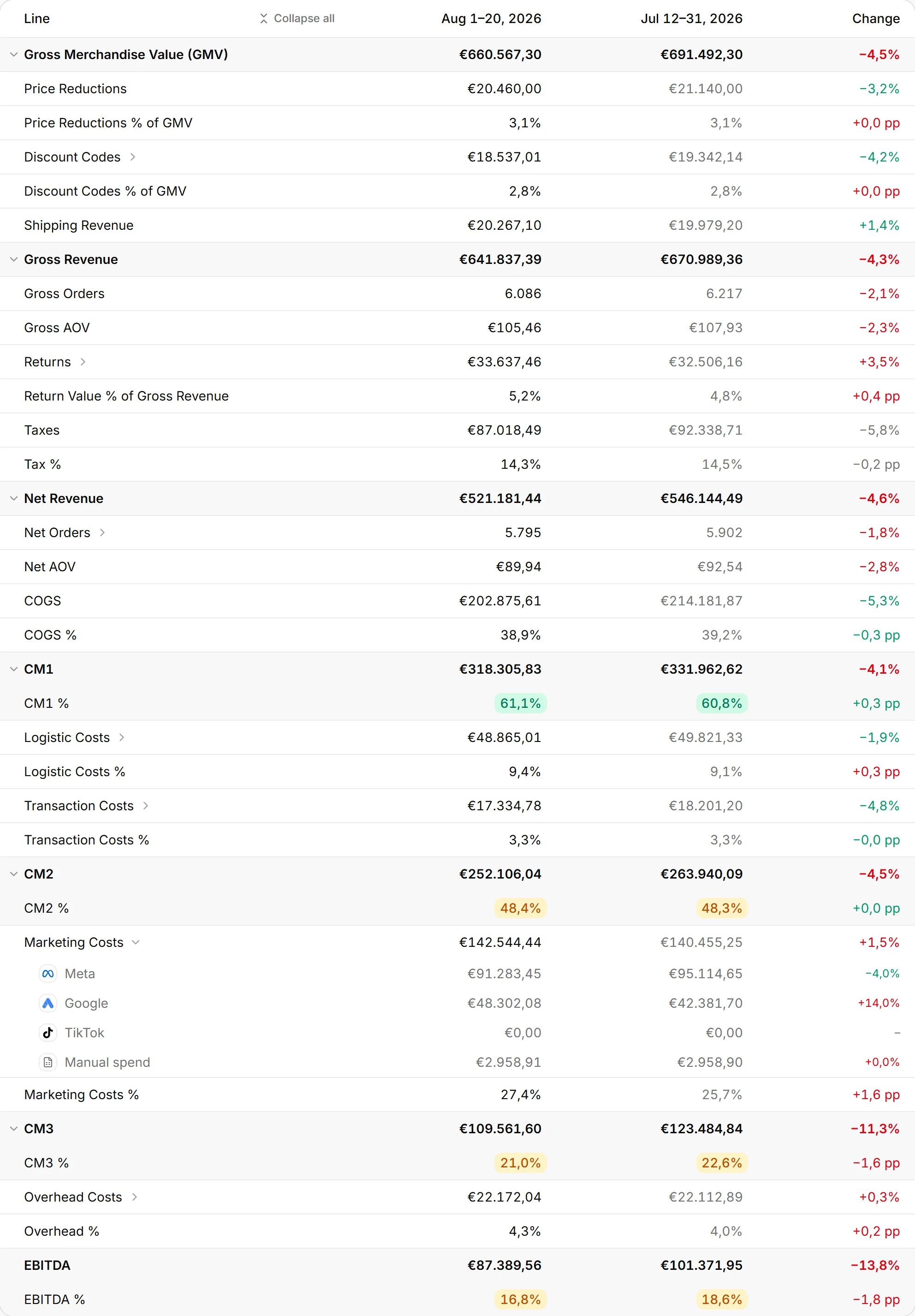
Work down from the top of an order. The customer pays; VAT comes out, because it belongs to the tax authority. What is left is net revenue. The goods come out of that and you have CM1. The parcel and the payment fee come out and you have CM2, which is what the order genuinely contributed. Advertising comes out and you have CM3, which is what the customer contributed. Only then is there anything to put against the rent.
So the break-even question is: how many CM3s does it take to pay for a month. Everything else in the calculation is detail about how big one CM3 is.
The numbers in the gutter are line numbers on a nouz P&L. They are the same lines in the product, so a figure worked out here can be checked against one computed from real orders.
Where it goes wrong
Four inputs that quietly move the answer by weeks
Break-even is arithmetic, so a wrong answer is always a wrong input. These are the four that do the most damage, in the order we see them.
VAT left inside the revenue figure
The commonest European error by a distance. A merchant takes the number Shopify shows and puts it in as revenue, but that figure includes 19% or 20% of money that belongs to the tax authority. At German rates, gross revenue overstates contribution by roughly a sixth, which pulls break-even several days earlier than it really is and makes a losing month look like a thin one.
Use net revenue: what is left after returns and after tax. It is the denominator of every percentage on a real P&L for exactly this reason.
Fixed costs that are not fixed
A cost is fixed if it does not move when you ship one more parcel. Rent, salaries and software subscriptions are fixed. Pick and pack, packaging, the shipping label and the payment fee are not, however regular they look on a bank statement, and putting them in the fixed block counts them twice: once in the block, and once inside the margin you are dividing by.
The test is not how predictable the cost is. It is whether the next order changes it.
Ad spend treated as a law of nature
A monthly ad budget behaves like a fixed cost right up until the moment you want to grow, at which point it is the most variable cost you have. Both treatments are honest and they give different answers, which is why the calculator asks rather than assuming.
Treat it as a budget when the number is committed and you are asking whether this month works. Treat it as a ratio when you are asking what happens if you scale.
Cost of goods taken from today's price list
Most tools, including Shopify’s own cost field, hold one unit cost per variant. Change it and every past order is silently re-priced at the new number, so last month’s break-even moves every time a supplier raises a price.
An order should be costed at the price that was in force on the day it was placed. That is what effective dating is, and it is the difference between a closed month staying closed and a figure that drifts every quarter.
Worked example
A store doing €60.000 a month
An example store, not a customer: a DACH apparel shop turning over €60.000 of net revenue a month on an €85 basket, so about 706 orders. Goods take 38%. A parcel costs €6,40 to pick, pack and ship. The gateways take 1,9%. The ad budget is €15.000 and the fixed costs are €7.000.
One order is worth €85. The goods take €32,30, leaving CM1 of €52,70. The parcel takes €6,40 and the gateway takes €1,62, leaving CM2 of €44,68. That is what one order actually contributes, and it is a fifth less than the gross margin suggested.
€22.000 of fixed costs and ad budget, divided by €44,68 an order, is 493 orders. At 706 orders a month the store passes that on day 22 of a 31-day month and finishes about €9.500 up.
The safety margin is 30%: nearly a third of the month could disappear before the store stops paying for itself. That is a far more useful sentence than “we did €60.000”, and it is the one a merchant can actually act on when a supplier raises a price or a channel stops working.
Questions
Break-even, answered
What is the break-even point for an online store?
The point at which the contribution your orders make covers what the month costs to run. For a store that means CM3, the margin left after goods, shipping, payment fees and advertising, covering your fixed costs. It is not the point where revenue equals costs, because revenue includes money that was never yours: VAT, and the cost of the goods you shipped.
How many orders do I need to break even?
Divide what the month costs by what one order contributes after every variable cost. If your fixed costs are €7.000, your ad budget is €15.000 and an order contributes €44,68 after goods, shipping and payment fees, you need 493 orders. The calculator above does this and also tells you which day of the month you reach it at your current pace.
Should ad spend count as a fixed cost or a variable one?
Both answers are defensible and they give different break-even points, which is why the calculator asks. If your budget is set for the month and will not move, it behaves like a fixed cost and joins the block to be covered. If you scale spend with orders, it is variable and comes out of every order before it contributes anything. Most stores are somewhere in between and closer to the budget answer than they think.
Why is my break-even higher than my accountant's?
Usually because the textbook version stops at gross margin. It takes price minus unit cost and divides fixed costs by that, which ignores shipping, picking, packing, payment fees and every euro of advertising. Those are real per-order costs and they can be a quarter of the contribution you thought you had.
Does VAT belong in the revenue figure?
No, and this is the most common European mistake in a break-even calculation. VAT is collected on behalf of the tax authority and passed on, so it was never margin. Put net revenue in, not the gross amount the customer paid. At 19% German VAT, using gross revenue overstates your contribution by about 16% and moves break-even several days earlier than it really is.
What is a safety margin?
The share of your current orders you could lose before the month stops paying for itself. At 706 orders against a break-even of 493, the safety margin is about 30%: a third of the month could disappear before you are into a loss. It is the most useful single number for deciding how much risk a new ad budget or a price change actually carries.
More calculators
Four more, all free, all built on the same statement.
Want the long version rather than the arithmetic? CM1, CM2 and CM3 explained.
The terms this calculator uses:
See the real day, from your own orders
nouz recomputes this every night from what your store actually sold and what you actually spent, so the break-even day is a fact rather than an estimate.