Judged on order value
A bundle nearly always raises the average order, and can still lower contribution per euro of revenue. The metric that settles it is contribution per order before and after, never the basket size the bundle obviously increased.
Free calculator
Three worlds priced at once: the items as separate orders, the same items in one full-price order, and the bundle, so the discount is judged against the fulfilment it actually saves.
The bundle contributes
€26,34
25Sold as separate orders
€23,72
29,1% of net
25One order, full price
€37,02
45,4% of net
25One order, bundle price
€26,34
37,3% of net
Hero product
Companion
Refill
The bundle, and what an order costs
One parcel and one fixed payment fee instead of several is the part of the discount the store does not actually pay for.
↑ ↓ to nudge, Shift for ten. Commas or dots both work.
The bundle can discount up to 16,7% before it contributes less than the same items sold as separate orders, because one parcel and one fixed fee replace 3. Against a single full-price order, though, every cent of discount is a cent of contribution: €37,02 becomes €26,34.
37,3% of its own net revenue, after a 13,4% discount worth €13,00. Against the same items in one full-price order it gives up €10,68, and against three separate orders it earns €2,62 more.
An estimate from flat rates. In nouz every order is priced from the costs of its own day.
A bundle margin calculator prices three worlds at once: the items sold as separate orders, the same items in one full-price order, and the bundle itself. The gap shows what the discount costs and what the single parcel and single fixed fee save.
The formula
A bundle is normally judged on the discount alone, which misses the reason bundles work. Three items in one parcel consume one parcel and one fixed payment fee rather than three, and that saving is a real budget the discount can be paid out of.
Which comparison you use decides the answer, so this prices both. Against three separate orders a discounted bundle usually wins. Against the same items in one full-price order every cent of the discount is a cent of contribution, and the bundle always loses.
The honest question is which of those two worlds the bundle actually replaces. If customers were buying one item and the bundle moves them to three, the first comparison applies. If they were already buying all three, you have simply discounted them.
Where it goes wrong
Bundles raise order value almost by definition, which is what makes them so easy to celebrate and so easy to get wrong.
A bundle nearly always raises the average order, and can still lower contribution per euro of revenue. The metric that settles it is contribution per order before and after, never the basket size the bundle obviously increased.
“15% off the bundle” is a marketing decision wearing arithmetic’s clothes. The defensible discount is bounded by what the single parcel and single fee actually save, which this calculator solves for rather than assumes.
Bundling dead stock onto a hero product moves inventory once and teaches customers to wait for bundles permanently. The second effect outlives the first, and it is far harder to undo than a write-down.
If the customers taking the bundle were already buying all three items, the bundle is a discount on your best orders. Check whether bundle buyers previously bought one item or three before concluding the bundle created anything.
Worked example
The calculator’s defaults: a €49 hero product, a €29 companion and a €19 refill, costing €18,50, €10,50 and €7,00, bundled at €84,00 against €97,00 of shelf prices. One parcel costs €6,40 and the gateway takes 1,9% plus €0,25.
That is a €13,00 discount, 13,4% off, against a fulfilment saving of €13,30 when three orders become one.
The bundle earns €2,62 more than the same items sold as three separate orders and €10,68 less than one full-price order containing all three. Both facts are true, and which one applies depends entirely on what the customer would otherwise have done.
The discount could go to 16,7% before the bundle stops beating separate orders. Beyond that it is buying volume with margin, which can still be the right call, provided it is a call rather than an accident.
In the app
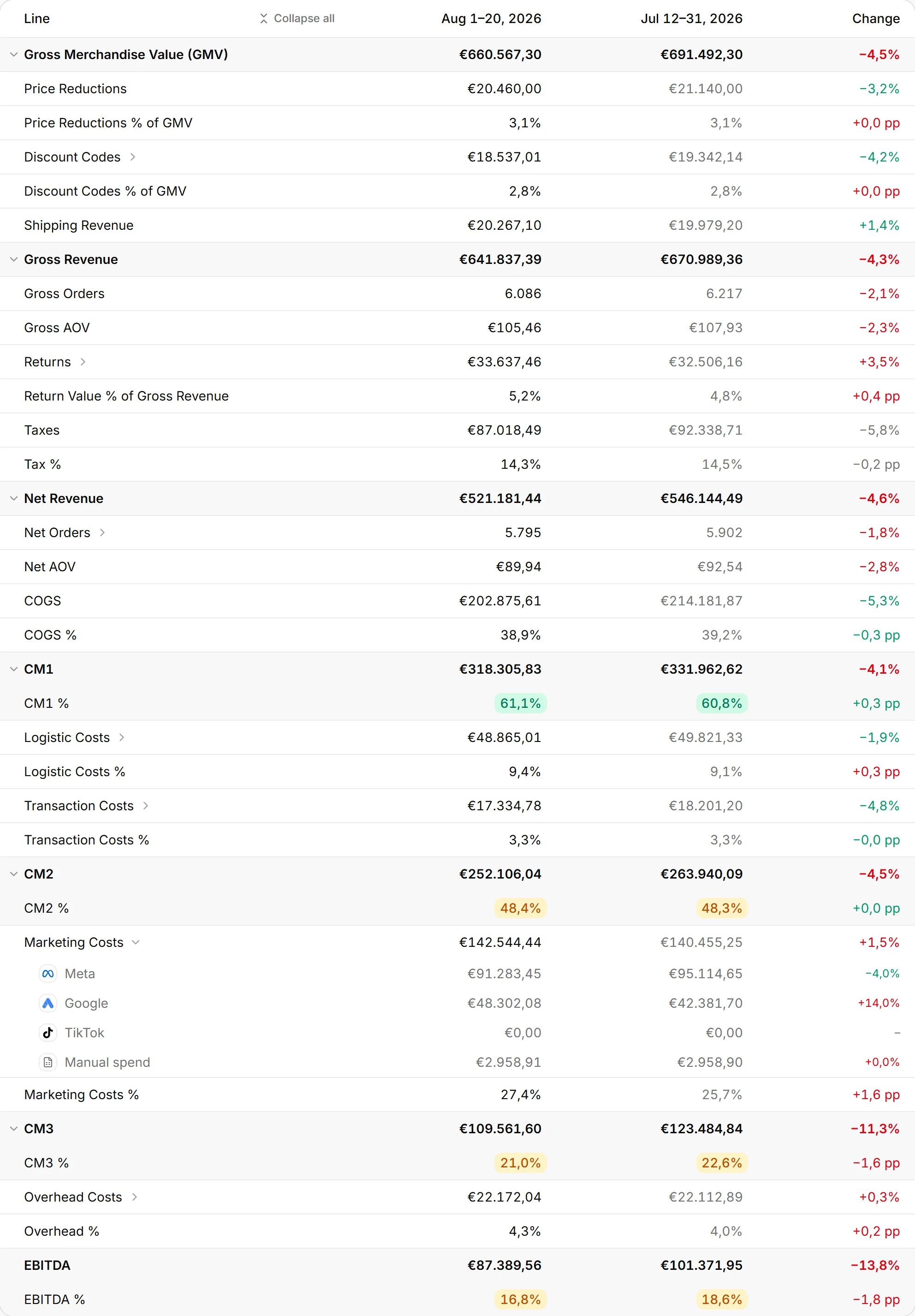
A calculator works from flat rates you type once. nouz prices every single order from the cost rules that were in force on that order's own date, and rebuilds the same statement every night from your own orders and your own ad spend.
More calculators
Each one is a different question about the same statement. All 32 are free, and none of them asks you to sign up.
All calculatorsThe terms this calculator uses
The long version
Want the long version rather than the arithmetic?
Bestseller list≠ profit listfour forces reorder it11 min readWhich products actually make money? Rebuild the bestseller listYour bestseller list is a revenue ranking. Rebuilt as a profit ranking, it reorders: discounts, returns, parcels and fees decide which products actually earn.Which products actually make moneynouz prices every order at its own costs, so a bundle's real contribution sits beside the products it contains rather than inside an average that flatters both.