The basket a free delivery offer has to reach before it pays for what it gives away: the delivery charge you stop collecting, once its payment fee is taken off. The carrier bill is yours with or without the offer.
Free, nothing to sign up forLines 16 to 25 of a nouz P&L
Threshold that leaves you no worse off
€93,02
6Given away per order
€4,79
the charge you stop collecting
25Contribution today
€49,17
customer pays shipping
25At €99,00
€52,74
shipping free
Your orders today
€
%
%
Shipping today
€/order
€/order
%
You pay the carrier with or without the offer, so the cost never moves the threshold. What the offer gives up is the charge you stop collecting.
A threshold you are considering
€
↑↓ to nudge, Shift for ten. Commas or dots both work.
One order
16Average order today€85,00
6Shipping charged€4,90
21Shipping cost−€6,40
25Contribution today€49,17
Break-even threshold€93,029,4%
A threshold of €99,00 earns €3,57 more per order than today, IF the basket actually reaches it. That is the assumption to test, not to hope.
An order has to reach €93,02 net, 9,4% above today’s average, before free delivery pays for itself. Below that the offer buys orders you were getting anyway, at a discount.
An estimate from flat rates. In nouz every order is priced from the costs of its own day.
What this calculator does
What it does
A free shipping threshold calculator finds the basket size at which absorbing delivery leaves you no worse off than charging for it. It counts what the offer really costs, the delivery charge you stop collecting (the carrier bill is yours either way), and returns the order value whose extra margin replaces it.
The formula
Only the margin on the extra basket pays for the delivery.
The instinct is to set the threshold at or just above the average order, which is almost always too low. An extra €5 of basket does not bring €5 of margin: it brings whatever survives the goods and the payment fee, commonly around three fifths of it. So covering a €4,90 delivery charge takes rather more than €4,90 of extra spend.
You pay the carrier either way: the parcel cost the same before the offer, so it is not part of what free shipping gives away. What the offer changes is the delivery charge you stop collecting, and that charge, not the carrier bill, is what the extra basket has to replace. On the example figures it is €4,79 per order once its own payment fee is taken off.
What the arithmetic cannot tell you is whether customers actually spend up to the line. That is an experiment, and the threshold is what you measure it against: watch the share of orders reaching it, and watch the average order value, together.
Where it goes wrong
Four ways a free shipping offer just becomes a discount.
Free delivery is one of the strongest levers in ecommerce and one of the easiest to give away for nothing.
The threshold set at the average order
Half of all orders already clear the average, so a threshold set there hands free delivery to customers who were buying anyway and changes nobody’s basket. It is a straight margin cut on half the store, wearing a marketing name.
Counting the whole carrier bill
The carrier bill was yours before the offer too: every order already paid for its parcel. Counting that bill as the cost of free shipping overstates what the offer gives away and pushes the threshold higher than it needs to be, so a store can turn down an offer that would have paid.
One threshold for every product
A heavy or bulky product costs multiples of a light one to ship, so a single threshold subsidises exactly the orders that can least afford it. Category thresholds are more work and considerably more honest.
Never measured afterwards
The offer is a bet that baskets rise. Two numbers settle it: the share of orders that reach the threshold, and the average order value before and after. If neither moves, the offer is costing you money for nothing and should be withdrawn.
The calculator’s defaults: an €85,00 average order net of VAT, goods at 38%, a gateway taking 1,9% of the gross, €6,40 of shipping cost and €4,90 charged for delivery today. The €6,40 is paid with or without the offer.
About 59,7 cents of every extra euro of basket survives to contribution, so replacing the €4,79 the charge was worth takes €8,02 of additional spend.
So a threshold of €93 is neutral, and anything under it hands margin away. A store setting €75 “because that is about our average” would be discounting most of its orders by €4,90 and calling the result a shipping strategy.
Note what makes this store’s number relatively kind: a 62% margin after goods. A store at 40% needs a much bigger uplift to cover the same charge, which is why the threshold has to be computed rather than copied.
In the app
nouz works this out from every order, every day.
A calculator works from flat rates you type once. nouz prices every single order from the cost rules that were in force on that order's own date, and rebuilds the same statement every night from your own orders and your own ad spend.
Every cost at the rate of its own day. Product costs, parcels and payment fees per order, so a price change never rewrites last month.
Ad spend comes in by itself. Meta, Google and TikTok through their official APIs, plus anything you add by hand or by CSV.
The same lines, per product. What is left after product costs, after shipping and payment fees, and after ads, for every product you sell.
High enough that the extra basket pays for the delivery you give away. On a €85 average order at a 38% cost of goods, giving up a €4,90 delivery charge needs the basket to reach about €93 before the offer is neutral. Any threshold below that is a discount for orders you were already getting, dressed as a shipping offer.
Why is the threshold above my average order value?
Because only the margin on the extra basket pays for the shipping, not the whole of it. If roughly 60% of an order survives goods and fees, then covering a €4,90 giveaway needs about €8 of additional basket, so the threshold sits that far above the average rather than at it.
Does free shipping actually raise basket size?
Often, and never by a number a calculator can know for you. That is why this one gives you the threshold the offer must clear rather than a prediction: set it, watch the share of orders that reach it and the average order value together, and you learn your own answer within a few weeks.
Should the threshold be net or gross?
Set the threshold on the figure your customers see, which is the gross basket including VAT, but do the arithmetic on the net value, because that is what carries the margin. The calculator works in net figures, so convert once at the end rather than quietly mixing the two.
What about the payment fee on shipping?
The gateway charges its percentage on the whole amount it moved, delivery charges included, so shipping revenue is not free money: a €4,90 charge carries its own fee. It is small, and it is part of why the honest break-even threshold is slightly higher than the back-of-envelope version.
More calculators
Four that go with this one.
Each one is a different question about the same statement. All 32 are free, and none of them asks you to sign up.
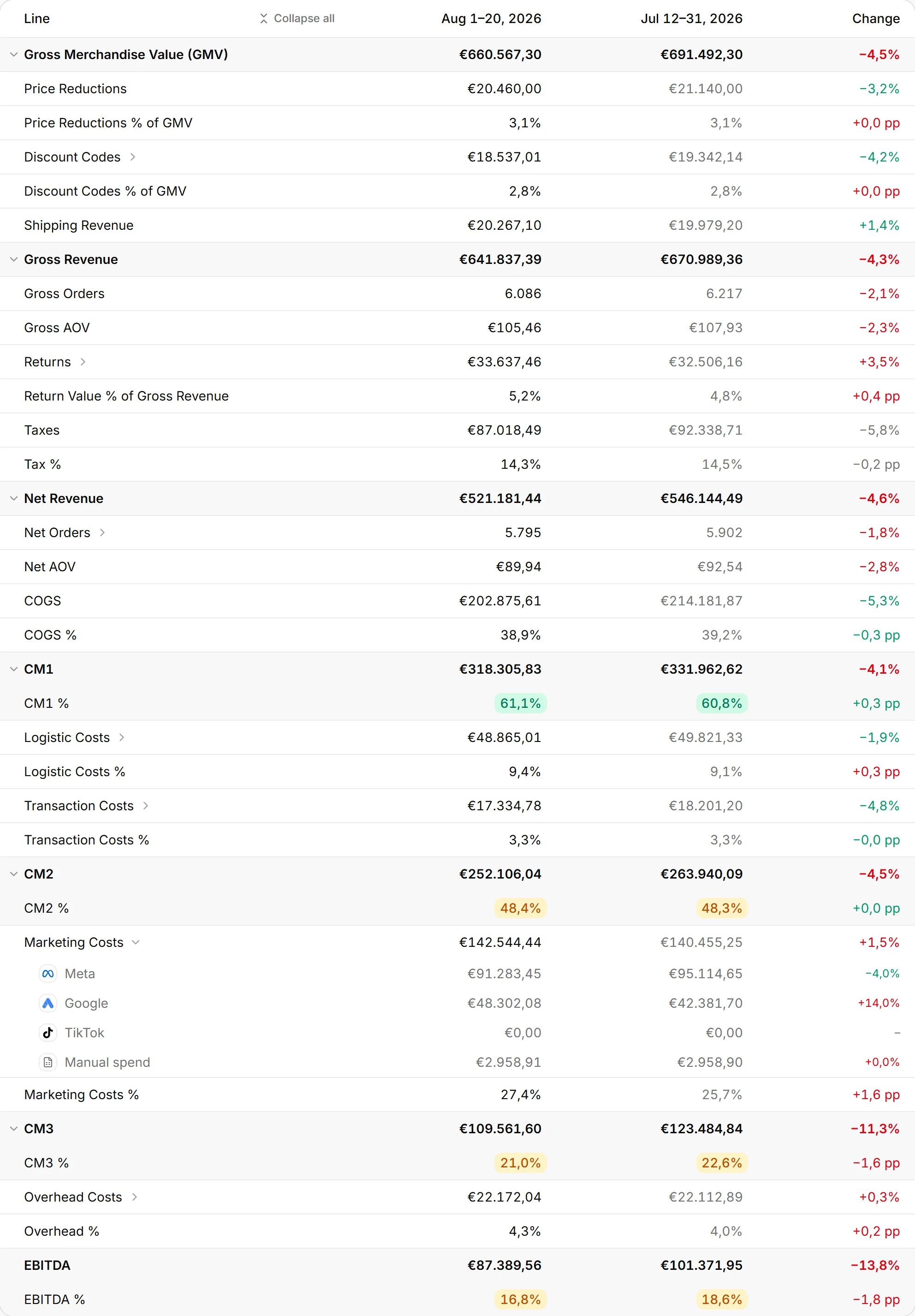
nouz prices shipping per order against the revenue it earned, so the month before an offer and the month after are the same statement with the difference visible on line 6, the shipping revenue the offer gave up.