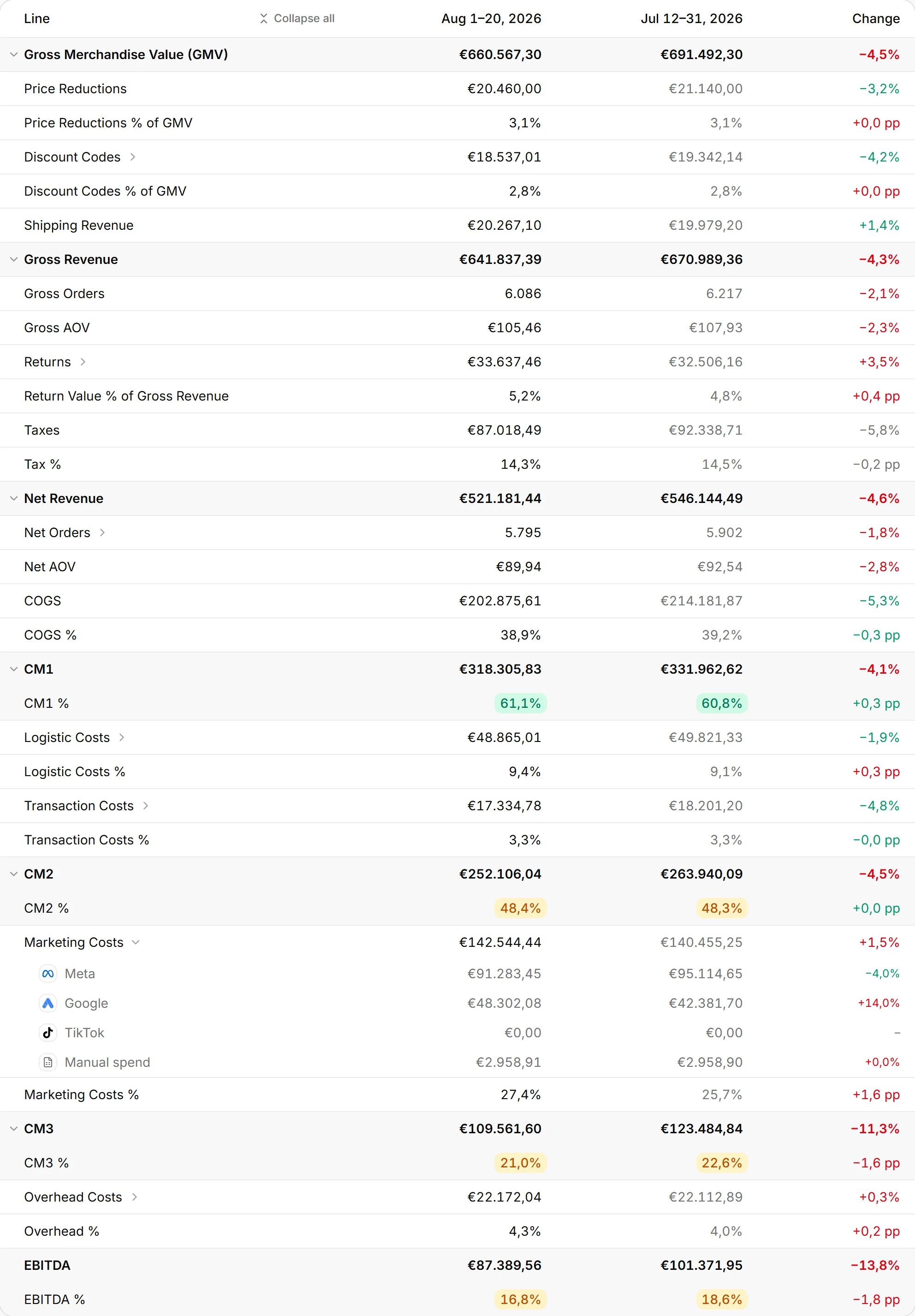
Three margins, not one. CM1 asks whether the product pays, CM2 whether the order pays, and CM3 whether the customer pays. A single contribution margin cannot tell you which of the three went wrong.
Free, nothing to sign up forLines 14 to 33 of a nouz P&L
CM1after product costs
62,0%
€37.200,00 a month
CM2after shipping and fees
52,6%
€31.541,60 a month
CM3after ad spend
27,6%
€16.541,60 a month
EBITDAafter running costs
15,9%
€9.541,60 a month
Your month
What comes in
€
€
That is about 706 orders a month.
What goes out
%
0%90%
€/order
%
0%6%
€
€
↑↓ to nudge, Shift for ten. Commas or dots both work.
What the ads bring back
MERnet revenue per euro of ads
4,00
POASleft after goods, shipping and fees, per euro of ads
2,10
Break-eventhe MER at which the ads pay for themselves
1,90
break-even
yours
Each ad euro has to bring in €1,90 of net revenue to pay for itself. Yours brings in €4,00, so the ads pay their way.
The statement
706 orders a month
LineItemA month% of netPer order
14Net revenue. What you sold, after returns and after VAT comes out.€60.000,00100,0% of net€84,99 an order
What you sold, after returns and after VAT comes out.
17Cost of goods. What the units in the parcel cost you to buy or make.−€22.800,0038,0% of net−€32,29 an order
What the units in the parcel cost you to buy or make.
19CM1after product costs. Net revenue minus the goods. Does the product make money.€37.200,0062,0% of net€52,69 an order
Net revenue minus the goods. Does the product make money.
21Logistics. Shipping, picking, packing and the box, on every order.−€4.518,407,5% of net−€6,40 an order
Shipping, picking, packing and the box, on every order.
23Payment fees. What the gateways take out of what the customer paid.−€1.140,001,9% of net−€1,61 an order
What the gateways take out of what the customer paid.
25CM2after shipping and fees. CM1 minus logistics and fees. Does the order make money.€31.541,6052,6% of net€44,68 an order
CM1 minus logistics and fees. Does the order make money.
27Marketing. Every euro of ad spend, on the day it was spent.−€15.000,0025,0% of net−€21,25 an order
Every euro of ad spend, on the day it was spent.
29CM3after ad spend. CM2 minus advertising. Does the customer make money.€16.541,6027,6% of net€23,43 an order
CM2 minus advertising. Does the customer make money.
31Overhead. Rent, salaries, software, agencies. The month's fixed block.−€7.000,0011,7% of net−€9,92 an order
Rent, salaries, software, agencies. The month's fixed block.
33EBITDAafter running costs. What is actually left at the end of the month.€9.541,6015,9% of net€13,52 an order
What is actually left at the end of the month.
You keep €15,90 of every €100 that comes in, across roughly 706 orders. Your heaviest single cost is cost of goods, at 38,0% of net revenue. Every share on this statement is measured against net revenue, which is what makes them comparable to each other.
An estimate from flat rates. In nouz every order is priced from the costs of its own day.
What this calculator does
What it does
A contribution margin calculator takes net revenue and removes each cost layer in turn: goods for CM1, logistics and payment fees for CM2, advertising for CM3, overhead for EBITDA. Each margin appears in euros and as a share of net revenue, laid out exactly like a 34-line P&L.
Why three
One number hides which cost is the problem.
Take two products with the same contribution margin of 22%. One is a heavy €40 item with a good purchase price and an expensive parcel. The other is a light €140 item with a poor purchase price and a cheap parcel. They look identical on a single figure and they need opposite decisions.
Splitting the margin into three layers makes the difference visible on sight. The heavy item has a strong CM1 and a weak CM2, so the answer is a better rate card or a smaller box. The expensive item has a weak CM1 that no amount of logistics work will fix, so the answer is a supplier conversation or a price rise.
The third layer is the one most stores never compute. CM3 takes advertising out, and it is where a product with a healthy CM2 turns out to be losing money because it takes €30 of ads to sell one. That is not a marketing problem or a product problem on its own; it is only visible when the two sit on the same statement.
Overhead comes off below all three and is deliberately not a contribution margin, because rent does not change when you ship one more parcel. What is left after it is EBITDA.
Contribution margin is only useful if every cost is on the layer it belongs to. These four move around the most, and each one flatters a different margin.
Line 7 vs line 14
Gross revenue used instead of net
The European mistake. Shopify shows a figure that includes VAT and, depending on where you look, includes orders that were later refunded. Neither is margin. Net revenue is what is left after returns and after tax, and it is the only denominator that makes the percentages comparable.
Get this wrong and all three margins are overstated by roughly a sixth at German rates, in the same direction, so nothing looks obviously broken.
Line 6 and line 21
Shipping revenue counted as a cost offset
What the customer paid for delivery is revenue and belongs at the top. What the carrier charged is a cost and belongs in CM2. Netting the two against each other hides both, and it is how a store ends up believing shipping is free when it is running a €2 loss on every parcel.
Line 23
Payment fees taken out of the wrong base
A gateway charges a percentage of the gross amount it moved, VAT and shipping included, plus a fixed fee per transaction. Applying the advertised percentage to net revenue understates the cost, and ignoring the fixed leg understates it badly on a low basket.
Use the blended rate you actually pay across every gateway, which is rarely the number on any one of their pricing pages.
Line 27 vs line 31
Overhead mixed into CM3
Agency retainers, software subscriptions and salaries feel like marketing costs when they sit on a marketing budget, but they do not vary with the sale, so they belong below CM3. Only spend that bought this month’s orders belongs in the marketing line.
The exception worth knowing: an influencer retainer or a campaign booked as a one-off really is marketing, and nouz routes costs categorised as marketing into the marketing line rather than into overhead, so each euro is counted exactly once.
The calculator’s own defaults, not a customer’s books. €60.000 of net revenue in a month across about 706 orders. Goods at 38%, a parcel at €6,40, gateways at 1,9%, €15.000 of advertising and €7.000 of fixed costs.
CM1 is 62,0%, which is a perfectly respectable apparel margin and the number most merchants would quote if asked. CM2 is 52,6%: shipping, packing and the payment fees took 9,4 points between them. CM3 is 27,6%, because 25,0% of net revenue went on advertising.
A store with a 62% margin kept 15,9% of what came in. Nothing here is dysfunctional and no single line is a scandal; the gap is just the sum of four ordinary costs that a gross-margin figure never shows.
Which is the point of computing three margins rather than one. If this store wanted another five points, the statement says exactly where to look first: advertising is the largest single cost below the goods, and it is the one that can be changed this week.
In the app
nouz works this out from every order, every day.
A calculator works from flat rates you type once. nouz prices every single order from the cost rules that were in force on that order's own date, and rebuilds the same statement every night from your own orders and your own ad spend.
Every cost at the rate of its own day. Product costs, parcels and payment fees per order, so a price change never rewrites last month.
Ad spend comes in by itself. Meta, Google and TikTok through their official APIs, plus anything you add by hand or by CSV.
The same lines, per product. What is left after product costs, after shipping and payment fees, and after ads, for every product you sell.
What is left from a sale after the costs that only exist because the sale happened. In a store that is not one number but three, because there are three layers of such costs: the goods, then the parcel and the payment fee, then the advertising that won the order. CM1, CM2 and CM3 are those three layers.
Which costs come out at CM1, CM2 and CM3?
CM1 is net revenue minus the cost of goods, and it asks whether the product makes money. CM2 takes shipping, picking, packing and payment fees out of CM1, and asks whether the order makes money. CM3 takes advertising out of CM2, and asks whether the customer makes money. A product can pass the first test and fail the third, which is precisely why one contribution margin is not enough.
How do I calculate contribution margin?
Start from net revenue, not gross. Subtract the cost of goods to get CM1. Subtract logistics and payment fees to get CM2. Subtract marketing to get CM3. Divide each one by net revenue for the percentage. Overhead comes off below all three and is not a contribution margin at all, because it does not move when you ship one more parcel.
Is contribution margin the same as gross margin?
No. Gross margin is an accounting figure that usually stops after the cost of goods, which makes it roughly CM1 and only if your cost data is complete. Contribution margin is an operating idea: everything that varies with the sale comes out, wherever it sits in the chart of accounts. The gap between the two is shipping, packing and payment fees, which for a typical DACH store is around 10% of net revenue.
Why is net revenue the denominator for every percentage?
Because a set of percentages is only comparable if they share a denominator. Measuring the cost of goods against gross revenue and marketing against net revenue produces two numbers that cannot be added, compared or subtracted, and it is the reason most spreadsheet P&Ls stop being trusted after a few months. On a nouz statement every cost percentage below net revenue uses net revenue.
Should VAT be in the revenue figure?
No. VAT is collected for the tax authority and passed straight on, so it was never yours and it is not margin. Every figure on this calculator is net of VAT. Putting gross revenue in overstates all three margins by roughly a sixth at German rates, and a merchant who does that will believe a losing product is a thin one.
More calculators
Four that go with this one.
Each one is a different question about the same statement. All 32 are free, and none of them asks you to sign up.