The lowest price a unit can carry before the sale makes the store poorer, built one rung at a time: the goods, then the order, then the customer, then the store.
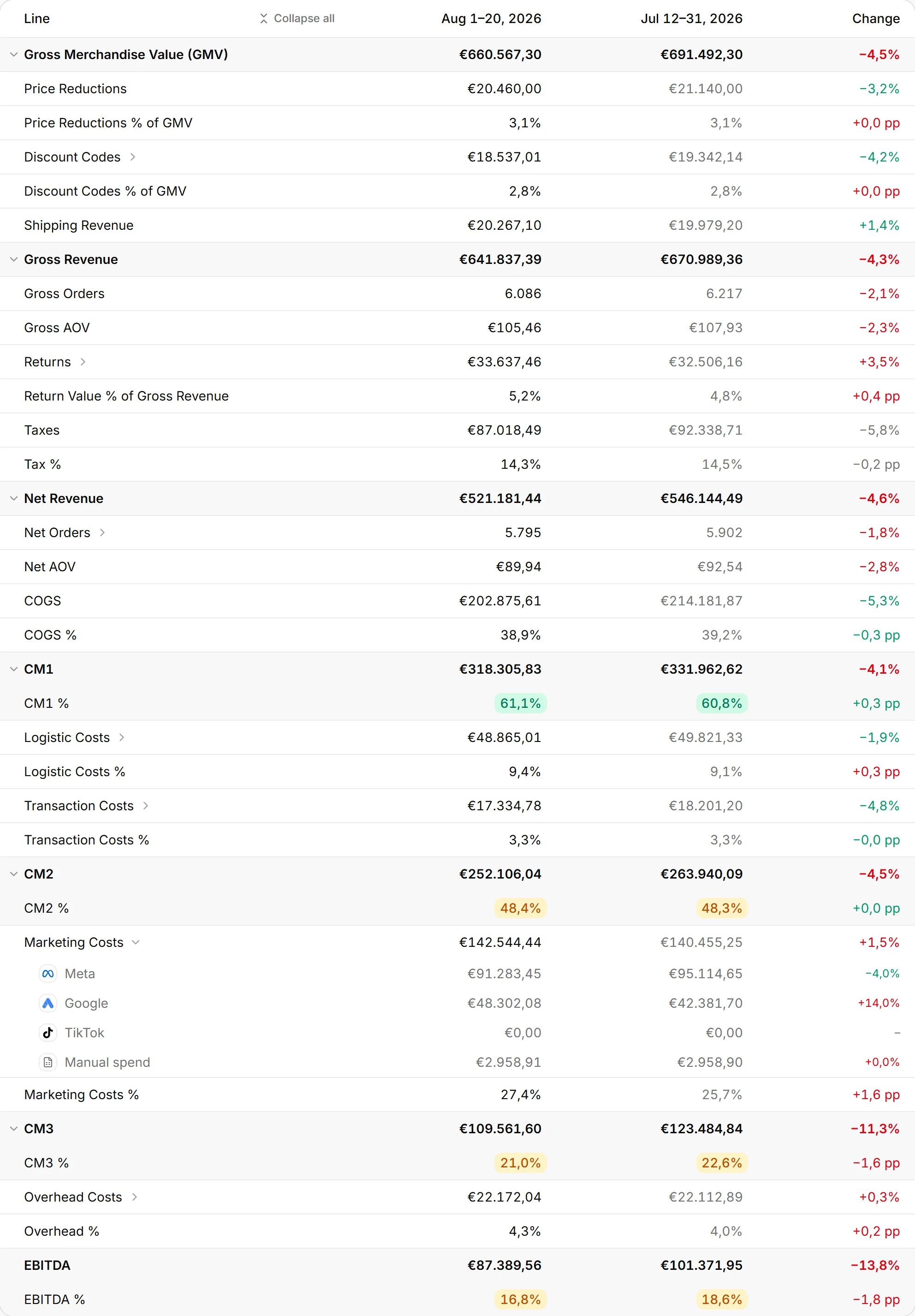
Free, nothing to sign up forLines 19 to 33 of a nouz P&L
Lowest price that still pays for everything
€68,26
19Covers the goods
€22,02
and nothing else
25Covers the order
€30,32
parcel and fee too
29Covers the customer
€56,19
advertising too
What one unit has to carry
€
€/order
%
What the store has to carry
€/order
€/order
%
Two numbers most pricing calculators leave out entirely, which is why their answers are always too low.
↑↓ to nudge, Shift for ten. Commas or dots both work.
One unit, at the floor price
19Covers the goods€22,02€18,50 to cover
25Covers the order€30,32€24,90 to cover
29Covers the customer€56,19€46,15 to cover
33Covers the store€68,26€56,06 to cover
A floor is not a price. It is the line under which a sale makes the store poorer, so it belongs in every discount decision and every negotiation, not on the shelf.
Incl. VAT, on the shelf. Below this the unit sells at a loss once the goods, the parcel, the payment fee, the advertising that won the order and its share of the fixed costs are all paid. €57,36 of it is revenue.
An estimate from flat rates. In nouz every order is priced from the costs of its own day.
What this calculator does
What it does
A break-even price calculator finds the lowest price a unit can sell at before the sale costs you money. It solves for the price that covers the goods, the parcel, the payment fee on the gross, the advertising that won the order and the order's share of fixed costs.
The formula
Four floors, because there are four answers.
“What is the lowest I can sell this for” has no single answer, because it depends which costs the price is being asked to carry. Covering the goods is one number. Covering the goods, the parcel and the payment fee is a much bigger one. Adding the advertising that won the order, then its share of the rent, moves it twice more.
Every rung is a real decision. Clearing stock at the second rung is defensible; clearing it below the first is paying people to take it. Quoting a bulk enquiry at the third means the order must be one that needed no advertising to arrive.
One piece of arithmetic matters more than it looks: the payment fee is a share of the FINAL price, so it grows as the price does. A floor built by adding a fee to a pile of costs is always slightly too low, which is why this one divides.
Where it goes wrong
Four reasons a floor turns out to be a ceiling.
Every one of these produces a floor that is too low, which is the dangerous direction to be wrong in.
Only the goods are counted
A price above unit cost feels safe and often is not: the parcel and the fee take a fixed bite that a cheap unit cannot absorb. On a €6,40 parcel, anything under roughly €10 net is losing money before the payment fee is even charged.
The fee added instead of solved
Adding 1,9% of the costs to the costs understates the fee, because the gateway charges 1,9% of the price it actually moves, VAT included. The gap is small per unit and constant in direction, which is exactly the kind of error that never shows up until the month does.
Advertising treated as somebody else's line
If an order needed a paid click to exist, its price has to carry that click. Pricing to a floor without acquisition is how a store discovers that its whole promotional calendar sells at a loss with a healthy-looking gross margin.
A floor used as a price
The floor is the line under which a sale destroys value, not a target. Selling at it means working for nothing, which is occasionally worth doing for dead stock and never worth doing as a strategy.
The calculator’s defaults, and the example store’s own economics: a unit costing €18,50, a €6,40 parcel, a gateway taking 1,9% of the gross, €21,25 of advertising per order and €9,91 of fixed costs per order.
Each rung solves for the price that leaves exactly nothing after the costs it carries, then adds VAT to show what the customer would pay.
The product sells at €49,00, which sits comfortably above the order floor and below the customer floor. That is not a contradiction: it means the unit contributes well, and the store relies on orders that do not each need €21,25 of fresh advertising to arrive.
It also prices the promotional question exactly: a discount that takes this unit under €30,32 is selling at a loss, whatever the volume does.
In the app
nouz works this out from every order, every day.
A calculator works from flat rates you type once. nouz prices every single order from the cost rules that were in force on that order's own date, and rebuilds the same statement every night from your own orders and your own ad spend.
Every cost at the rate of its own day. Product costs, parcels and payment fees per order, so a price change never rewrites last month.
Ad spend comes in by itself. Meta, Google and TikTok through their official APIs, plus anything you add by hand or by CSV.
The same lines, per product. What is left after product costs, after shipping and payment fees, and after ads, for every product you sell.
The price at which a sale leaves you exactly as well off as not selling at all. It is not the unit cost: a price that covers only the goods still loses the parcel, the payment fee, the advertising and the share of rent that order consumed. The floor is whichever of those four rungs you decide the price must carry.
Why is the fee solved rather than added?
Because the payment fee is a percentage of the final price, so it grows as the price does. Adding a percentage of the COSTS to the costs always lands slightly low, and the error scales with the fee rate. The honest version divides by one minus the fee rate, which is the arithmetic this calculator uses.
Should advertising be inside a pricing floor?
If the order needed advertising to exist, yes. A price that covers goods, parcel and fee but not the ad spend that produced the customer is a price that only works for orders you did not pay for. Both rungs are shown here so you can price differently for channels that acquire and channels that merely convert.
What do I do with the number?
Not put it on the shelf. A floor belongs in the decisions where prices move: how deep a promotion may go, what a bulk enquiry can be quoted at, which products can join a sitewide code. Anything below the floor is a sale that makes the store poorer, however good the revenue looks.
Why is my floor higher than I expected?
Usually because two costs that never appear in a pricing spreadsheet are in this one: the advertising per order and the fixed costs per order. Together they are commonly a third of a small basket, and a store pricing without them is pricing to a break-even that only existed when it had no marketing and no rent.
More calculators
Four that go with this one.
Each one is a different question about the same statement. All 32 are free, and none of them asks you to sign up.
nouz computes what each order actually contributed after goods, logistics, fees and its share of the ad spend, so a price that fell through the floor is visible the next morning.