Free calculator
Markup and margin calculator
A cost and a target become a price, net and on the shelf, with the same euro of profit shown as both a margin and a markup so a target can never be hit against the wrong denominator.
A markup and margin calculator turns a unit cost plus a target into a price. Margin measures profit against the selling price and markup measures it against the cost, so the same euro reads as two very different percentages, and this shows both plus the shelf price including VAT.
Your product
Profit as a share of the price you sell at. Never reaches 100%.
Price on the shelf, incl. VAT
€48,92
€41,11 of that is revenue, and €22,61 of it is profit after the goods. The same euro reads as a 55,0% margin or a 122,2% markup, depending on which one you were asked for.
16Net price
€41,11
what a P&L sees
Margin
55,0%
of the net price
Markup
122,2%
of the cost
This price covers the goods and nothing else. The parcel, the payment fee and the advertising still have to come out of the profit above, which is what the pricing floor calculator works out in full.
See the margin you actually got, nightlyThe formula
One profit, two denominators, two answers
Margin divides profit by the price you sell at. Markup divides the same profit by what the unit cost you. Both describe one euro, and the gap between the two percentages widens with every point of profit: 50% margin is 100% markup, 60% margin is 150% markup.
That is why pricing to a target has to name which one it means. Multiplying a €18,50 cost by 1,55 to hit “55%” produces €28,68 and a margin of 35,5%, nearly twenty points short of the target that was set. Dividing by 0,45 produces €41,11 and hits it exactly.
The third trap is VAT. The price the customer sees still contains it, and it was never yours, so a target hit on the shelf price is missed on the statement by roughly a sixth at German rates. Set the target on the net price, then add VAT.
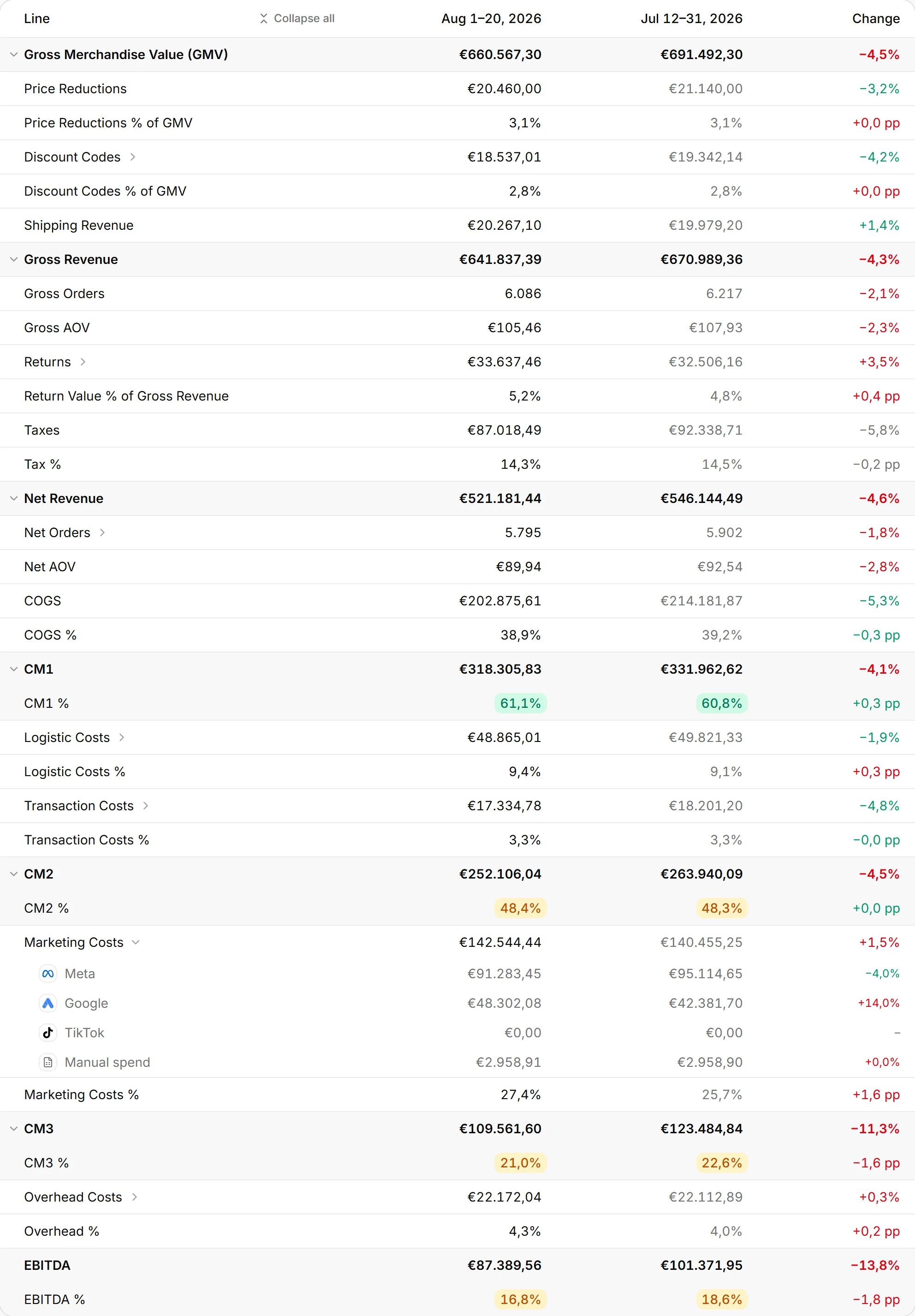
The numbers in the gutter are line numbers on a nouz P&L. A price is set here; what it earned is read there.
Where it goes wrong
Four ways a target margin quietly becomes something else
Each of these produces a price that looks like it hit the target and did not.
Multiplying when you meant to divide
Cost times 1,55 is a markup of 55%, not a margin of 55%. On a €18,50 unit the two land €12 apart, and the multiplied version quietly ships a catalogue priced twenty points under its own target. If a spreadsheet ever produced a suspiciously round price, this is usually why.
Setting the target on the gross price
The tax authority takes its share of every shelf price before you see a cent, so a 55% target hit on €49,00 including VAT is really 46% of the €41,18 that reached your revenue. Enter net targets and let the calculator add VAT afterwards.
A target that ignores the rest of the order
A margin after goods pays for nothing on its own: the parcel, the payment fee, the advertising and a slice of rent all come out of it. A 40% goods margin on a small basket is frequently a loss by the time the parcel ships, which is what the pricing floor calculator is for.
One target across every product
Heavy products, returned products and cheap products all consume more of their margin than a catalogue average suggests. Uniform targets are convenient and reliably wrong at both ends: they overprice what sells easily and underprice what costs most to serve.
Worked example
A €18,50 unit priced for 55%
The calculator’s defaults: a unit costing €18,50, a target margin of 55%, VAT at 19%. Dividing the cost by 0,45 gives €41,11 of net revenue, which puts €48,92 on the shelf.
The €22,61 of profit that produces is a 55,0% margin and a 122,2% markup. Both sentences describe the same coin; only one of them answers a question about the price.
Had the same target been applied as a multiplier, the shelf price would have been €34,13 and the margin 35,5%. That is the entire distance between the two words, on one ordinary product.
What this price does NOT yet cover is the parcel, the fee and the advertising. The floor those impose is the next calculator below.
Questions
Markup and margin, answered
What is the difference between markup and margin?
The denominator, and nothing else. Margin divides the profit by the selling price; markup divides the same profit by the cost. A unit costing €18,50 sold at €41,18 net carries €22,68 of profit either way: a 55,1% margin and a 122,6% markup. Margin can never reach 100%, markup can pass it easily, and that is the fastest way to tell which number you have been handed.
How do I price for a target margin?
Divide the cost by one minus the margin. A €18,50 unit at a 55% target needs €41,11 of net revenue, then VAT goes on top for the shelf price. The mistake to avoid is multiplying the cost by 1,55, which is a 55% markup and lands more than €7 lower, at a margin of only 35,5%.
Why can a margin never be 100%?
Because a 100% margin says the selling price is all profit, which means the goods were free. As the target approaches 100% the required price runs away toward infinity, which is why this calculator refuses the input rather than printing an absurd number. Markup has no such ceiling: tripling your cost is a 200% markup and an ordinary 66,7% margin.
Should I set the target on the gross price or the net one?
The net one, always. VAT is collected for the tax authority and passed straight on, so a margin computed on the shelf price counts somebody else's money as yours and overstates itself by roughly a sixth at German rates. Enter your VAT rate here and the calculator shows both figures: the net price the target was built on, and the price the customer actually sees.
Is a margin after the goods enough to price on?
No, and this is the commonest pricing mistake in ecommerce. A margin after goods still has to pay for the parcel, the payment fee, the advertising that won the order and a share of the rent. On a typical basket those take another fifth of the net price, which is why the pricing floor calculator exists beside this one.
More calculators
Four more, all free, all built on the same statement.
Want the long version rather than the arithmetic? Which products actually make money.
The terms this calculator uses:
The margin you targeted, against the one you got
nouz prices every unit you actually sold at the cost that was effective on its own order date, so the catalogue's real margins stand next to the ones it was priced for.