Free calculator
VAT calculator
The tax divided out of a shelf price or added onto a net one, with the share of the gross it actually represents, which is the number most spreadsheets get wrong.
A VAT calculator divides the tax out of a gross price or adds it to a net one. Dividing matters: at a 19% rate the tax is 15,97% of the gross price, so subtracting 19% from a shelf price removes too much and understates the revenue every margin is measured against.
Your amount
What the customer pays. The tax comes out of it.
Net, without the VAT
€41,18
€7,82 of €49,00 is the tax authority’s, which is 16,0% of the gross price rather than the 19,0% rate itself. Only the €41,18 is revenue.
14Net
€41,18
your revenue
12VAT
€7,82
collected, not earned
Gross
€49,00
what is paid
The trap this page exists for: taking 19,0% off a gross price is not how VAT comes out. It is divided out, not subtracted, and the difference on this amount is €1,49.
See every margin computed net, nightlyThe formula
19% of the net is 15,97% of the gross
VAT is charged on the net price, which makes the gross 119% of it at a 19% rate. So the tax inside a shelf price is 19 ÷ 119 of what the customer paid, not 19 ÷ 100. Subtracting the rate from a gross price removes about a fifth too much and quietly understates the revenue every margin is measured against.
The correct move is a division: gross ÷ 1,19 is the net, and the difference is the tax. It is one keystroke away from the wrong answer, which is exactly why it survives so long inside pricing spreadsheets.
The rule underneath the arithmetic matters more than the arithmetic. VAT is collected for the tax authority and passed on. It sits in your bank account looking exactly like your money for weeks, and it was never yours for a moment.
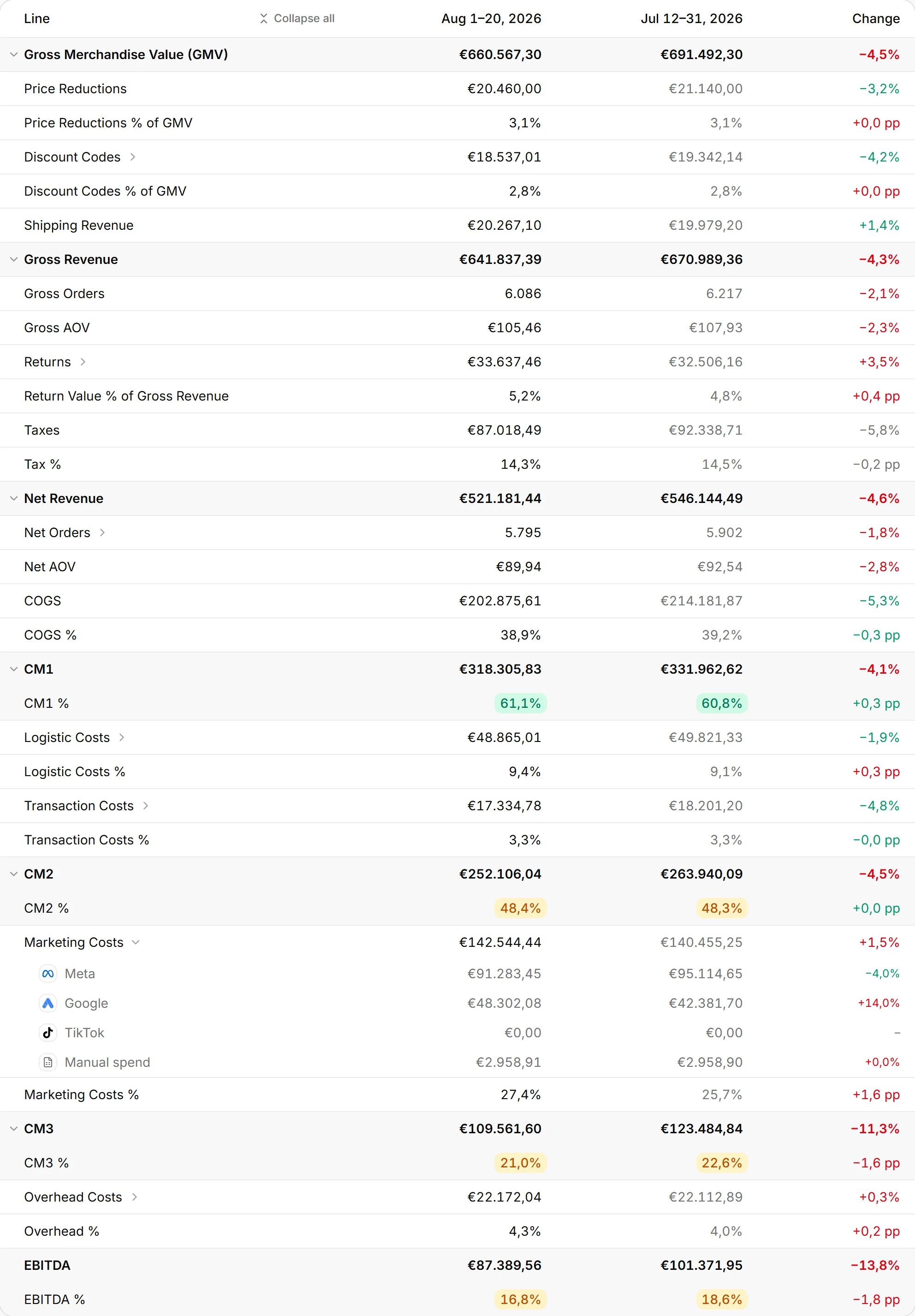
The numbers in the gutter are lines 12 and 14 of a nouz P&L: the tax, and the revenue that survives it.
Where it goes wrong
Four VAT habits that misstate a whole month
All four are small per order and completely systematic, which is the combination that does the most damage over a year.
Subtracting the rate from a gross price
€49,00 minus 19% is €39,69. The correct net is €41,18. The error is €1,49 on one unit and always in the same direction, so a catalogue priced this way is wrong everywhere by a consistent amount that no single check will surface.
Computing margins on the gross price
A 55% margin measured on the shelf price is roughly 46% on the revenue that actually reached you. Every downstream decision, pricing, discounting, ad budgets, inherits the error, and the store believes it has room it does not have.
Treating the VAT in the bank as spendable
Roughly a sixth of every gross euro in the account belongs to the tax authority and leaves in a lump when the declaration falls due. A store reading its balance as its own money overestimates itself by the tax rate every single day until that morning.
Applying the payment fee to net revenue
The gateway charges on the gross it moved, VAT and shipping included, so a fee computed against net revenue is always a little low. It is one of the small systematic gaps that make a spreadsheet P&L drift away from the bank statement.
Worked example
A €49,00 shelf price at 19%
The calculator’s default: the example store’s own product, priced at €49,00 on the shelf, in a market with a 19% standard rate.
Dividing by 1,19 gives €41,18 of revenue. The remaining €7,82 is the tax authority’s, which is 15,97% of what the customer paid rather than 19% of it.
On a store selling a thousand of these a month, the wrong method understates revenue by roughly €1.490 monthly, which is enough to turn a healthy product into an apparent problem and trigger exactly the wrong decision.
The same division runs the whole revenue bridge, from ticket price down to the figure every cost percentage uses, which is the next calculator below.
Questions
VAT, answered
How do I remove VAT from a price?
Divide by one plus the rate, never subtract the rate. At 19%, a €49,00 shelf price is €49,00 ÷ 1,19 = €41,18 of revenue and €7,82 of tax. Subtracting 19% instead gives €39,69, which is €1,49 too low on one product and enough to misprice a whole catalogue.
Why is the VAT share of a gross price smaller than the rate?
Because the rate is charged ON the net price, not on the total. A 19% rate makes the gross 119% of the net, so the tax is 19 ÷ 119 of what the customer pays: 15,97%. It is the same money described from two ends, and mixing them up is the most common arithmetic slip in ecommerce pricing.
Is VAT revenue?
No. It is collected on behalf of the tax authority and passed on, so it was never yours even while it sits in your bank account. Every margin, every cost percentage and every break-even figure has to be computed on the net amount, which is why a statement takes the tax out before it does anything else.
Which rate should I use?
The one that applies to your product in the market where the customer is, which is a question for your accountant rather than for a table on a marketing site. Many countries carry reduced rates for particular categories, and cross-border distance selling has its own rules, so this calculator takes the rate as an input rather than assuming it.
Does the payment fee apply to the gross or the net?
The gross. The gateway charges its percentage on the amount it actually moved, which includes the VAT and any shipping the customer paid, so the fee is always slightly larger than a calculation on net revenue suggests. It is a small systematic error, and it always runs in the same direction.
More calculators
Four more, all free, all built on the same statement.
Want the long version rather than the arithmetic? How to calculate your true profit.
The terms this calculator uses:
Every margin computed net, without you thinking about it
nouz takes VAT out on line 12 of every statement it builds, so no percentage anywhere in the product is ever measured against money that was never yours.