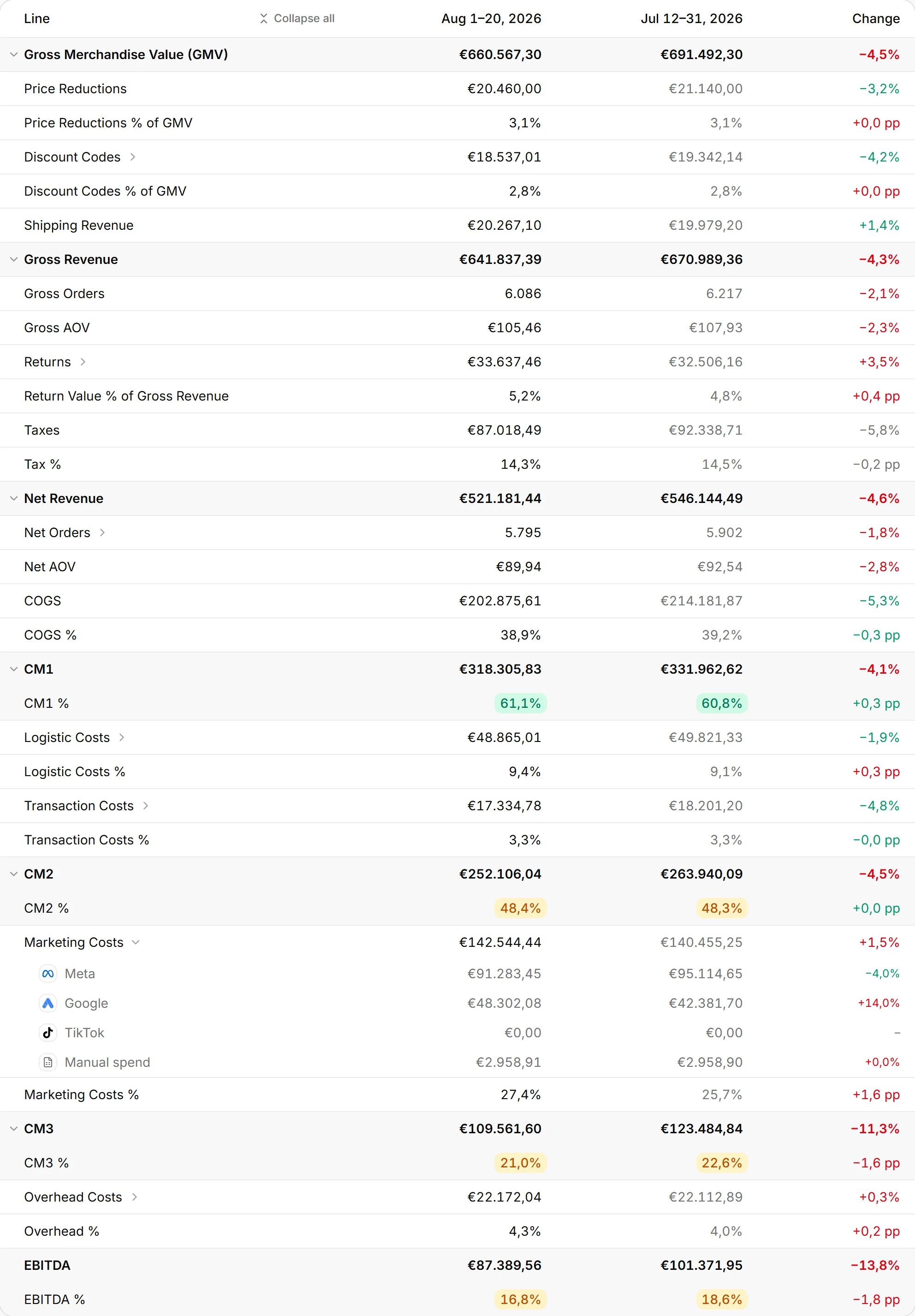
The bridge a dashboard never draws: ticket price down through reductions, codes, shipping, returns and VAT, to the one figure every cost percentage is measured against.
Free, nothing to sign up forLines 1 to 14 of a nouz P&L
Net revenue, the only honest denominator
€51.596,64
7Gross revenue
€69.400,00
after discounts
12VAT
€9.803,36
on what was kept
14Net revenue
€51.596,64
what a P&L uses
Your period
€
€
€
€
What came back
€
%
Refunds belong to the day they were issued, so this is the period's own refunds rather than refunds of the period's own orders.
↑↓ to nudge, Shift for ten. Commas or dots both work.
The statement
1Gross sales, at ticket price€72.000,00
2Price reductions−€1.800,00
4Discount codes−€3.200,00
6Shipping charged€2.400,00
7Gross revenue€69.400,00100,0%
10Returns−€8.000,00
12VAT, collected for the tax office−€9.803,36
14Net revenue€51.596,6474,3%
Two rules do most of the work here. Discounts come off before the tax, and the tax is computed on what was KEPT, so a refunded order hands back its VAT along with its revenue.
71,7% of the ticket price survived the bridge. Every cost percentage on a statement is measured against this figure, never against the €72.000,00 at the top.
An estimate from flat rates. In nouz every order is priced from the costs of its own day.
What this calculator does
What it does
A net revenue calculator walks gross sales down to the figure a P&L works from: price reductions and discount codes come off, shipping charged goes on, then returns and the VAT contained in what was kept. What survives is net revenue, the denominator for every cost percentage.
The formula
Six movements between the two numbers.
“Revenue” is at least three different numbers in any store, which is why two reports of the same month rarely agree. The ticket price of what was ordered, the amount actually charged after reductions and codes, and the figure that survives refunds and tax are three separate quantities, and only the last one can carry a margin.
The order of operations matters. Discounts come off before the tax, because tax is charged on what was actually paid. Refunds come off before the tax as well, because a refunded order hands its VAT back too. Compute the tax on gross sales and the bridge overstates both what you owe and what you kept.
What survives is net revenue, and it is the denominator for every cost line below it on a statement. Percentages measured against anything higher up describe a bigger store than the one you have.
Where it goes wrong
Four ways a top line describes a bigger store.
Each of these leaves revenue looking larger than the money that actually stayed.
Reporting the ticket price as revenue
Gross sales at full price is a measure of ambition, not of trade. Between it and the money you kept sit reductions, codes, returns and tax, which together commonly take a quarter or more of the number a dashboard leads with.
Netting refunds backwards
Booking a refund against the month of its original order rewrites a closed period, so last month improves every time this month bleeds. Refunds belong to the day they were issued, full stop, and the discipline is what makes a statement’s history trustworthy.
Counting gift card sales as revenue
A gift card sale is a liability: money held until the card is spent. Revenue happens on redemption, where the card is just a payment method. Counting both is a straightforward way to report a month that never happened.
Leaving test and cancelled orders in
Both sit in raw exports and neither is trade. A handful of test orders is noise; a cancelled bulk order is a headline. Filter them once, at the top of the bridge, rather than wondering later why two reports disagree.
The calculator’s defaults: €72.000 of goods at ticket price, €1.800 sold below it, €3.200 of codes, €2.400 of shipping charged, €8.000 of refunds issued, VAT at 19%.
Reductions, codes and shipping give €69.400 of gross revenue. Refunds take it to €61.400, and dividing that by 1,19 leaves €51.596,64 of net revenue with €9.803,36 of tax.
About 71,7% of the ticket price reached the statement. A store measuring its cost of goods against the €72.000 rather than the €51.596,64 would report a cost share 28% lower than the truth, and would believe it had room for an ad budget it cannot afford.
From here every cost comes off in order, which is what the contribution margin calculator below picks up.
In the app
nouz works this out from every order, every day.
A calculator works from flat rates you type once. nouz prices every single order from the cost rules that were in force on that order's own date, and rebuilds the same statement every night from your own orders and your own ad spend.
Every cost at the rate of its own day. Product costs, parcels and payment fees per order, so a price change never rewrites last month.
Ad spend comes in by itself. Meta, Google and TikTok through their official APIs, plus anything you add by hand or by CSV.
The same lines, per product. What is left after product costs, after shipping and payment fees, and after ads, for every product you sell.
What is the difference between gross revenue and net revenue?
Gross revenue is what was ordered after discounts and including the shipping you charged, with the tax still in it. Net revenue is what is left after refunds and after the VAT comes out. The gap between them is routinely a quarter of the top line, which is why a margin computed against gross revenue is always flattered.
Which day do refunds belong to?
The day the refund was issued, not the day of the original order. Netting a refund backwards rewrites a month you already closed, so every past period improves whenever the present one bleeds. Booking it forward keeps history still, which is the whole point of having a statement rather than a running total.
Should shipping I charge count as revenue?
Yes, on the revenue side, and the cost of actually shipping counts on the cost side. Treating charged shipping as a pass-through that cancels its own cost hides both, and the two are rarely equal: most stores under-recover shipping, and the gap only becomes visible when both halves are on the statement.
Why is the VAT calculated on what was kept?
Because a refunded order hands its tax back too. Charging tax on the full gross sales and then subtracting refunds separately overstates what you owe and understates what you kept. Taking the tax out of gross revenue minus returns is what a correct statement does, and it is what this calculator does.
Do gift cards belong in gross sales?
No. Selling a gift card is not revenue, it is a liability: money held until the card is spent. The revenue happens on redemption, where the card is simply a payment method. Counting the sale and the redemption both is one of the easier ways to overstate a month by a genuinely large amount.
More calculators
Four that go with this one.
Each one is a different question about the same statement. All 32 are free, and none of them asks you to sign up.
nouz computes lines 1 to 14 from the orders themselves, with refunds on their issue day and gift cards treated as the liability they are, so the denominator under every percentage is always the real one.