VAT left in the takings
The European mistake, and the one US-built calculators make by design. At a 19% rate the tax is 16,0% of everything a customer pays, so leaving it in turns the tax office’s money into profit on every order.
Free calculator
What your store actually made this month, from what customers paid down to EBITDA. Refunds come off first, the VAT inside what you kept comes out next, and every cost lands on the line of a real P&L it belongs to.
What the month left you, EBITDA
€7.285,00
14Net revenue
€57.000,00
after refunds and VAT
29CM3
25,1%
kept after the ads
With VAT left in
€18.115,00
what a US-built calculator shows
What customers paid
European prices: the VAT comes out of what you kept, after refunds.
What the month cost
↑ ↓ to nudge, Shift for ten. Commas or dots both work.
€10.830,00 of the €73.780,00 customers paid was VAT, taken out of what you kept after the €5.950,00 of refunds. Leave it in, as calculators built for US sales tax do, and the same month reads €18.115,00 instead of €7.285,00. The payment fees of €1.575,00 were charged on the full amount paid, which is how a gateway charges them.
You keep €9,87 of every €100 customers paid, VAT and shipping included: €10,41 kept on an average order.
An estimate from flat rates. In nouz every order is priced from the costs of its own day.
A Shopify profit calculator starts from what customers paid and works down to what the month left you. This one takes refunds out, then the VAT inside what you kept, then the goods, shipping and packing, payment fees, ad spend and overhead, and shows every step as a line of a real P&L, ending in EBITDA.
The method
A Shopify store’s takings are not its revenue. What customers paid holds three things that were never margin: the refunds still to go back, the VAT collected for the tax office, and the shipping the store charged on behalf of a carrier it still has to pay.
So the statement starts where the money starts, with products after discounts plus shipping charged, and takes refunds out on the day they were issued. The VAT comes out of what was kept, never out of what was sold, which is why a refunded order hands its tax back as well as its revenue.
What survives is net revenue, and every cost after it is measured against it: the goods for CM1, shipping, packing and payment fees for CM2, advertising for CM3, overhead for EBITDA. Calculators built for US sales tax skip the VAT step, because in the US it was never in the price. In Europe it always is.
This page prices a whole month of a store. To price one product, its margin and markup, use the profit margin calculator instead.
Where it goes wrong
Three of these make the month look better than it was, and one makes it look worse. None of them shows up as an error anywhere.
The European mistake, and the one US-built calculators make by design. At a 19% rate the tax is 16,0% of everything a customer pays, so leaving it in turns the tax office’s money into profit on every order.
Taking the tax out of gross sales and subtracting refunds afterwards charges VAT on orders that were handed back. It understates profit and overstates the tax, and it is why a P&L built that way never agrees with the VAT return.
A gateway takes its percentage of what it moved, VAT and shipping included, plus a fixed fee per payment. Applying the rate to net revenue understates every fee, and it keeps the fee when the order is refunded.
Shopify’s profit reports stop at net sales minus a static cost field, and only for products with a cost entered. Shipping labels, payment fees, advertising and overhead all sit below that line, and they decide whether the month made money.
Worked example
The calculator’s starting month: 700 orders, €71.400 of product sales and €2.380 of shipping, all at 19% VAT, with €5.950 refunded in the month.
The goods cost €21.660, a parcel €6,40, the gateways 1,9% plus €0,25 a payment, the ads €15.000 and the fixed costs €7.000.
Customers paid €73.780 and the month kept €7.285, which is €9,87 of every €100 they paid.
Leave the VAT in and the same month claims €18.115 of profit, 2,5 times the real figure. Nothing in that month changed except whose money the tax was counted as.
In the app
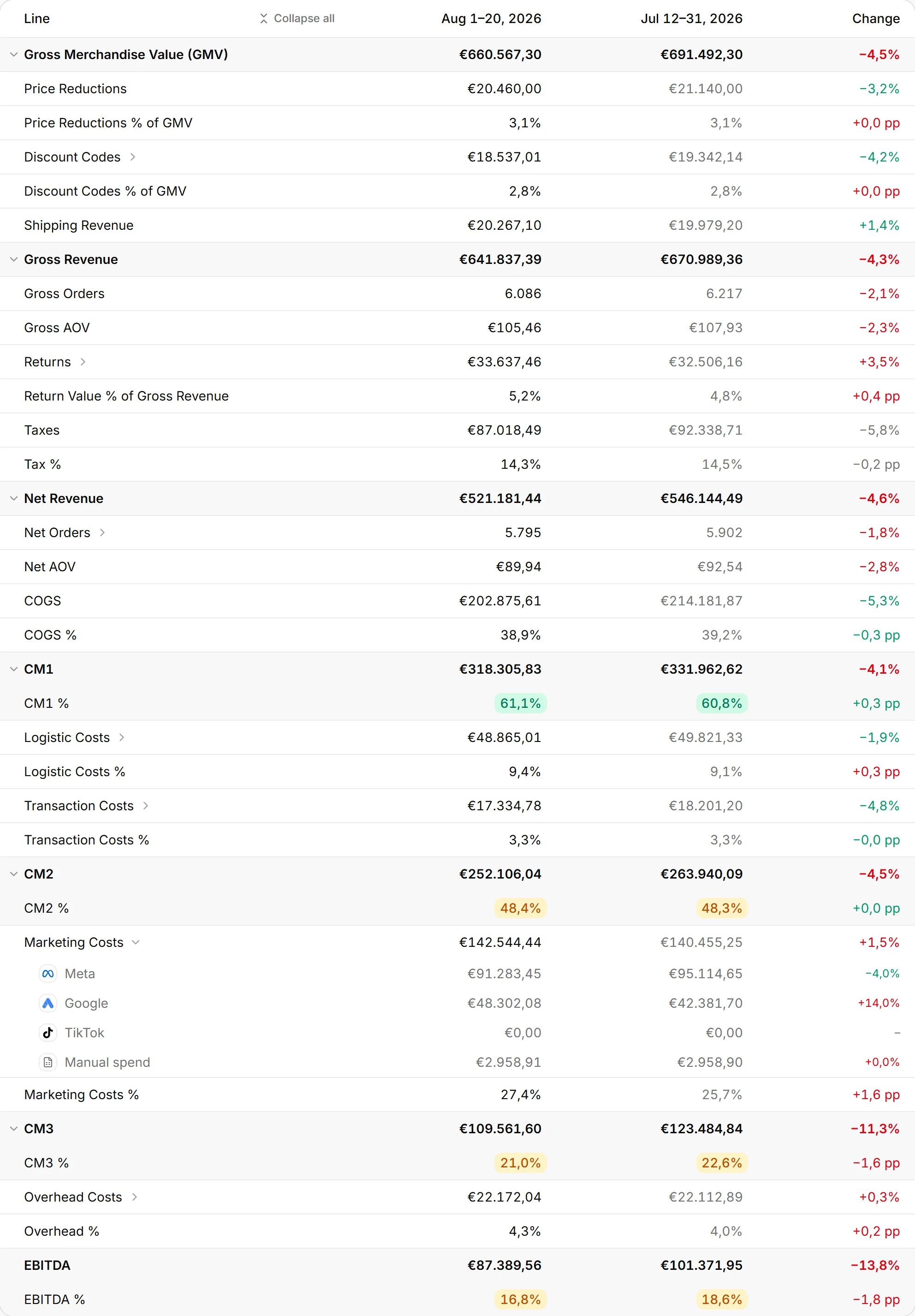
A calculator works from flat rates you type once. nouz prices every single order from the cost rules that were in force on that order's own date, and rebuilds the same statement every night from your own orders and your own ad spend.
More calculators
Each one is a different question about the same statement. All 32 are free, and none of them asks you to sign up.
All calculatorsThe terms this calculator uses
The long version
Want the long version rather than the arithmetic?
Of a €49 price€15,35remains after VAT, goods, parcel, fee13 min readHow to calculate your Shopify store's true profit, step by stepStrip the VAT, price the goods, subtract parcel, fees and ad spend, then spread the fixed block: the full method for computing what your Shopify store actually keeps.How to calculate your true profitnouz builds this P&L for your store from Shopify itself: every order, refund and payment, your own cost rules and your ad spend, priced every night down to EBITDA, so nobody types a month in again.