Ratios and unit economics

Unit economics

Whether one order makes money, before anything is scaled.

Updated

The short answer

Unit economics is the profitability of a single order or a single product rather than of a period: what one sale earns after the costs it causes. It is the level at which growth is decided, because scaling a business with negative unit economics multiplies the loss rather than diluting it.

A store with healthy unit economics and a bad month has a volume problem, which more sales fix. A store with weak unit economics and a good month has a structural problem, which more sales make worse. The two look identical on a revenue chart and require opposite responses.

The walk is short: net price, minus goods, minus the parcel and the payment fee, minus the advertising the order needed. What survives is what the order contributed towards rent, salaries and profit, and the arithmetic works on a single product as readily as on a whole store. The SKU margin sheet runs it for every product in one file.

It is also the honest test for a price change, a new channel or a discount: each of them changes the unit before it changes the total, and the total is where the change becomes visible far too late. Margin-based pricing runs the same walk backwards, from the margin a product must keep to the price it needs.
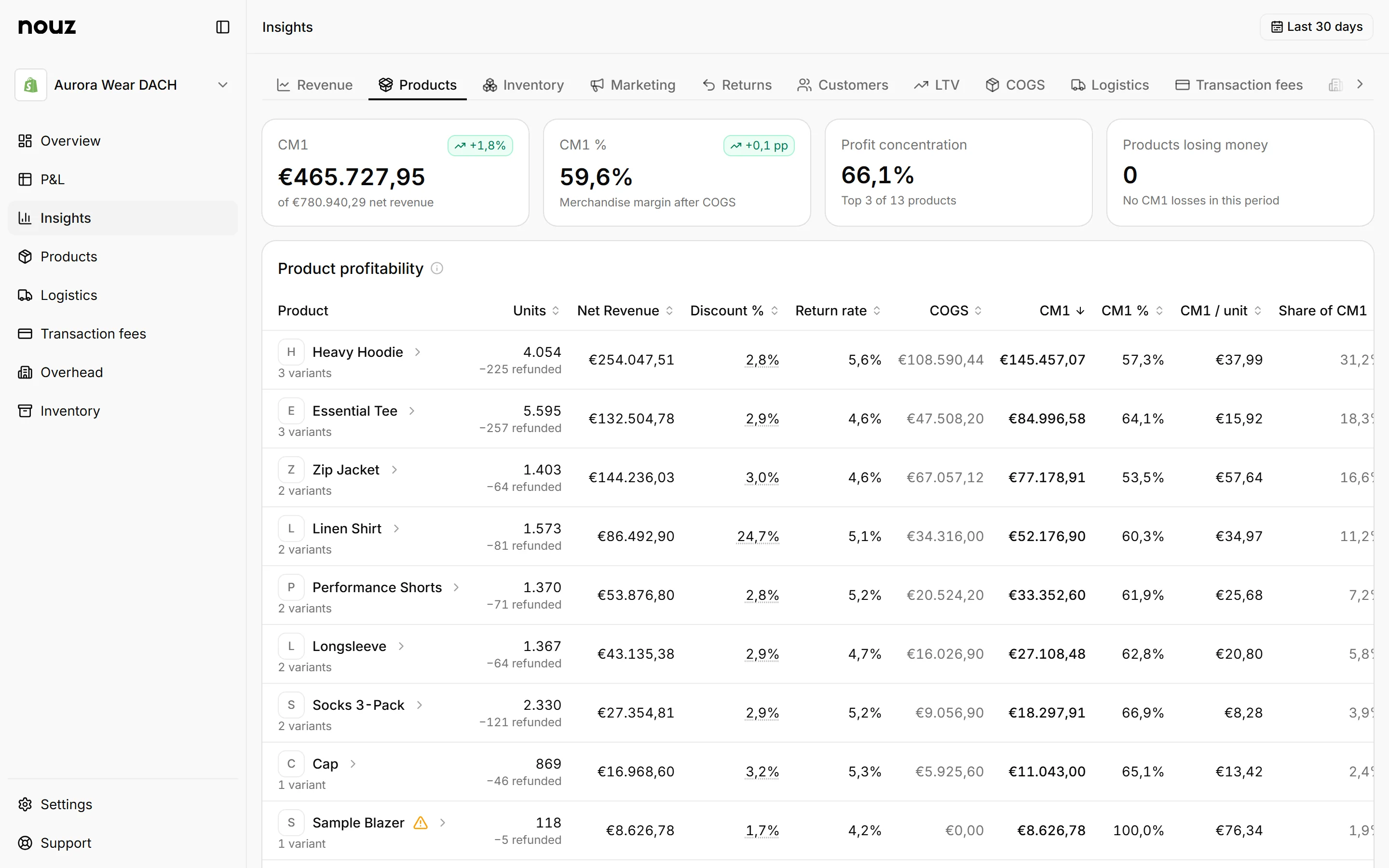
Where you see it in nouz

Insights, the Products tab, per product, from CM1 down to EBITDA.

app.nouz.co/insights
CM1 per unit for each product, Insights, Products tab, last 30 days.

See this on your own store, every morning.

Install nouz in minutes from the Shopify App Store. It builds your whole statement from your own orders, refunds and costs, every night, and imports every order your store has ever taken.

Your trialToday
14 days of nouz, every feature€0,00
Card needed to startNone
Access to your storeRead-only
Due today€0,00