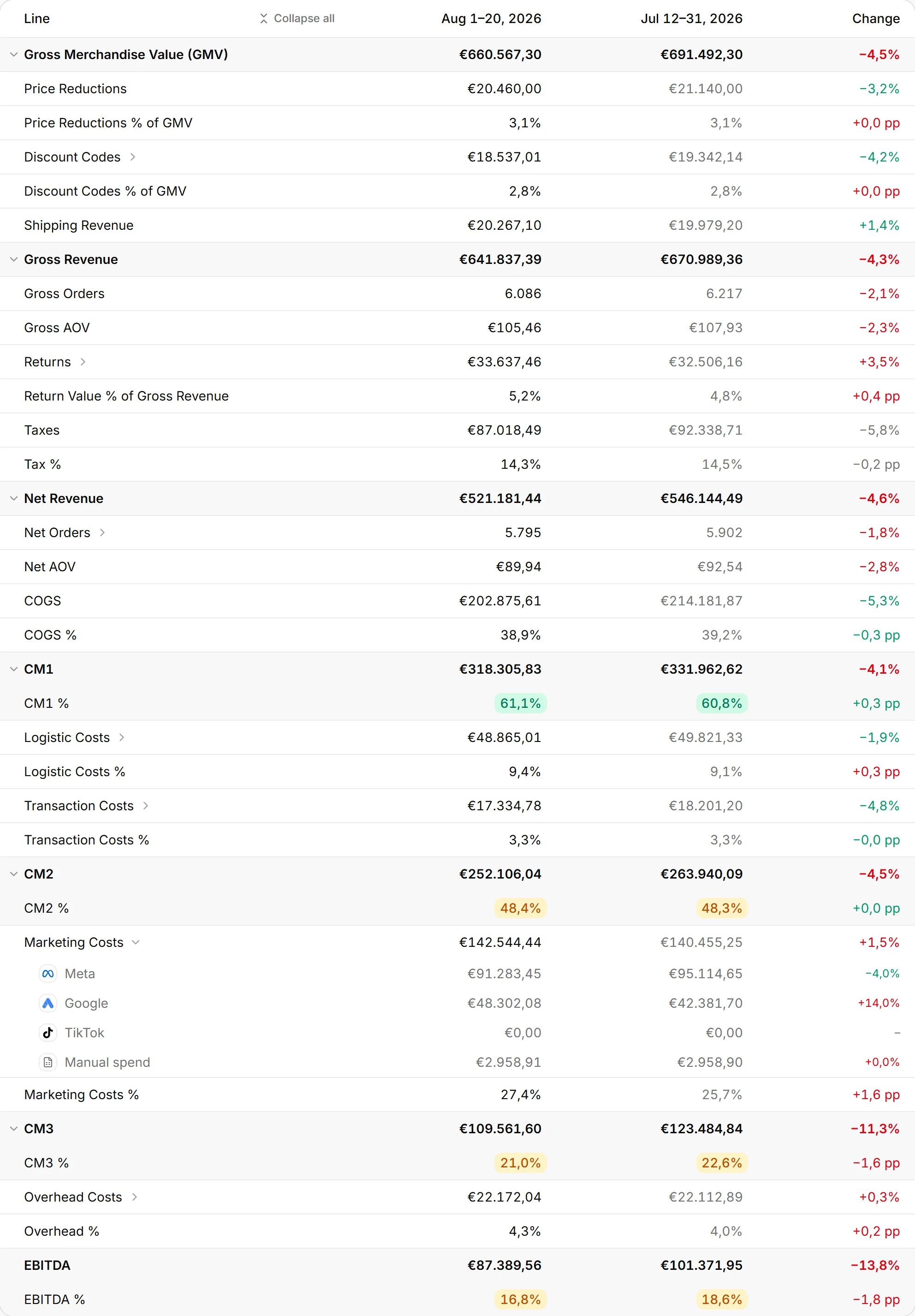
CM1 is the first contribution margin: net revenue minus the cost of goods sold. It answers whether the products themselves make money, after VAT, discounts and returns are out and before anything is shipped, charged or advertised. On a nouz statement it is line 19.
CM1 is the ceiling on everything below it. If CM1 is thin, no amount of marketing efficiency or shipping negotiation will save the month, because there was never enough margin to pay for winning the customer. A store that knows only one margin should know this one second and net revenue first. When it is thin, there are five ways to raise CM1 without touching your prices.
On the example store the calculators use, an €85 order carries €32,30 of goods at a 38% cost share, so CM1 per order is €52,70, or 62% of net revenue. Read that per product rather than only in total: one heavily discounted line can pull the whole figure down while the rest of the catalogue is healthy. The per-product view is also where price rises get tested, because five euro more on a mid-seller moves CM1 further than most cost projects manage in a quarter. How much volume a rise can afford to lose is the subject of the price rise playbook.
Two recognition rules keep the number honest. The units sold on a day are priced at the unit cost effective on that day, so a supplier increase in April never re-prices March. And when an order is refunded, the cost credit is valued at the original order's cost rule, so the credit exactly reverses the original debit and a price change between order and refund cannot invent margin out of nothing. Both rules exist for the same reason: line 19 is only worth reading if no later event can quietly rewrite it.
The most common way CM1 goes wrong is quieter than either: a missing unit cost silently treated as zero, which reports margin you do not have. nouz flags uncosted products instead of guessing, because a wrong number is worse than a missing one.
For how CM1 sits against the two margins below it, and which decision each one drives, see CM1, CM2 and CM3 explained.