Free calculator

Wholesale price calculator

Two margins in one chain: what you charge a stockist, what their own margin puts on the shelf, and whether the price on your own site leaves them anywhere to stand.

A wholesale price calculator chains two margins: yours on the unit you sell to a stockist, and theirs on the unit they sell to a customer. It returns the wholesale price, the shelf price their margin implies, and how that compares with the price on your own site.

Your product

Your own shop

The comparison that decides whether stocking you is viable: a retailer cannot sell above a price you already beat.

Your wholesale price, per unit

€30,83

Net of VAT, €12,33 of it yours. At the retailer's margin that puts their shelf price at €73,38 incl. VAT.

19You keep

€12,33

per wholesale unit

They keep

€30,83

per unit sold

Their shelf price

€73,38

incl. VAT

Your unit cost−€18,50
Your wholesale margin€12,3340,0%
Wholesale price, net€30,83
The retailer's margin−€30,8350,0%
Shelf price, incl. VAT€73,38

Their shelf price sits €24,38 above your own, so a stockist cannot match you and will notice. Either your own price rises, their margin falls, or the two channels carry different products.

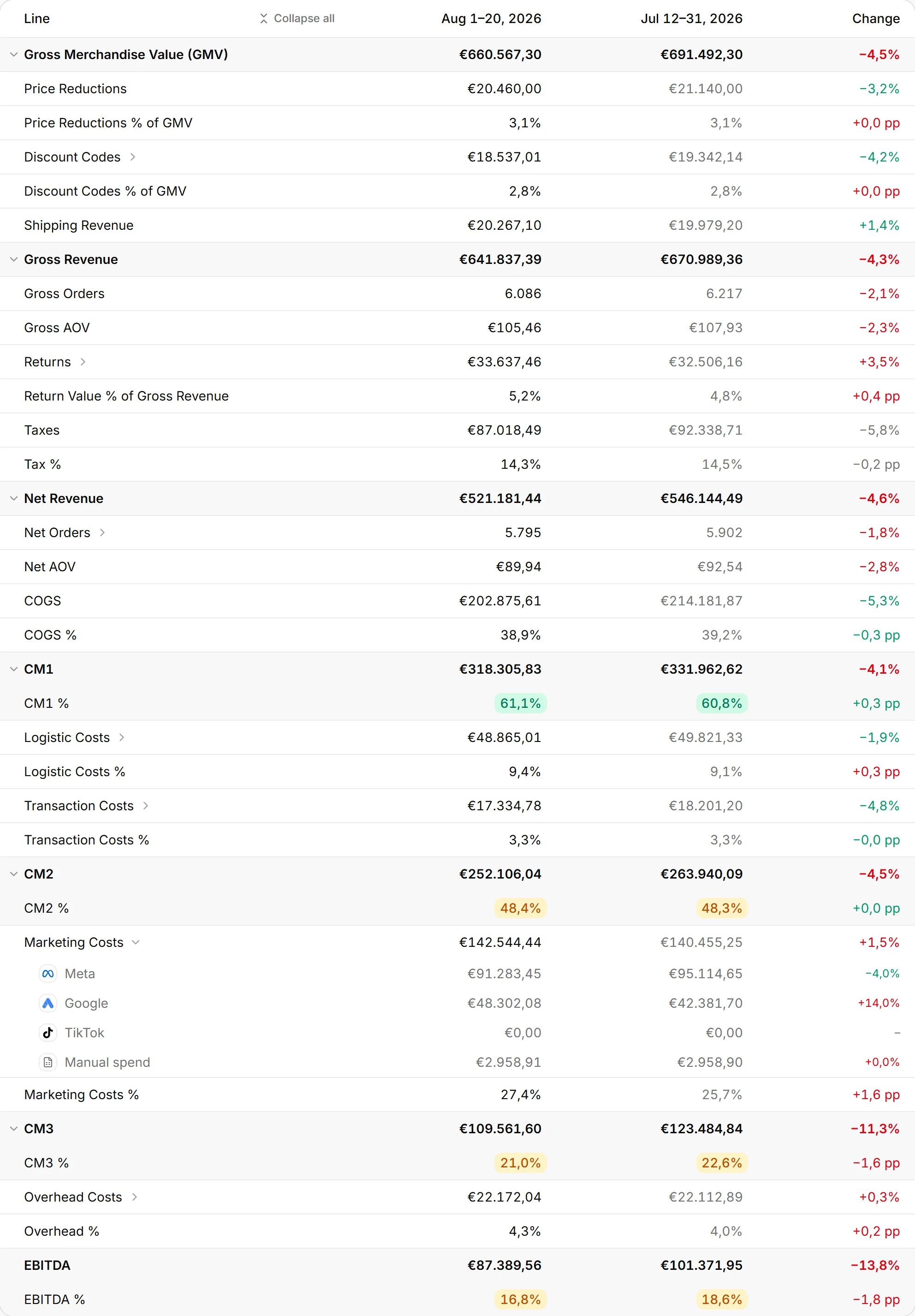
Track both channels on one statement

The formula

Two margins, one shelf price at the end

A wholesale price is not a discount off your retail price. It is your cost with your own wholesale margin on it, and it has to survive a second margin being applied on top by whoever stocks you. Two divisions, in order, and the shelf price at the end is the number that decides whether the arrangement works for either party.

That end price is the test almost every first wholesale conversation fails. Give a stockist half of their selling price, take a healthy margin yourself, and the shelf price routinely lands well above your own site, where the same customer can buy the same product cheaper today.

The resolution is a decision, not a formula: raise your own price, take a thinner wholesale margin, or give the channel something the other channel does not sell. What is not available is hoping nobody compares.

16Wholesale pricecost ÷ (1 − your margin)
19You keepwholesale − cost
Their shelf pricewholesale ÷ (1 − their margin)
On the shelf× (1 + VAT)

Trade prices are quoted net, so VAT appears once: on the price the final customer pays.

Where it goes wrong

Four ways a wholesale deal quietly costs you money

Wholesale margins look thin next to retail ones, which is why they are so often set by feel and so rarely by arithmetic.

  1. Pricing wholesale as a discount off retail

    “Trade is retail minus 40%” anchors your trade price to a number set for a completely different cost structure. Build it from the cost upward instead, and the question becomes what a wholesale unit must earn rather than what a retail one happened to charge.
  2. Comparing the two margins as if they were equal

    A 40% wholesale margin is not worse than a 55% retail one. Wholesale units carry no parcel to a consumer, no payment fee on a card, no advertising and no returns handling. Per hour of your time a pallet at 40% frequently beats a fortnight of direct orders at 55%.

  3. Forgetting the costs wholesale does carry

    Trade orders bring their own: bulk packing, freight, credit terms that finance the retailer for sixty days, samples, trade shows and the occasional bad debt. Thin those out of a thin margin and a big order can contribute less than the invoice suggests.

  4. Letting the two channels sell one product

    If your shelf price undercuts your own stockist, they will discover it, and the relationship ends over it. Different sizes, bundles or exclusive lines per channel are the usual answer, and they cost far less than the conversation you avoid by having them.

Worked example

A €18,50 unit through both margins

The calculator’s defaults: a unit costing €18,50, a 40% wholesale margin for you, a 50% margin for the retailer, VAT at 19%, against your own shop price of €49,00.

Your trade price is €30,83 net, of which €12,33 is yours. Doubling it for the retailer’s margin gives €61,66 net, which is €73,38 on their shelf.

Their shelf sits €24,38 above your own, so no stockist can match you and the arrangement is unstable as it stands. Three honest ways out: raise your own price toward theirs, drop your wholesale margin so their shelf lands nearer €49, or sell them a product your own site does not carry.

Note what the arithmetic did NOT do: it did not say the deal is bad. €12,33 on a unit that costs you nothing to advertise, ship to a consumer or process a card for can be excellent business.

17Your unit cost€18,50
19Your wholesale margin · 40%€12,33
16Wholesale price, net€30,83
The retailer's margin · 50%€30,83
Their shelf price, incl. VAT€73,38
Your own shop price€49,00

Questions

Wholesale pricing, answered

How do I calculate a wholesale price?

Divide your unit cost by one minus the margin you need on wholesale units. At €18,50 and a 40% wholesale margin, the price is €30,83 net, of which €12,33 is yours. Then the retailer applies their own margin on top, and the resulting shelf price is the number that decides whether the arrangement is viable for either of you.

What margin do retailers expect?

Around half of their selling price is a common expectation in many consumer categories, though it varies widely by trade and by how much work the retailer does. The number that matters is not the convention but the arithmetic it forces: their margin sets the shelf price, and the shelf price has to survive comparison with your own site.

What if the retail price ends up above my own shop price?

That is the usual outcome of a two-margin chain, and it is a decision, not an accident. Either you raise your own price, accept a thinner wholesale margin, give the retailer a different product or size, or accept that the stockist is buying reach rather than price. What you cannot do is pretend the stockist will not notice.

Should my wholesale margin match my retail margin?

No, and expecting it to is what kills most wholesale plans. Selling direct carries costs wholesale does not: the parcel to the customer, the payment fee, the advertising. Selling wholesale carries far fewer of them per unit, so a thinner margin on a bigger, cheaper-to-serve order can contribute more per hour of your time than a fat direct margin.

Does VAT belong in these figures?

Wholesale prices are quoted net between businesses, so both margins here are computed on net figures. VAT appears only once, on the shelf price the consumer sees, which is why that is the single gross number in the chain. Cross-border trade inside the EU adds reverse charge rules, which change the paperwork rather than these margins.

Both channels, on one statement

nouz prices every order by its own costs, so trade orders and direct orders sit on the same P&L with their real margins rather than one blended average that flatters both.