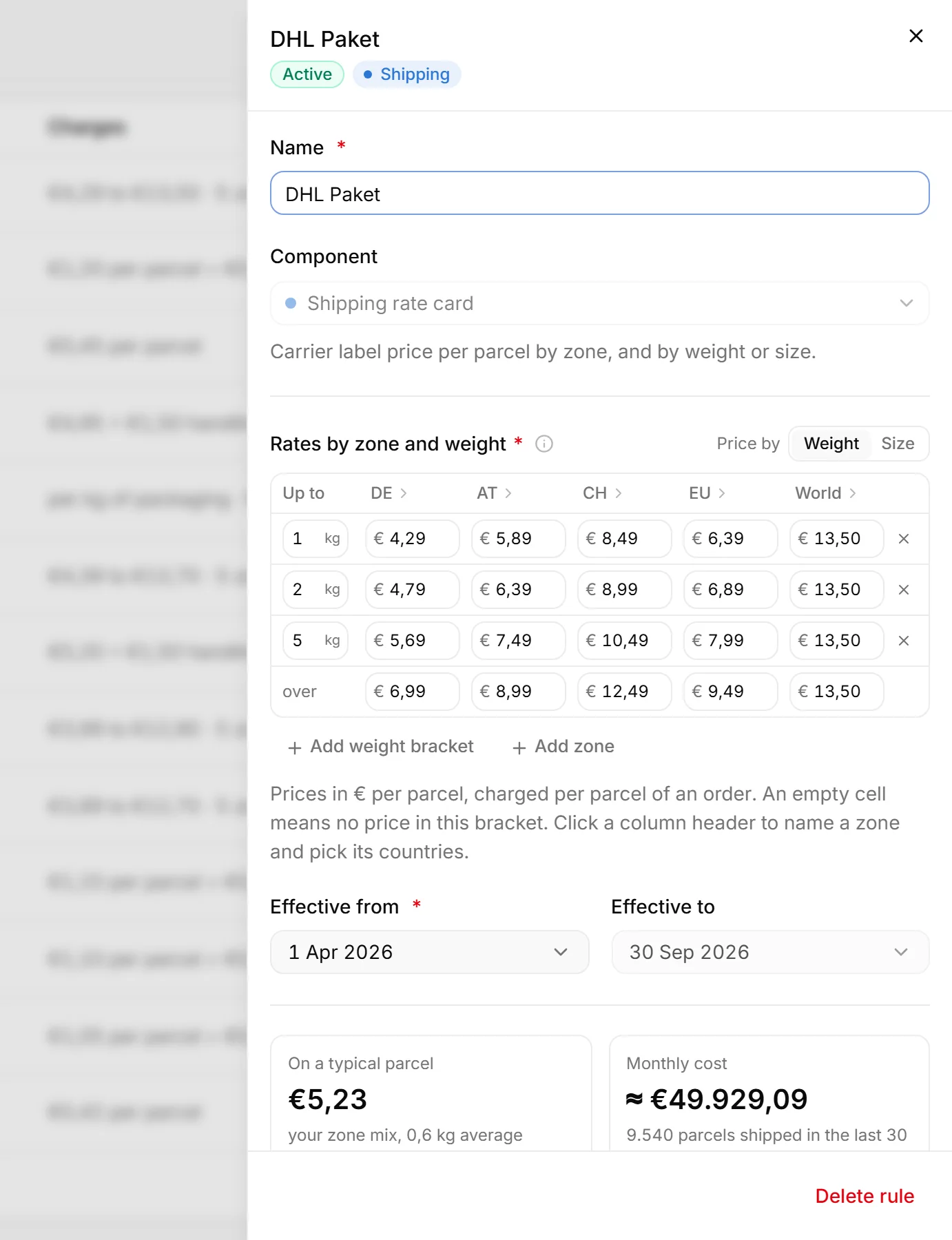
Pricing per bracket rather than per kilo changes packaging decisions. A parcel sitting just under a boundary is efficient, and one sitting just over it is paying a full band for a few grams, which is a genuinely common and genuinely fixable waste. The other fix is at the source: negotiating a carrier rate card with the arithmetic in hand.
Missing weights are the practical problem. A variant with no weight recorded cannot be placed in a bracket, so the engine falls back to the zone's flat price and flags the gap rather than guessing, because a guessed weight silently misprices every order containing that product. Shopify's default weight of 0 g is read as unknown for the same reason: a parcel is never weightless.
Volumetric weight is the other half of the story. Carriers charge on the greater of actual and volumetric weight, so an oversized box can cross a bracket without weighing any more, which is one more reason right-sizing packaging pays three ways at once.
Some carriers and many 3PL contracts price by size instead, and a rate card can work that way too: brackets of parcel size rather than grams, with each parcel's size added up from the packaging size of what is inside it. In nouz every rate card prices either by weight or by size, chosen per card. A parcel whose contents have no size yet falls to the zone's flat price and is flagged, exactly like a missing weight, and a parcel to a zone no active card prices at all is flagged too, never treated as free.