nouz is a daily 34-line Shopify P&L with CM1 to CM3, VAT read from Shopify's tax lines and every cost dated. Profitario reports output VAT per country and fee overrides per payment method, from $30 a month plus a fee per extra order. Checked 6 Nov 2026, nouz is the lower bill from 1.651 orders a month.
nouz fits a Shopify store that wants a daily 34-line statement with CM1 to CM3, every cost kept with its date and a bill that stops climbing past Base's order limit; Profitario fits a store that wants VAT reported country by country, its app in German, a free plan, and a bill no higher than nouz's below 1.651 orders a month. CM1, CM2 and CM3 are the margins after goods, after shipping and fees, and after ads.
nouz is one of the tools compared here; competitor prices were read on 6 Nov 2026.
Profitario is made by Saritra GmbH and has been on the Shopify App Store since 2019. Of the profit apps whose help pages were read for this comparison, its documentation goes furthest on EU tax: a Tax row that splits output VAT by country, rates per billing country where Shopify's own tax is missing or wrong, input VAT and tax on ad spend. nouz comes at the same stores from the other end, with a contribution margin statement whose costs keep their dates. This page sets out where each is stronger, with prices at four volumes. The table of every tool nouz is compared with prices the rest of the field, and the page on a Shopify profit tracker for EU stores covers how nouz treats VAT, payment methods and number formats.
- nouz is Base $55, Pro $115 and Scale $289 a month (about €49, €99 and €249). Base covers up to 500 orders a month, and Pro and Scale have no order limit, every plan carries every feature, and each starts with a 14-day trial; billing runs through Shopify, month by month.
- Profitario publishes a free plan and three paid ones, checked 6 Nov 2026: Free to 50 orders a month, Starter at $30 to 300, Growth at $55 to 600 and Pro at $100 to 1.500, each paid plan with a fee for every order past it up to a monthly cap, and larger plans offered without a published price.
- Bills: nouz is the cheaper of the two from 1.651 orders a month, at 5.000 orders $115 on Pro against $330 on Starter, Profitario's cheapest configuration; below that Profitario costs no more.
- VAT: nouz reads it from Shopify's tax lines into one Taxes line; Profitario takes order tax off revenue, splits output VAT by country and computes it from its own rates where Shopify's tax is missing.
- Payment fees: nouz shows Klarna, iDEAL and EPS taken through Shopify Payments as rows of their own at the fee Shopify reports; Profitario lets a merchant add an override rate per payment method beneath its gateway, Klarna on Shopify Payments its own example.
nouz and Profitario at a glance
| Feature | nouz | Profitario |
|---|---|---|
| Price | Base $55, Pro $115 and Scale $289 a month (about €49, €99 and €249) | Free; Starter $30, Growth $55, Pro $100 a month, plus a fee per extra order |
| Order limits | Base covers up to 500 orders a month, and Pro and Scale have no order limit; no fee per order | Free 50 orders a month; Starter $0,30 an order above 300, at most $300 a month; Growth $0,20 an order above 600, at most $500 a month; Pro $0,10 an order above 1.500, at most $700 a month |
| VAT-inclusive accounting | revenue lines down to Taxes include VAT; Taxes is its own line, from Shopify's tax lines; net revenue and every line below exclude VAT | order tax deducted from revenue before profit; a Tax row with output VAT per country; tax from Shopify or from a saved rate per billing country; input VAT and ad spend tax settings |
| CM1 to CM3 | CM1, CM2, CM3 and EBITDA on a 34-line daily statement | gross profit, net profit and margin on a live P&L dashboard; CM1 to CM3 not on its listing |
| Dated cost history | every cost type effective-dated: unit costs, five logistics components, payment fees, overhead | not on its listing |
| EU payment methods | the fee Shopify Payments reports; Klarna, iDEAL and EPS through Shopify Payments as rows of their own; a % plus fixed rule per other gateway | a % plus fixed rule per gateway with an override per payment method, Klarna on Shopify Payments the example; Stripe and PayPal fees synced from Growth |
| Shipping | per parcel: rate card by zone and weight or size, pick and pack, packaging, returns, packaging EPR | shipping costs by weight; shipping provider costs synced from Starter |
| Ad platforms | Meta, Google and TikTok by API, Shop Campaigns, manual and CSV spend; blended, no attribution | Meta, Google and more; ROAS, POAS and channel-level attribution |
| Several stores | one store on Base, up to 5 stores on Pro, up to 10 stores on Scale; stores in one currency added up | one store on Free and Starter, up to 3 on Growth, up to 6 on Pro; currencies converted from Growth |
| LTV and cohorts | on every plan, with LTV:CAC | from Growth |
| Language | English, with DACH number formats | English, German, French, Spanish, Italian and Portuguese |
| Free plan and trial | no free plan; 14-day trial | free plan to 50 orders; 14-day trial on paid plans |
What each costs at 300, 500, 1.500 and 5.000 orders
Profitario prices the way TrueProfit does. Its paid tiers cover the same 300, 600 and 1.500 orders as TrueProfit's first three, charge the same $0,30, $0,20 and $0,10 for every order past them, and stop at the same monthly caps of $300, $500 and $700. Its first two tiers cost $30 and $55 against TrueProfit's $35 and $60, and its third the same $100. TrueProfit pricing walks through that ladder step by step, and nouz vs TrueProfit sets its profit side against nouz. The table prices every Profitario plan at four volumes, overage included.
Orders a month
| Tool | 300 orders a month | 500 orders a month | 1.500 orders a month | 5.000 orders a month |
|---|---|---|---|---|
| nouz | $55 (Base) | $55 (Base) | $115 (Pro) | $115 (Pro) |
| Profitario Free, $0 | upgrade | upgrade | upgrade | upgrade |
| Profitario Starter, $30 | $30 | $90 | $330 | $330 |
| Profitario Growth, $55 | $55 | $55 | $235 | $555 |
| Profitario Pro, $100 | $100 | $100 | $100 | $450 |
Read down each column for Profitario's cheapest bill: Starter at 300 orders, Growth at 500, where it matches nouz's Base price, Pro at 1.500, and Starter again at 5.000, because at 3.800 orders and above, Starter's capped fee makes it the cheapest tier. That configuration leaves out what Profitario puts on Growth: LTV and cohorts, a second store and currency conversion. With LTV, Profitario at 5.000 orders is Pro at $450 a month, against nouz at $115 on Pro with every feature. Across the whole range nouz is the lower bill from 1.651 orders a month, and the profit tracker cost calculator puts both at your own volume.
VAT: a report per country, or one Taxes line
Profitario's help centre treats order tax as money that is not the store's, and deducts it from revenue before it calculates profit. Expanded, its Tax row shows output VAT on orders, the tax collected minus the tax on refunds, with one line per country, and a refund lowers profit by its amount without tax. The tax can come from Shopify, or, where Shopify's orders carry no tax or the wrong tax, Profitario computes it from a rate saved for each billing country, with standard rates filled in and the business's own country marked domestic. Settings for input VAT, the VAT in product and handling costs a business reclaims, and for tax charged on advertising complete it. A merchant preparing a VAT return country by country will find much of that work done.
nouz reads VAT rather than computing it. Every revenue line down to Taxes, line 12, includes VAT the way the shop prices; Taxes is the VAT Shopify recorded on each order minus the VAT handed back on refunds; and Net Revenue, line 14, and every line below it exclude VAT. There is no rate to enter: each order carries the tax Shopify charged on it, 19% to Germany or 20% to Austria where the shop charges destination rates. An order whose prices exclude tax is grossed up line by line at the rate Shopify actually charged, so it lands on the same basis as its tax-inclusive twin. Both tools measure every margin on money the store keeps; nouz carries that money down a contribution ladder, and Profitario breaks the tax itself down further.
Klarna, iDEAL and EPS on Shopify Payments
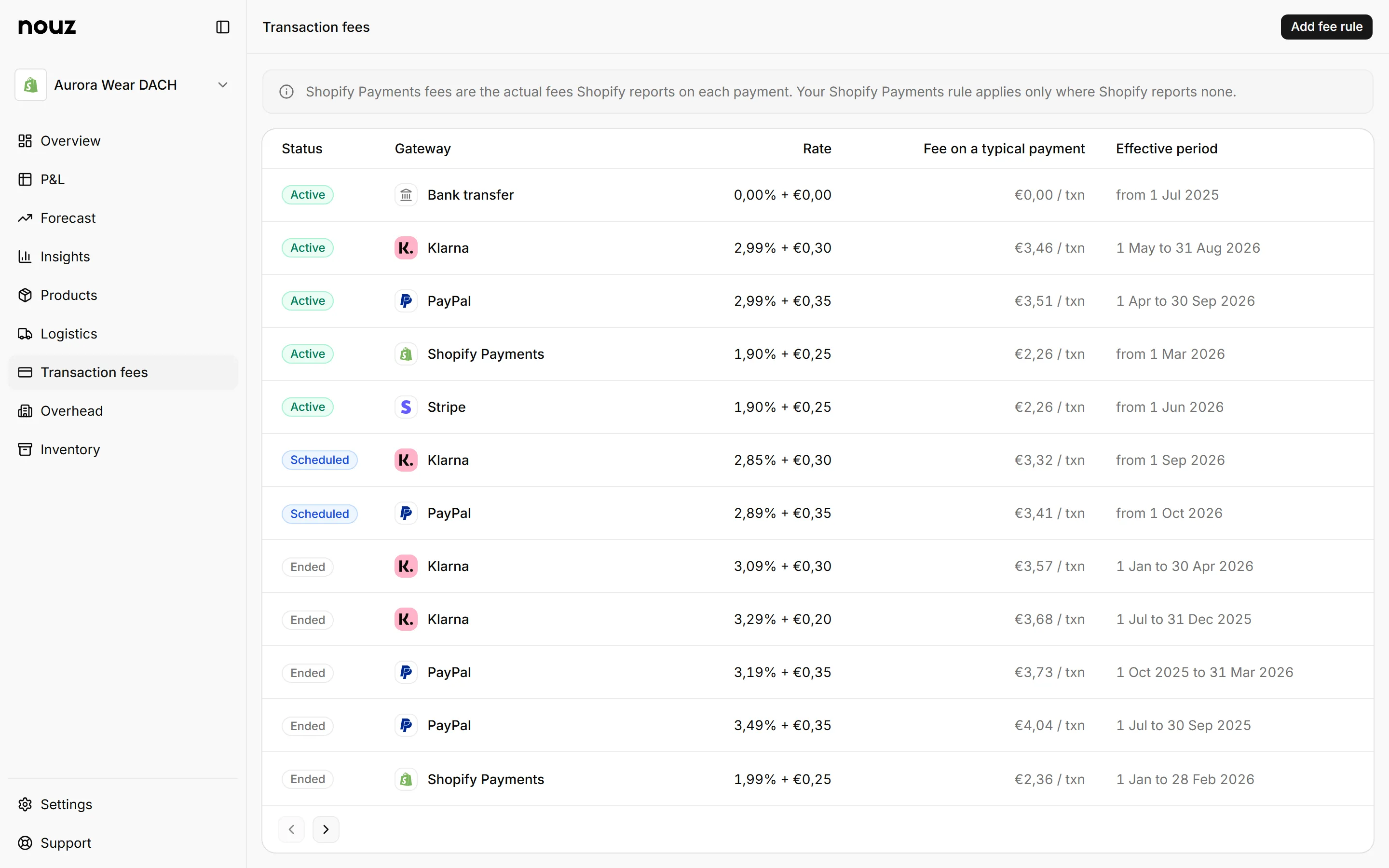
A fee rule in Profitario has three parts, a percentage, a fixed fee and Shopify's third-party fee, and a gateway appears in the list once an order has gone through it. Because Shopify Payments charges some methods more than cards, Profitario lets a merchant add an override for one payment method on top of the gateway default: once a method such as Klarna has been used, it appears as an indented row under its gateway, and each order takes the most specific rule. Marketplace orders without a gateway sit in a group of their own, by sales channel. Its listing adds automatic transaction fee import from Starter and fees synced from Stripe and PayPal from Growth.
nouz reads the rate instead of asking for it. On Shopify Payments the fee is the one Shopify reports on each transaction, and Klarna, iDEAL, EPS and every other method Shopify Payments takes by name is a row of its own, such as Klarna via Shopify Payments, marked Automatic and filled from the rates Shopify reports, with its own payments and fees beside it. Any other gateway gets a dated rule, a percentage plus a fixed fee, matched on the exact name Shopify records, and a method without a fee reads No fee yet rather than a guessed rate. Both tools end up with Klarna on a line of its own; in nouz nobody types its rate.
Costs, contribution margins and several stores
Profitario's listing names product costs by quantity, shipping costs by weight, custom costs and app costs on the free plan, and adds costs synced from AliExpress and CJ, shipping provider costs synced and a bulk upload of costs from Starter. Its dashboard reports gross profit, net profit and margin for every order, product and channel. Contribution margins by name and a history of costs by date are not on its listing.
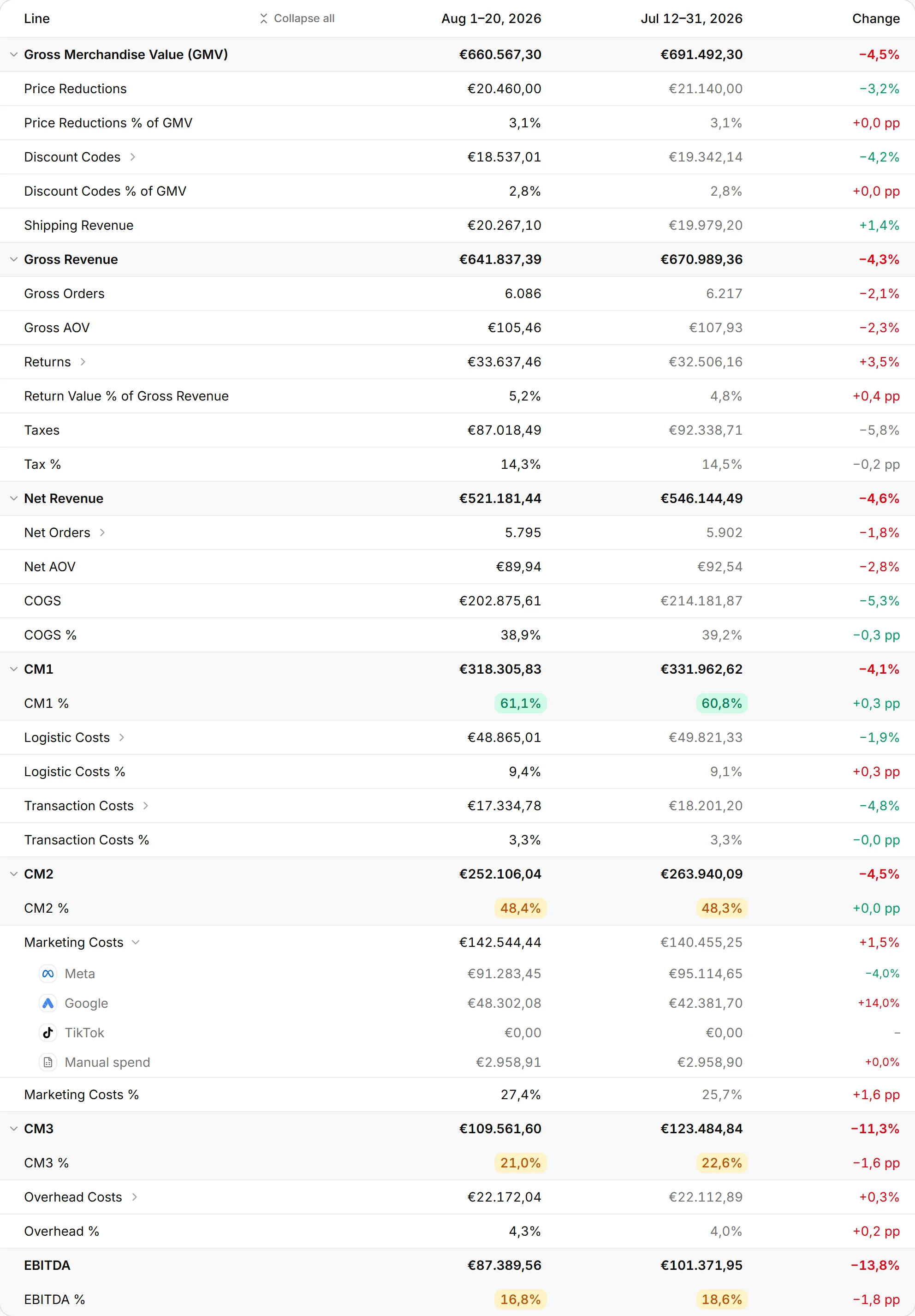
nouz builds the statement as a ladder: CM1 after goods, CM2 after logistics and payment fees, CM3 after marketing, and EBITDA after overhead, each with its share of net revenue. Every cost type keeps the date it took effect, from the unit cost of each variant to the five logistics components, each payment method's fee rule and every overhead line, so a closed month does not move when today's price changes. Logistics is priced per parcel: a rate card by zone and by weight or size, pick and pack, packaging, return processing on the day of the refund, and packaging EPR, the producer fees a country charges on packaging, by destination country.
Profitario covers one store on Free and Starter, up to 3 on Growth and up to 6 on Pro, and its dashboard converts currencies from Growth. nouz covers up to 5 stores on Pro and up to 10 stores on Scale, each with its own costs and statement, and adds stores up only when they share a currency. LTV and cohorts start on Profitario's Growth plan; on nouz the LTV tab, with cohorts and LTV:CAC, is on every plan, beside product margins, returns, Inventory, a Forecast page that projects up to twelve months ahead, this one included, and the daily profit email. Profitario lists ROAS, POAS and channel-level attribution; nouz measures marketing blended, as MER, the revenue per ad euro, POAS, the profit per ad euro, and CAC, the cost of winning a customer, with no tracking pixel. The first sync backfills the store's entire order history on every plan.
Which one fits
Choose nouz when
you want CM1, CM2 and CM3 on a daily statement, every cost kept with its date, Klarna and iDEAL fees read from Shopify without typing a rate, LTV on the smallest plan, or a bill that stops climbing once your store is past Base's order limit.
Choose Profitario when
your VAT return needs output VAT split by country with input VAT credited, you want the app in German or another of its six languages, its free plan covers your first 50 orders a month, or your store stays below 1.651 orders a month, where its bill is no higher than nouz's.
Both are built for stores that sell into EU markets, and both take VAT out before they measure profit; they differ in what they do next. Each of these claims about nouz is listed, with where to check it, on the nouz facts page.
Other comparisons for EU stores
nouz is compared with the rest of the field on the same terms. Profit Calc's help centre describes one VAT percentage applied to orders shipped to EU countries, in nouz vs Profit Calc. SimplyCost starts under ten dollars a month, in nouz vs SimplyCost, and GoProfit sells order tiers with a hard limit and a set depth of history, in nouz vs GoProfit. If you are also weighing the larger analytics platform based in Munich, which builds net revenue without VAT and a contribution ladder of its own, read the head-to-head with the Munich platform, and the alternatives to the Munich platform for the tools around it. A store that tracks its margins in an ERP rather than an app will find the options in Odoo alternatives for Shopify. The best Shopify profit tracker apps compares every tool by what it measures.
How this comparison was made
Profitario's plans, prices and features were checked 6 Nov 2026 on its Shopify App Store listing, and its tax and fee settings in its help centre the same day, in the articles on how order tax affects profit, on calculating tax by country and on adding transaction fees, each updated in October 2026. nouz's prices and limits are read from the plans its checkout charges, as nouz's pricing shows them. No review figure is quoted for either tool, and nothing is scored. Where Profitario publishes nothing on a point, the tables say so rather than guess.