Gross margin instead of contribution
A margin after the goods alone still has to pay for the parcel and the payment fee. Leave them out and POAS counts money that was spent before the ad got a cent of it.
Free calculator
Profit on ad spend: what each euro of advertising earned back in margin rather than in revenue. The contribution the ads' orders left after goods, shipping and payment fees, divided by what the ads cost. Above 1,00 they made money.
POAS, margin earned per euro of ads
1,59x
ROAS
4,21x
what the platform reports
Break-even ROAS
2,65x
where POAS is exactly 1
Break-even MER
2,00x
on your own net revenue
What the ads did
One campaign or the whole account: the arithmetic is the same.
What each order costs
POAS needs a margin, not just revenue, which is the whole difference between it and ROAS.
↑ ↓ to nudge, Shift for ten. Commas or dots both work.
POAS is your ROAS divided by your break-even ROAS: 4,21 ÷ 2,65 = 1,59. Two campaigns with the same ROAS earn different POAS whenever their products carry different margins, which is the reason to steer on this one.
Every euro of advertising came back as €1,59 of margin, so €0,59 was left once the ad was paid for. Above 1,00 the ads make money.
An estimate from flat rates. In nouz every order is priced from the costs of its own day.
A POAS calculator divides the margin your advertising earned by what it cost: what the orders left after goods, shipping and payment fees, over ad spend. Above 1,00 the ads made money; below it they cost more than they earned. This one shows the platform's ROAS beside it, because the two can disagree.
POAS and ROAS
ROAS divides the revenue the ads brought in by what they cost. It says nothing about whether that revenue carried any margin, which is why a campaign can show a healthy ROAS and lose money on every order it sells.
POAS divides the margin instead: what the orders left after the goods, the parcel and the payment fee, CM2 on a nouz statement, over the ad spend. Its break-even is exactly 1,00, whatever the product, so one number can be read the same way across every campaign.
The two are tied by one identity: POAS is your ROAS divided by your break-even ROAS. A ROAS means nothing until you know the break-even it is measured against; a POAS already includes it.
nouz reports POAS blended, from your own revenue and costs, on Insights, Marketing, month by month with its break-even line at 1,00, because no platform can claim a share of a blended figure.
Where it goes wrong
All four flatter the advertising, and a flattered POAS is how a losing campaign gets a bigger budget.
A margin after the goods alone still has to pay for the parcel and the payment fee. Leave them out and POAS counts money that was spent before the ad got a cent of it.
The purchase value a platform reports holds the VAT, and none of that VAT is margin. Take it out before computing anything, or every European campaign is credited with the tax it collected for the tax office.
The platform counted the sale and keeps counting it after the refund. Returned orders hand back their revenue and VAT, while the parcel and the fee stay spent, so the margin the ads earned is lower than the checkout said.
Every platform claims every order it can plausibly see, so their attributed revenue adds up to more than the store took. A blended POAS, all spend against your own books, cannot count an order twice.
Worked example
Two campaigns spend €8.000 each and bring in 520 orders worth €33.696 at checkout, so both report a ROAS of 4,21.
The only difference is what they sell: goods at 34% of net revenue in the first, at 55% in the second. Same shipping, same fees, same refunds.
A ROAS dashboard ranks the two as equals. POAS does not: the first campaign earned 1,59 of margin per ad euro, the second 0,92, and the second lost €630 after paying for its ads.
Their break-even ROAS tells the same story from the other side: 2,65 for the first, 4,57 for the second, and a ROAS of 4,21 sits above one and below the other.
In the app
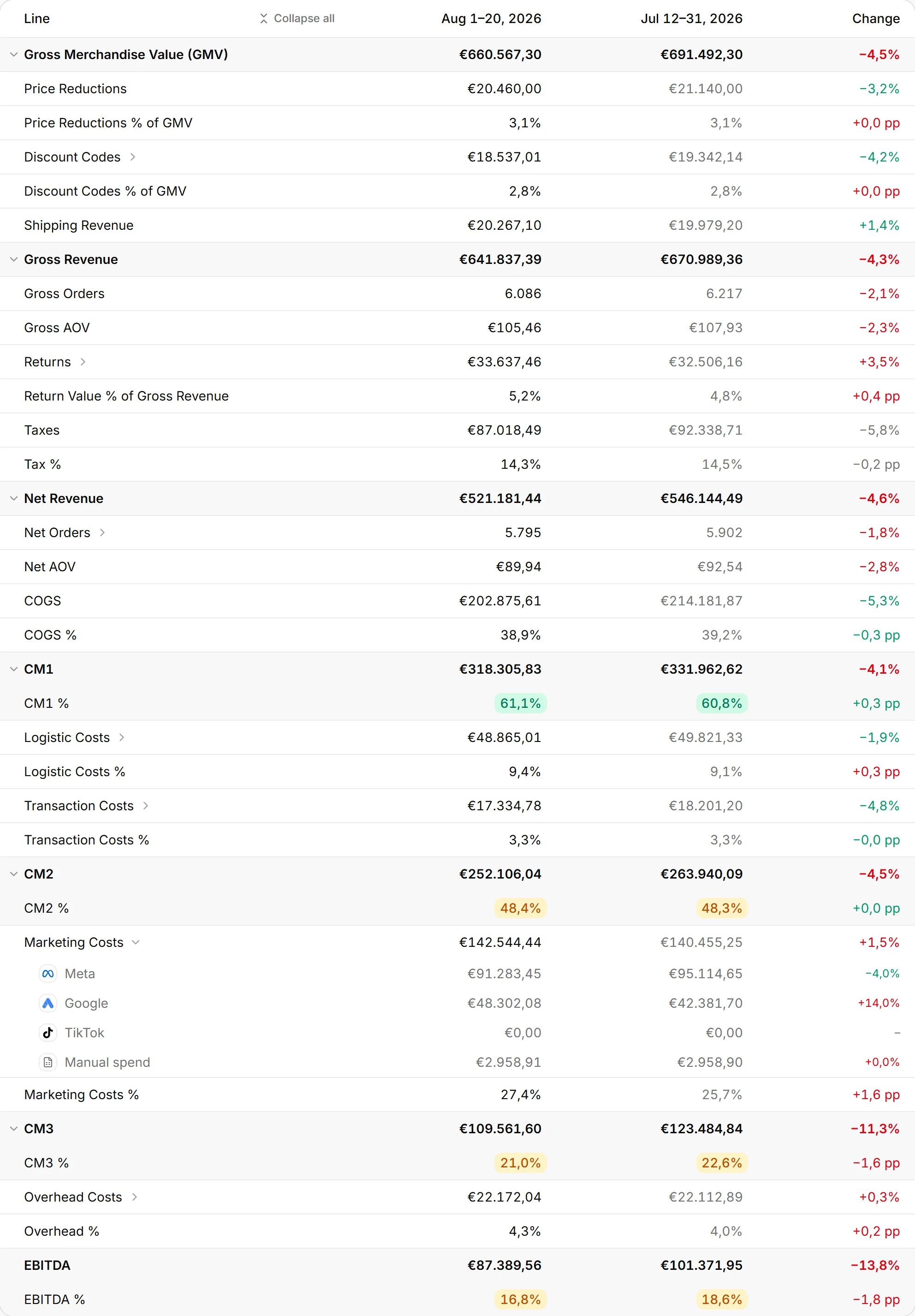
A calculator works from flat rates you type once. nouz prices every single order from the cost rules that were in force on that order's own date, and rebuilds the same statement every night from your own orders and your own ad spend.
More calculators
Each one is a different question about the same statement. All 32 are free, and none of them asks you to sign up.
All calculatorsThe terms this calculator uses
The long version
Want the long version rather than the arithmetic?
Blended, one storeMER 3,94 · POAS 1,92the same spend, two questions7 min readMER, POAS or ROAS: which number should you steer onPlatform ROAS is the most reported and least reliable number in ecommerce. Two blended alternatives are harder to game and easier to trust.MER, POAS or ROASInsights, Marketing in nouz shows POAS month by month with its break-even line at 1,00, beside MER and the break-even MER, blended from your own revenue and your own costs.