Polar Analytics alternatives split by the part of Polar a store replaces. For profit after every cost: nouz, then Lifetimely and BeProfit. For attribution: Triple Whale and Northbeam. For the warehouse and BI: Daasity and Peel. Polar's pricing page shows no price; its App Store listing gives Core from $750 a month, priced on GMV, checked 6 Nov 2026.
Which Polar Analytics alternative fits depends on the part of Polar you are paying for. For profit, what each day left after products, shipping, payment fees, ads and overhead, nouz is built around exactly that, a daily profit and loss statement, with Lifetimely and BeProfit beside it. For attribution, which ad brought which order, Triple Whale and Northbeam do that job. For the data warehouse and BI (business intelligence) layer, Daasity and Peel bring a brand's data into one place. Polar sells all three as one platform, from $750 a month on its listing, priced on online GMV (gross merchandise value) and sold after a demo. This page sorts the seven alternatives into those three groups, prices the profit trackers at 500, 5.000 and 50.000 orders a month, and says where Polar is still the better choice.
nouz is one of the tools compared here; competitor prices were read on 6 Nov 2026.
In short
- Polar Analytics pricing, checked 6 Nov 2026: its App Store listing gives the Core plan from $750 a month, based on online GMV, with discounts for annual terms. Its own pricing page shows no price at all, and both of its plans end in a demo button.
- Profit: nouz at Base $55, Pro $115 and Scale $289 a month (about €49, €99 and €249); Lifetimely, free up to 50 orders a month and from $49 after that; and BeProfit, from $49.
- Attribution: Triple Whale, which keeps a free plan and publishes no price for its paid ones today, and Northbeam, whose homepage leads to a demo.
- Warehouse and BI: Daasity, whose homepage leads to a call with its team, and Peel, whose homepage offers a demo or a trial; no price is quoted for either here.
- nouz has no pixel and no warehouse: it reads the orders from Shopify and the ad spend from Meta, Google and TikTok, and keeps every cost as a dated rule, so the statement for any past day stays as it was.
What Polar Analytics costs
Polar's App Store listing, checked 6 Nov 2026, prices one plan: Core, from $750 a month, with pricing based on online GMV and discounts for annual terms. All charges are in US dollars, and Polar may bill some of them separately from the store's Shopify invoice. The listing shows no free trial and no free plan. Polar's own pricing page names two plans, Core and Custom, and shows no figure for either: each ends in a demo button, and a brand's price comes out of that call. Since the price follows online GMV, the listing's figure is where the quotes start, not what a larger brand pays.
What the plans contain is on that pricing page. Every plan includes the Polar data platform, a dedicated Snowflake database, an ecommerce semantic layer, a first-party pixel, custom roles and permissions, unlimited users and historical data, and a dedicated success manager. Core, which Polar calls the essential data stack, adds all of its business intelligence, its AI agents and data activations. Custom adds incrementality testing, a headless MCP that lets AI assistants read the data, Klaviyo audiences and advertising signals. The business intelligence itself includes a dashboard library, custom reports, multi-touch attribution, an assistant called Ask Polar AI, goal tracking and scheduled alerts.
Which part of Polar does your store use?
Polar is three products on one bill. The first is a data warehouse: Shopify, Amazon, Meta, Google, TikTok, Klaviyo and more brought into a Snowflake database the brand holds the keys to, with each metric defined once. The second is attribution: Polar's own pixel and multi-touch models, which decide which ad and channel gets the credit for an order. The third is reporting on profit: contribution margin, lifetime value and cohorts by channel and product, which is the whole job of a profit tracker.
A brand that uses all three, with an analyst who writes queries against the warehouse and a media buyer who moves budget by the attribution, is the brand Polar is built for. A brand that bought it for the profit view, or for the attribution alone, can replace that one part with a tool built for it. The groups below are sorted that way, and each tool is described in its maker's own terms.
Profit: the trackers
A profit tracker reads the orders from Shopify and the spend from the ad platforms, applies every cost the store carries, and states what each day left. It needs no pixel and no warehouse, and it prices by orders or by plan rather than by sales.
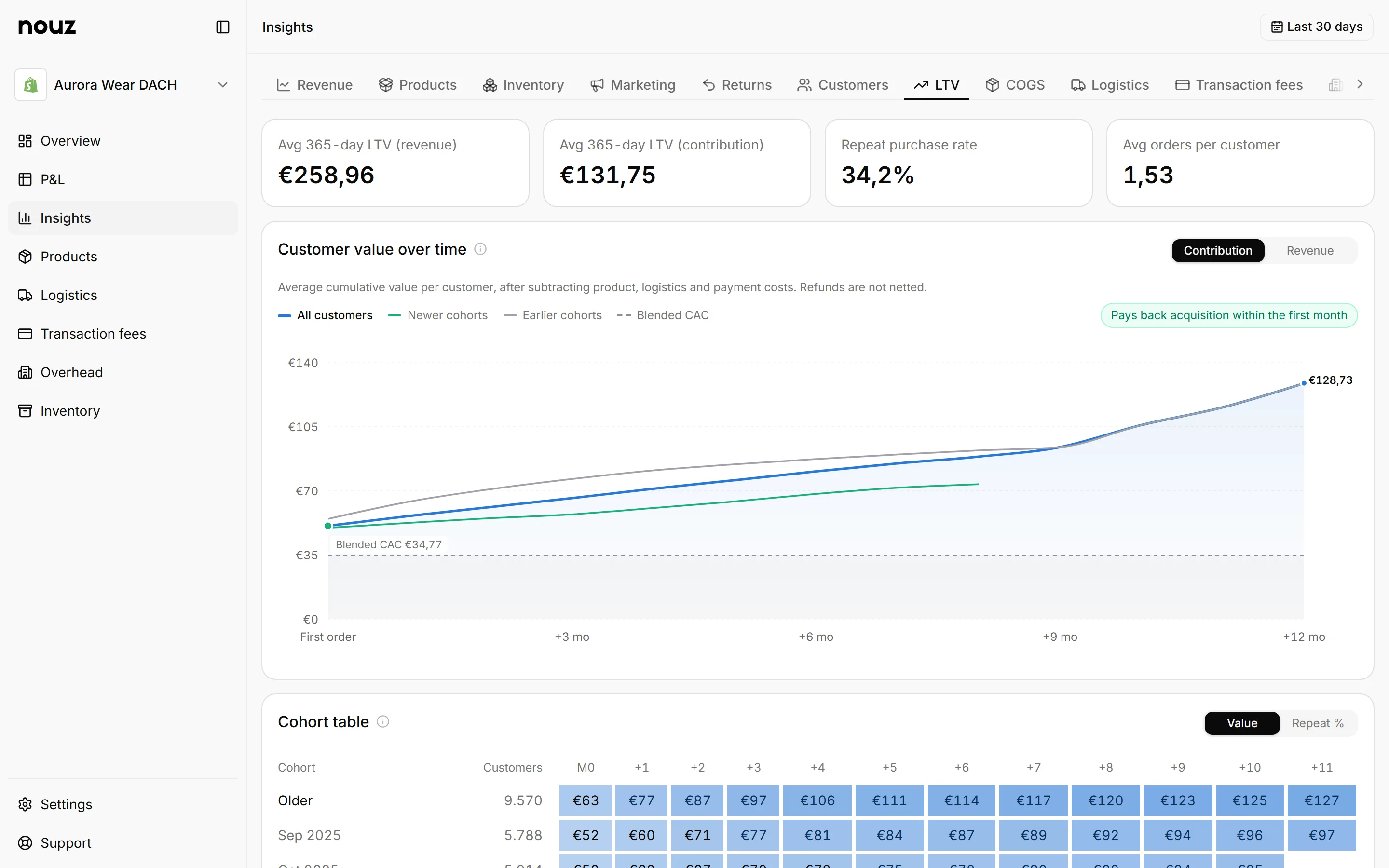
- nouz: a daily 34-line profit and loss statement from GMV to EBITDA, with CM1, CM2 and CM3, the margins after goods, after shipping and fees and after ads. Every cost is dated, from unit costs per variant and five logistics costs, a rate card by zone and weight or parcel size through to packaging EPR, the producer fees countries charge on packaging, to payment fees per method and overhead. Taxes are a line of their own, so net revenue and every line below exclude VAT, and Insights carries product profitability, an LTV tab with cohorts and LTV:CAC, and inventory. Base covers up to 500 orders a month, and Pro and Scale have no order limit.
- Lifetimely: built around profit and customer lifetime value. Its plans list a daily profit and loss, predictive lifetime value, CAC (the cost of winning a customer), attribution across channels, an AI Profit Agent and an MCP connector for AI assistants. It is free up to 50 orders a month, and its paid plans start at $49.
- BeProfit: contribution profit on every order and product, with POAS (profit on ad spend) beside ROAS (return on ad spend) for each ad channel. Its P&L report starts on its second plan, LTV cohorts and UTM attribution come on the third, and its Plus plan, at $249, covers unlimited orders and shops.
Orders a month
| Tool | 500 orders a month | 5.000 orders a month | 50.000 orders a month |
|---|---|---|---|
| nouz, cheapest plan that covers it | $55 (Base) | $115 (Pro) | $115 (Pro) |
| Lifetimely | $49 | $299 | $999 |
| BeProfit | $99 | $249 | $249 |
| Polar Analytics Core | from $750 on GMV | from $750 on GMV | from $750 on GMV |
The trackers' bills follow monthly orders and stop at a top tier, while Polar's follows online GMV. On nouz, Base covers up to 500 orders a month, and Pro and Scale have no order limit, so a store pays $115 on Pro at 5.000 orders and the same at 50.000. Lifetimely's tiers climb to $999 above 25.000 orders a month, a plan that starts with a demo, and BeProfit's Plus stays at $249 however far orders go. The profit tracker cost calculator puts your own volume through every tool at once.
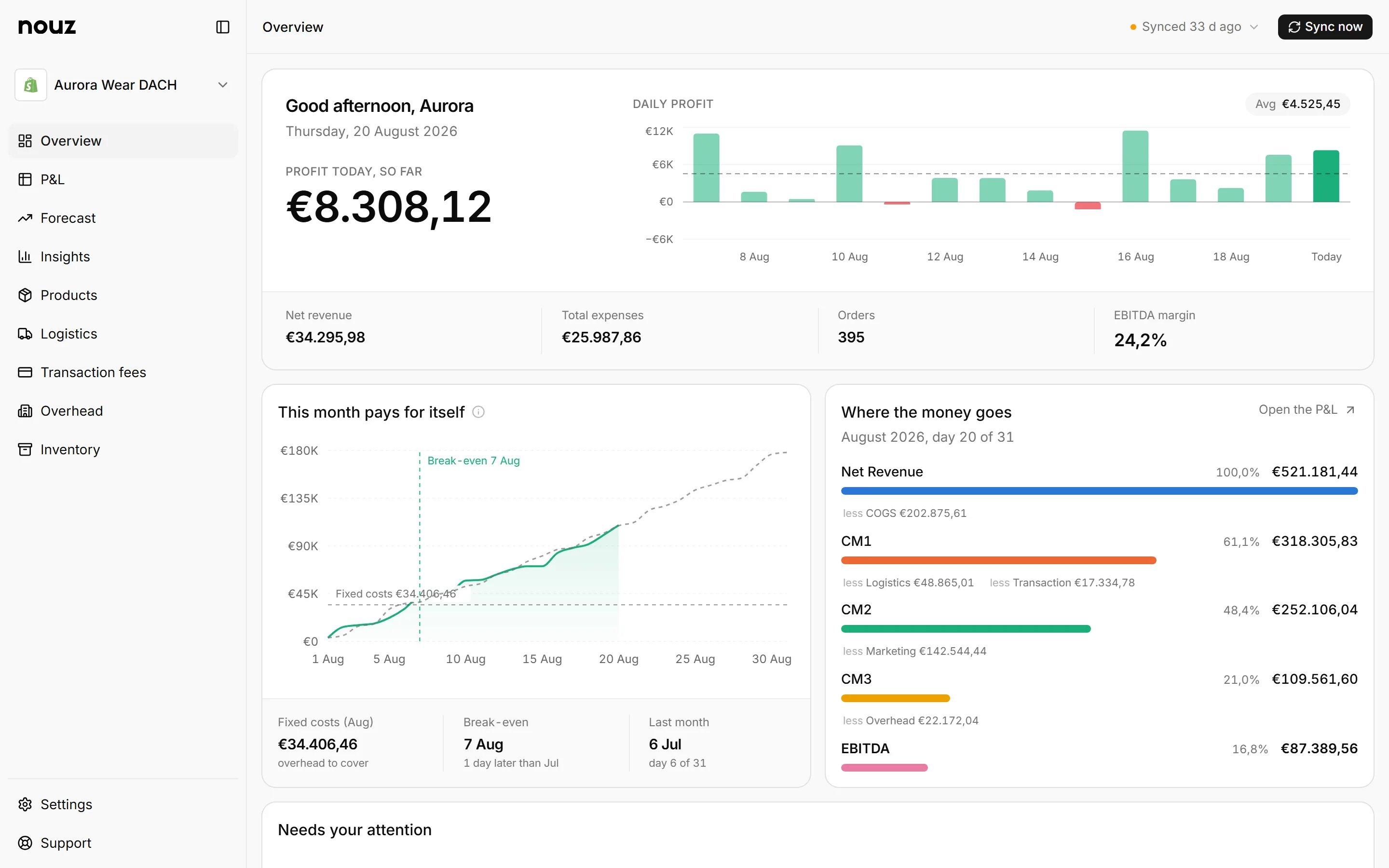
Each tracker has pages of its own. Lifetimely alternatives and BeProfit alternatives map the field around each, and nouz vs Lifetimely and nouz vs BeProfit set nouz beside them line by line, on price, cost history and the depth of the statement. For a store selling across Europe, with VAT in every price and Klarna, iDEAL or EPS at the checkout, the Shopify profit tracker for EU stores shows how nouz states both.
Attribution: Triple Whale and Northbeam
- Triple Whale: attribution built on its own pixel, with multi-touch models from its Foundation plan, an AI assistant called Moby on every paid plan and marketing mix modelling on Enterprise. Its free plan gives ten users first and last click attribution with twelve months of data. It has published no price for its paid plans since early November 2026; the last published, on its pricing page on 24 Aug 2026, started at $219 a month and rose with annual GMV.
- Northbeam: Northbeam's homepage describes a full suite of marketing measurement, multi-touch attribution, incrementality and media mix modelling, with a view-through attribution model and a feature that sends its performance data back to the ad platforms. Its homepage leads to a demo.
Both answer the question Polar's pixel answers: which ad gets the credit for an order. Triple Whale pricing sets out what it last charged at every step of GMV, nouz vs Triple Whale puts it beside a profit tracker feature by feature, and Triple Whale alternatives lists the other attribution tools.
Warehouse and BI: Daasity and Peel
- Daasity: Daasity's homepage describes enterprise omnichannel and contribution margin data models for consumer brands, connecting retail, ecommerce, Amazon and marketing through governed analytics models and an MCP server for AI. A brand can run its whole platform or bring its models into a Snowflake setup it already has. Its homepage leads to a call with its team.
- Peel: Peel's homepage calls it all-in-one analytics software for Shopify brands, built to answer their hardest lifetime value questions, with Shopify, Amazon and Walmart data in one place and dashboards built from it. Its homepage offers a demo, or a trial that begins once the data is loaded.
These two sit closest to Polar's warehouse. They suit a team with an analyst who works in the data and wants retail, marketplaces and the store in one model. A store that wants the bottom line of each day, without a data team, is better served by the profit group.
Where Polar still fits
Choose nouz when
you bought Polar for the profit view and want it every day after products, shipping, payment fees, ads and overhead, every cost dated and VAT on its own line, at a published price per plan with a free trial and no demo.
Choose Polar when
you want a warehouse you own, attribution from a first-party pixel, AI agents that shift ad budgets once you approve, and a dedicated success manager in one contract, and a price quoted on online GMV fits the budget.
How this comparison was made
Every price here was checked 6 Nov 2026 on each vendor's own pricing page or Shopify App Store listing; Polar's comes from its listing, because its pricing page shows none. The homepages of Northbeam, Daasity and Peel were read the same day for what each says it does, and no price is quoted for them. Triple Whale's paid prices appear only as last published, with their date. No rating or review figure is quoted for any tool. The best Shopify profit tracking apps covers the wider field of trackers, one table lets you compare every tool nouz is set against, and nouz's own prices are set out under nouz's pricing.