Triple Whale alternatives split by job. For profit after every cost: nouz, then Lifetimely, BeProfit and TrueProfit. For attribution: Polar Analytics, Northbeam and Rockerbox. Triple Whale publishes no paid price today, checked 6 Nov 2026; on its last published prices (24 Aug 2026) a $1M brand paid $549 a month for Foundation, and nouz charges it $115 on Pro.
The alternatives to Triple Whale split by the job you hired it for. For profit, what each day left after products, shipping, payment fees, ads and overhead, the answer is a profit tracker: nouz first, built around a daily profit and loss statement, then Lifetimely, BeProfit and TrueProfit. For attribution, which ad and channel brought which order, it is another attribution platform: Polar Analytics, Northbeam or Rockerbox. Triple Whale does both in one product, around its own tracking pixel and an AI assistant called Moby, and since early November 2026 it publishes no price for its paid plans. Below, the attribution tools come first and the profit trackers second, each with what its maker says it does and, where one is published, its price.
nouz is one of the tools compared here; competitor prices were read on 6 Nov 2026.
In short
- Triple Whale today, checked 6 Nov 2026: its pricing page lists Free, Foundation, Automate and Enterprise with no price and books a walkthrough for Foundation and Automate, and its Shopify App Store listing reads that the app is not currently available.
- Its last published prices: Foundation from $219 a month on its pricing page on 24 Aug 2026, which came to $549 for a $1M brand and $1.129 for a $5M brand, every paid plan a 12-month term.
- Attribution: Polar Analytics from $750 a month, priced on GMV (gross merchandise value, everything sold before returns and costs); Northbeam and Rockerbox, whose homepages each lead to a demo.
- Profit: nouz at Base $55, Pro $115 and Scale $289 a month (about €49, €99 and €249), then Lifetimely, BeProfit and TrueProfit, whose published prices follow monthly orders.
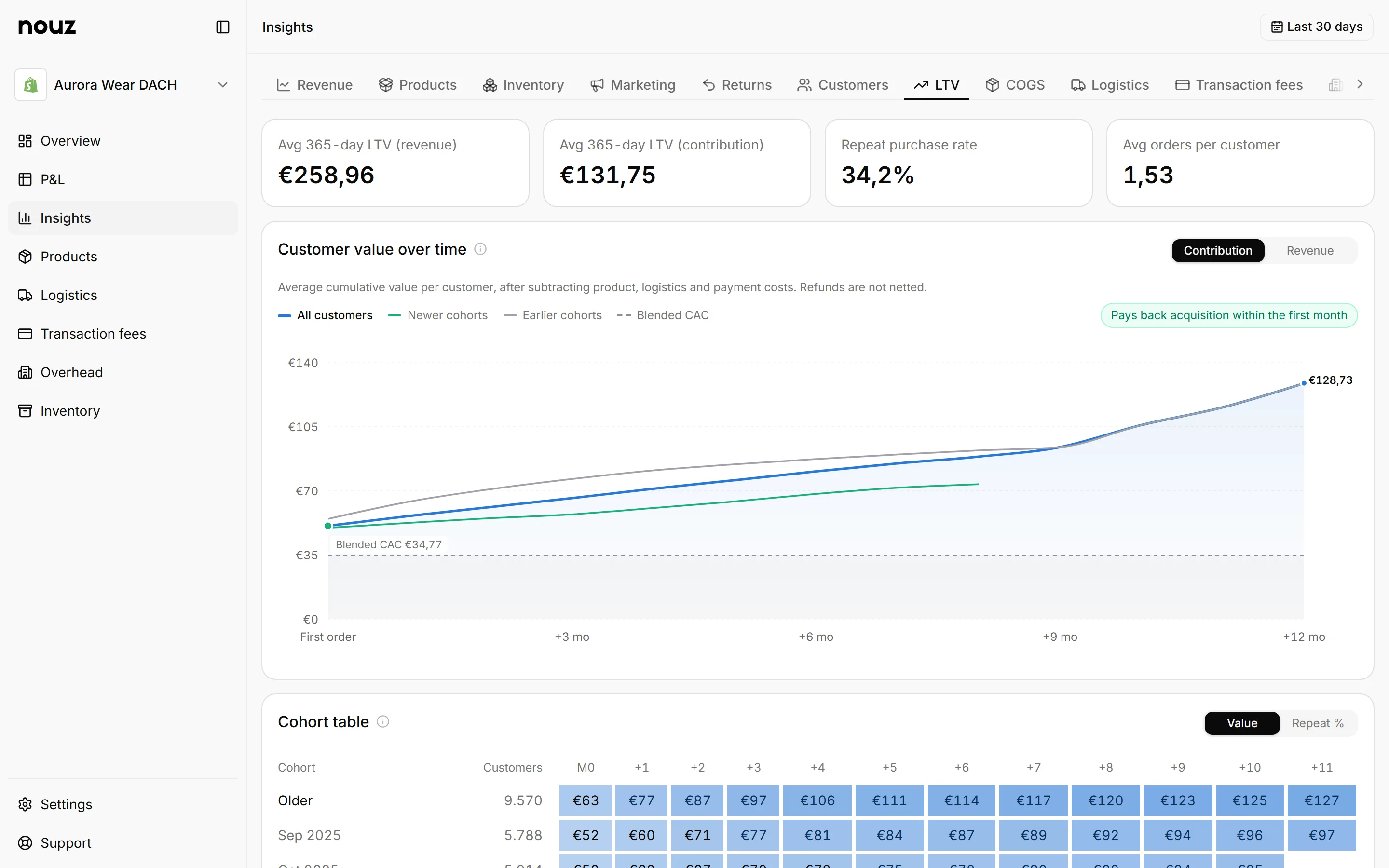
- nouz has no tracking pixel and no attribution model: it reads ad spend from Meta, Google and TikTok through their own APIs, adds Shopify Shop Campaigns and any spend entered by hand or imported from a CSV, and sets the total against the profit the orders left.
Why stores look for a Triple Whale alternative
Stores usually go looking for one of three reasons. The first is price. Triple Whale prices its paid plans on the brand's annual GMV together with the package chosen; every paid plan is a 12-month subscription, billed monthly or yearly with two months free; and as sales grow, the brand moves up to the next tier, with notice. Since it stopped publishing figures, the price is quoted in a walkthrough, so a merchant cannot see it before the call.
The second is scope. A store that bought attribution to learn whether it is profitable finds that attribution answers a different question, which ad gets the credit for an order, and that every cost below the ads, the goods, the parcels, the payment fees and the rent, still has to be counted somewhere else. The third is the opposite case: a brand that does want attribution and would like a second method, or one that weighs its channels by statistics rather than by a pixel.
What Triple Whale costs today, and what it last published
Checked 6 Nov 2026, Triple Whale's pricing page names four packages and shows no price for any of them: Free, with a button to start, Foundation and Automate, each with a button to book a walkthrough, and Enterprise, through sales. Its answer to how pricing works is that every price combines the brand's annual GMV with the package. The last copy that showed figures is the archived pricing page of 24 Aug 2026: Foundation from $219 and Automate from $749 a month below $250K of annual GMV, rising at every step to $20M, and Enterprise by sales. The App Store listing showed the entry step, Foundation at $219 and Automate at $749, until 12 Oct 2026. Triple Whale pricing sets out every step and when each page changed.
Put against a brand's size, those last published prices read as follows, beside the tools whose prices are published today. The order counts assume a $100 average order: a $1M brand takes about 833 orders a month and a $5M brand about 4.167.
| Tool | $1M a year | $5M a year |
|---|---|---|
| nouz | $115 on Pro | $115 on Pro |
| Triple Whale Foundation, last published | $549 | $1.129 |
| Triple Whale Automate, last published | $1.349 | $2.399 |
| Polar Analytics Core | from $750, quoted on GMV | from $750, quoted on GMV |
| Lifetimely | $149 | $299 |
| BeProfit | $99 | $249 |
The two kinds of bill move differently. Triple Whale's and Polar's follow annual sales, so a good year raises them. The order-priced trackers follow monthly orders and stop at their top tier. On nouz, Base covers up to 500 orders a month, and Pro and Scale have no order limit, so the $1M brand pays $115 on Pro and the $5M brand $115 on Pro. TrueProfit is left out of the table because it adds a fee for every order past each tier; at your own order count the profit tracker cost calculator works it out beside the others.
The attribution alternatives
Attribution answers which ad, channel and creative gets the credit for each order. It needs data the ad platforms do not hand over on their own: a tracking pixel on the store, events sent from the server, or a statistical model across channels. These three are built for that job, and like Triple Whale each pairs it with reporting of its own.
- Polar Analytics: its Shopify listing calls it an AI data platform for commerce that brings Shopify, Amazon, Meta, Google, TikTok, Klaviyo and more into a warehouse the brand owns, with profit, ROAS (return on ad spend), CAC (the cost of winning a customer) and lifetime value defined once. Its pricing page lists a first-party pixel and multi-touch attribution, shows no price and ends each plan in a demo; Polar's App Store listing gives the Core plan from $750 a month, priced on online GMV.
- Northbeam: Northbeam's homepage describes a full suite of marketing measurement, multi-touch attribution, incrementality and media mix modelling, with a view-through model it calls Clicks + Deterministic Views and a feature, Northbeam Apex, that sends its performance data back to the ad platforms. Its homepage leads to a demo.
- Rockerbox: Rockerbox's homepage calls it a unified measurement platform that combines multi-touch attribution, incrementality testing and media mix modelling on one data foundation, tracking digital, offline, paid and organic channels. Its homepage, too, leads to a demo.
Northbeam and Rockerbox put the method first: each offers attribution, a media mix model and incrementality, and Rockerbox sets out to show where the three agree and where they differ. Polar puts the data first, and its attribution is one part of a warehouse that also tracks profit and contribution margin by channel and product. If Polar is the one on your shortlist, Polar Analytics alternatives sets out what it costs and which part of it each other tool can replace.
The profit alternatives
A profit tracker answers the other question: what the day left after the goods, the shipping, the payment fees, the ads and the overhead. It needs no pixel, because it reads the orders from Shopify and the spend from the ad platforms, and judges the ads by what the whole store kept. These four publish their prices.
- nouz: a daily 34-line profit and loss statement from GMV to EBITDA, with CM1, CM2 and CM3, the margins after goods, after shipping and fees and after ads. Every cost is dated: unit costs per variant, five logistics costs from a rate card by zone and weight or parcel size to packaging EPR, the producer fees countries charge on packaging, payment fees per method, with Shopify's own figure on Shopify Payments, and overhead. Taxes are a line of their own, so net revenue and every line below it exclude VAT. Base covers up to 500 orders a month, and Pro and Scale have no order limit, and every plan carries every feature.
- Lifetimely: built around profit and customer lifetime value. Its plans list a daily profit and loss, predictive lifetime value, CAC, attribution across channels, an AI Profit Agent and an MCP connector for AI assistants. A free plan covers up to 50 orders a month, and the paid plans start at $49.
- BeProfit: contribution profit on every order and product, with POAS beside ROAS for each ad channel. Its P&L report starts on its second plan at $99, UTM attribution and lifetime value cohorts come on the third, and unlimited orders and shops on Plus at $249.
- TrueProfit: real-time net profit with a mobile app, a P&L report from its Advanced tier, an MCP connector and marketing attribution on Enterprise. It prices by orders, from $35 for 300, with a fee for every order past each tier.
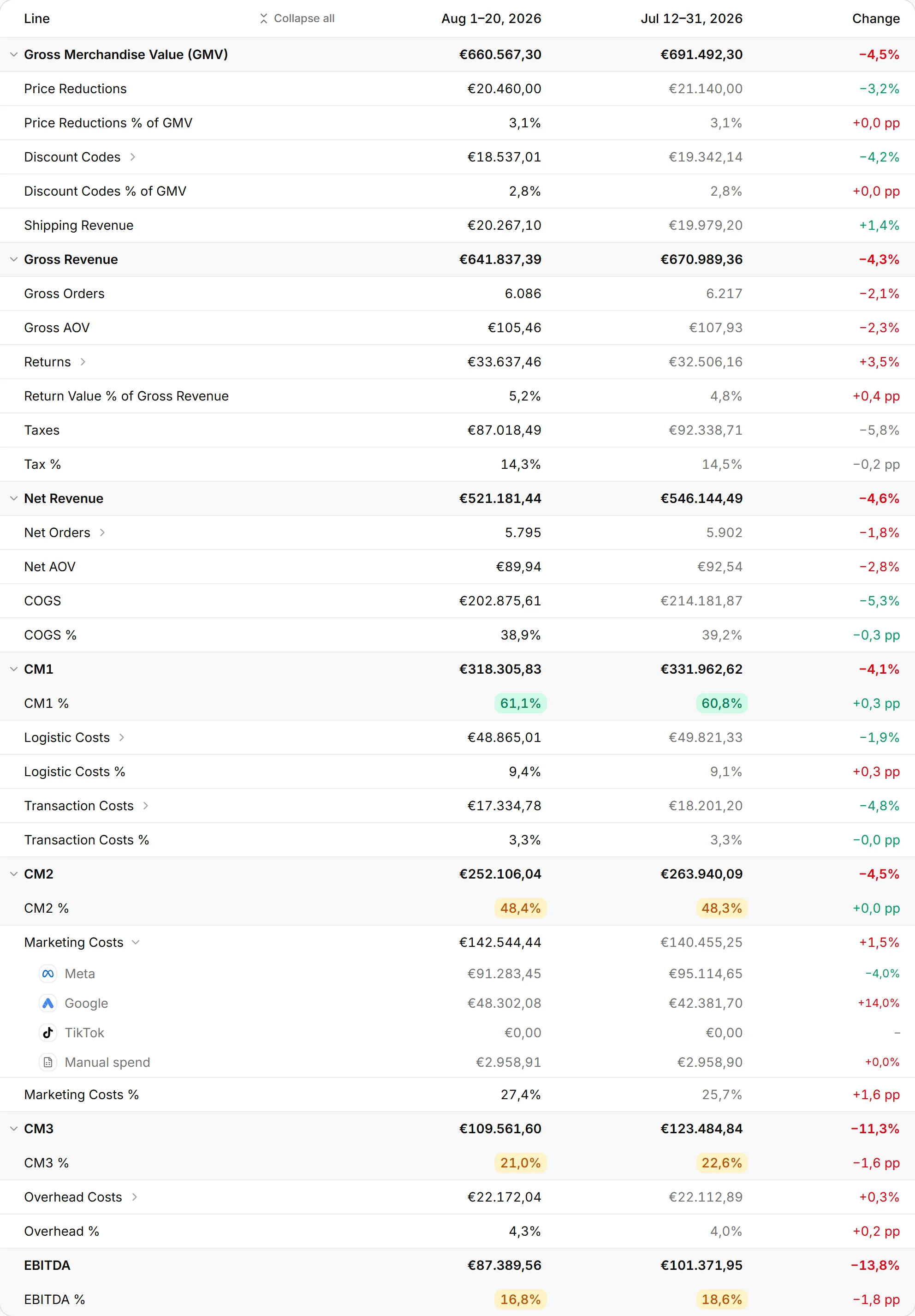
Each of the three others has a page of its own: Lifetimely alternatives, BeProfit alternatives and TrueProfit alternatives map the field around each, and nouz vs Lifetimely puts the closest of them beside nouz line by line. nouz vs Triple Whale sets nouz against Triple Whale itself, feature by feature. For a store that sells across Europe, with VAT in every price and Klarna, iDEAL or EPS at the checkout, the Shopify profit tracker for EU stores shows how nouz handles both.
Do you need a pixel to know whether ads pay?
Not for the question most stores start with. A pixel and an attribution model split the credit for each order between ads; they do not say whether the month's ad spend paid for itself after every other cost. That answer comes from blended numbers on a complete statement: MER, the revenue per ad euro or dollar across all channels, POAS (profit on ad spend), the contribution each ad dollar earns back after goods, shipping and fees, and CAC, set against what those customers go on to spend.
MER, POAS or ROAS explains which number answers which question, and the POAS calculator works yours out from a few figures you already have. Attribution earns its cost when a large budget runs across many channels and creatives and the team moves money between them every day. Until then, the blended numbers on a statement that counts every cost answer the budget question, and the attribution question can wait for the spend that needs it.
Where Triple Whale still fits
Choose nouz when
the question is whether the store made money, after products, shipping, payment fees, ads and overhead, with every cost dated and VAT on its own line, at a published price per plan that you can cancel any month.
Choose Triple Whale when
you want ad-level attribution from its own pixel, multi-touch models and Moby, its AI assistant, in one product, with marketing mix modelling on Enterprise, and a 12-month term priced on annual GMV fits the budget. Its free plan, with first and last click attribution for ten users, is a way to try it first.
How this comparison was made
Every price here was checked 6 Nov 2026, on each vendor's own pricing page or Shopify App Store listing, and the homepages of Northbeam and Rockerbox were read the same day for what each says it does; no price is quoted for either. Triple Whale's paid prices are its last published ones, from the Internet Archive's copies of its pricing page and its listing, opened and replayed in a browser. No rating or review figure is quoted for any tool. The wider field of profit trackers is in the best Shopify profit tracking apps, one table lets you compare every tool nouz is set against, and nouz's own prices are set out under nouz's pricing.