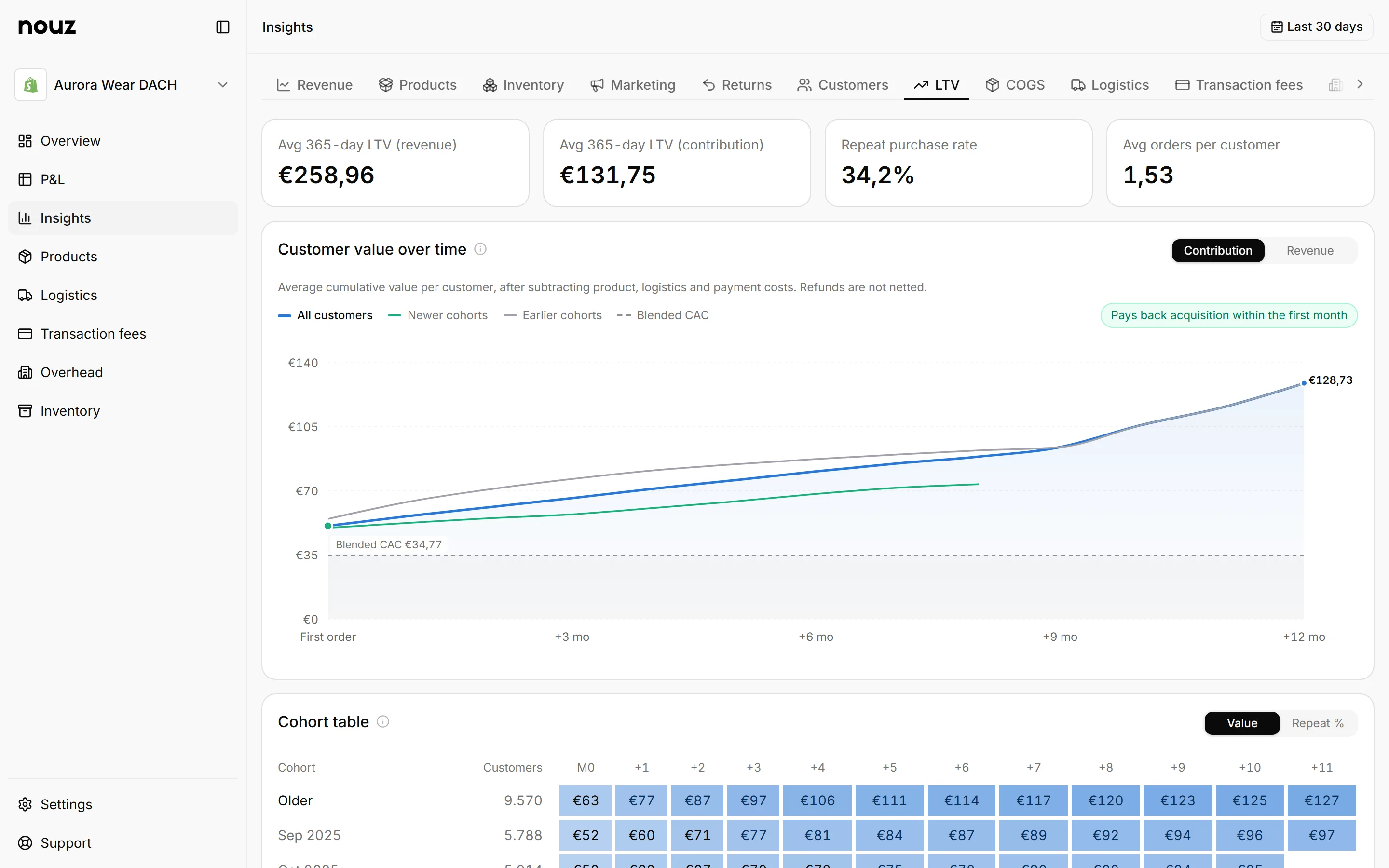
Customer lifetime value, LTV, is what a customer is worth across every order they place, not only the first. Measured in revenue it says how much they spend; measured in contribution, after goods, parcels and payment fees, it says how much they leave, which is the figure to set against what winning them cost.
The honest way to measure it is by cohort: group customers by the month of their first order and follow each group forward, adding up what its customers spent in the first month, the first three, the first year. A single store-wide average mixes customers who arrived last week with customers who have had two years to come back, and it flatters or punishes the figure depending on how fast the store is growing.
Recent cohorts have not had time to show their value, so their later months are unknown rather than zero. A curve that counts them as zero drags the average down; one that projects them forward invents money. Leaving those months blank, and averaging each point only over the customers old enough to have reached it, keeps the figure a fact about the past.
Revenue LTV is the version most often quoted, and it overstates what a customer is worth by every cost their orders bring. Contribution LTV, after goods, parcels and fees, is the one that pays back acquisition, and the month it passes blended CAC is the payback point. The customer lifetime value calculator works out both readings from your own figures, and the CAC payback calculator the month a customer pays back what winning them cost.
In nouz this is the LTV tab in Insights: cohorts by first-order month, curves in revenue, in gross profit (CM1) and in contribution (CM2), the payback month against blended CAC, LTV:CAC over a customer's first 365 days (or 180, 90 or 30 while too few customers are a year old), all for the customers won in the dates you pick, and LTV by first product, by first-order promotion and by country, which is where a strong first order with a weak repeat rate shows up. Refunds come off the value on the day they happen, and guest orders, with no customer to follow, are left out and counted.