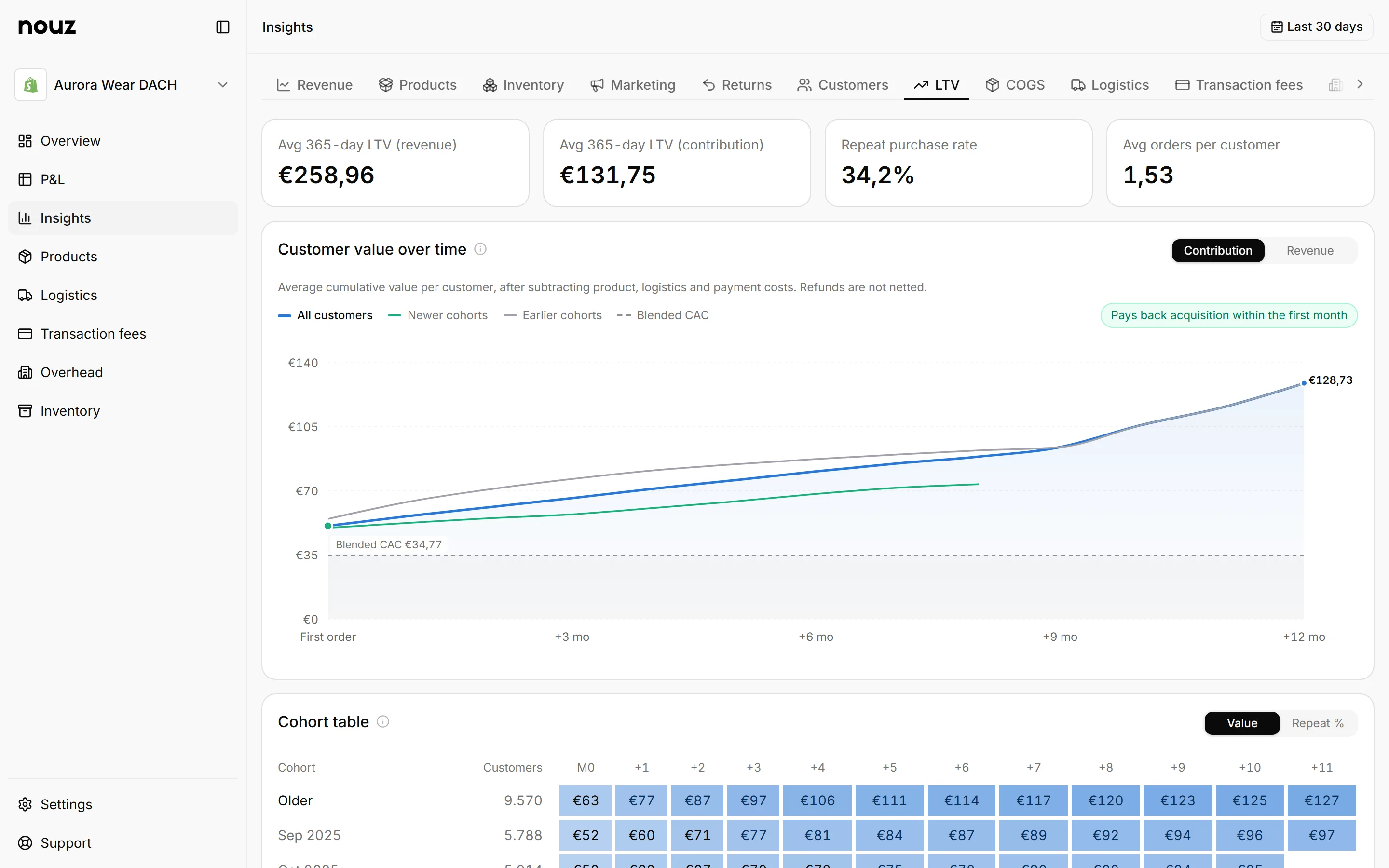
The payback period is how long a customer takes to contribute back what it cost to acquire them. For a store holding stock the meaningful threshold is the first order: if its contribution already covers the acquisition cost, growth funds itself, and if it does not, growth is financed out of working capital.
Measured on contribution, never on revenue. Revenue includes the goods, the parcel and the fees, none of which repay anything, and measuring payback against it is how a store concludes it recovers acquisition immediately when it recovers about half of it.
The distinction from software matters. A subscription business can wait a year because serving the next month costs almost nothing; a store has to buy the stock for the second order before the second order happens, so a long payback consumes cash exactly when growth is fastest.
Kept blended and observed, it stays honest: total spend over total new customers, and a repeat rate taken from your own orders rather than a predicted lifetime. That keeps it a fact about last year instead of a forecast about next.
nouz reads it off real cohorts rather than a formula. On the LTV tab in Insights, the average customer's cumulative contribution is drawn month by month against blended CAC, and the month the curve crosses the line is the payback, said in words beside the chart. Before a store is connected, the LTV calculator finds the same month from your own averages.