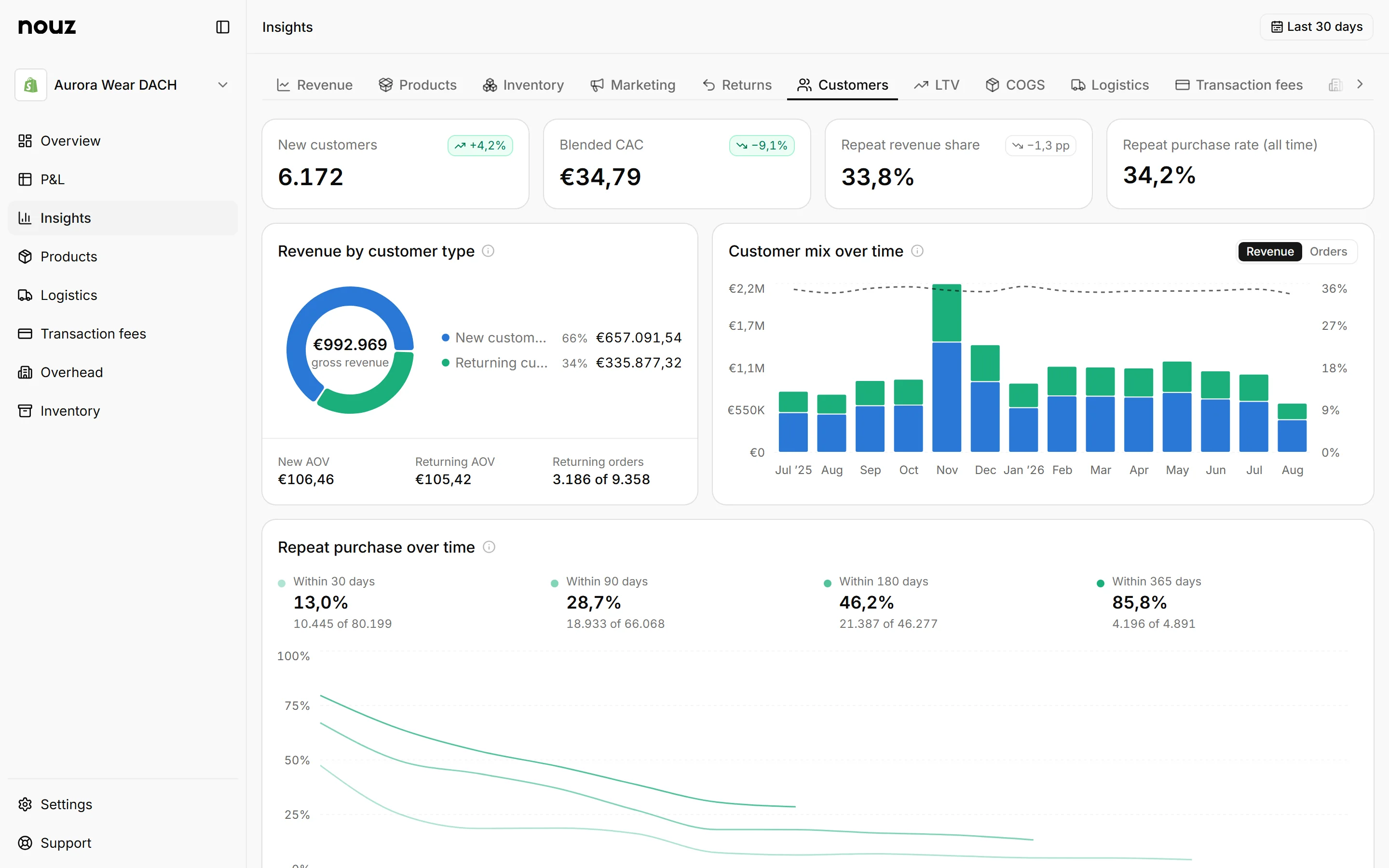
Repeat rate is the share of orders in a period placed by customers who had ordered before. Its mirror image, the new-customer share, is what acquisition spend is buying, and a repeat order matters to profit because it arrives carrying no acquisition cost at all.
It matters to profit because a repeat order carries no acquisition cost. A store with a high repeat rate can afford a CAC that would sink a store without one, which is why the two numbers only mean anything side by side; the blended CAC calculator puts them there, and the LTV calculator turns a repeat rate into what a customer is worth.
Worked through on the example store the calculators use: of 706 orders in a month, 438 come from first-time customers and 268 from customers who had ordered before, a repeat rate of 38,0%. Those 268 orders bring €11.973,30 of the month's CM2 with no acquisition cost against them, while the month's €15.000 of advertising has to be earned back by the other 438.
Read it together with time to second order: a rate that looks healthy can be an artefact of a long measurement window, because given enough months even a rarely returning customer base looks loyal.
Two measures share the name, and they answer different questions. The share of a period's orders placed by returning customers says how much of today's business needed no acquisition; the share of a cohort's customers who ever order again says how loyal the customers you win are. The second is the one to set against CAC, and it can only be read for cohorts old enough to have had the chance.
Judge it against your category before judging it against a goal. Consumables and sized goods repeat naturally; durables do not, and pushing repeat rate on a product people need once a decade buys discounts, not loyalty.
In nouz the Customers tab on Insights shows both: the split of orders and revenue between new and returning customers, and the share of each monthly cohort ordering a second time within 30, 90, 180 and 365 days, each window reported only once every customer in the cohort has had that long.