- nouz
- Help centre
- Setting up your costs
- What does the effective-from date do?
Setting up your costs Answer 13 of 46 Updated
What does the effective-from date do?
It is the day a new cost starts to count. Every order before that day keeps the cost that was true on its own day. So a new price never changes your past.
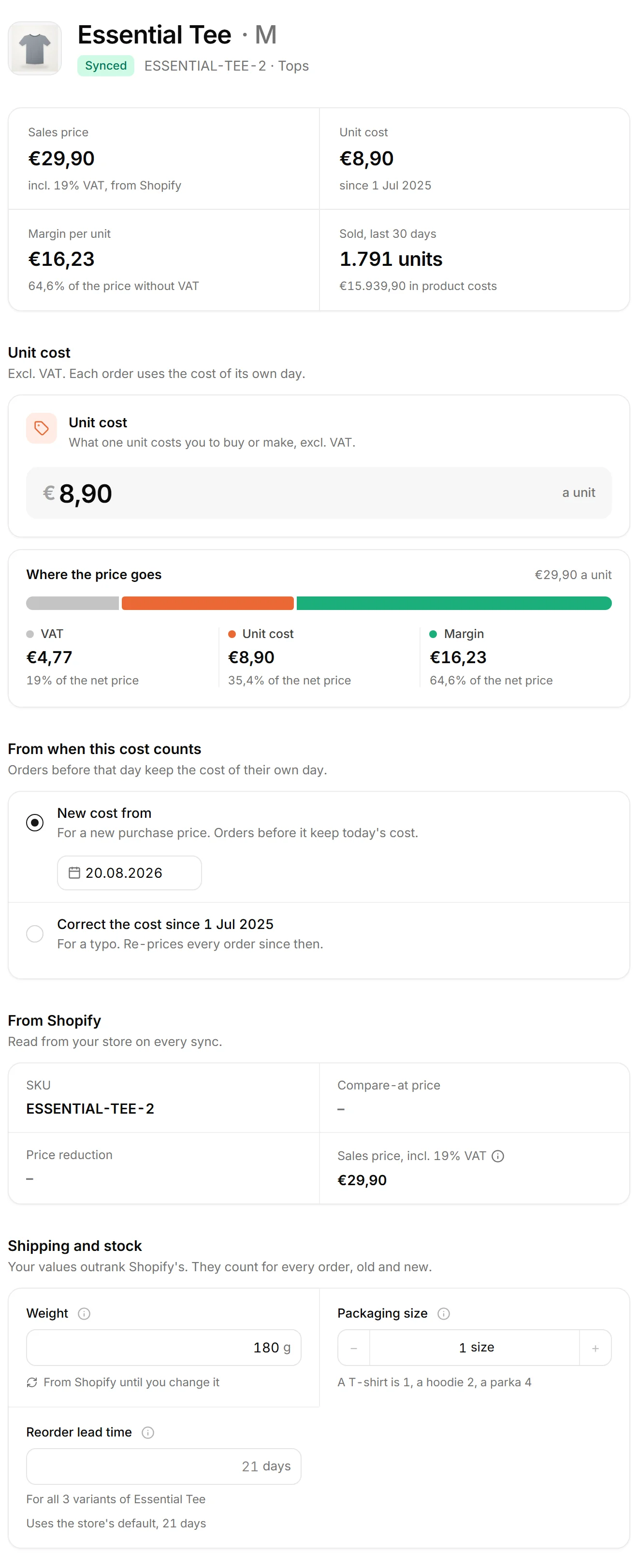
No page has a field called Effective from, because each one names it for what it does. Logistics asks From when these prices count. Transaction fees asks Applies. Products asks From when this cost counts. The Overhead forms ask Start date, and Change applies from when you change a running cost.
An example: a T-shirt costs you €8,90 until 30 June. From 1 July your supplier charges €9,40, so you choose New cost from 1 July and save €9,40. A sale on 30 June still costs €8,90, and a sale on 1 July costs €9,40. Your June profit does not move.
When you save, nouz ends the old cost on the day before the new one starts. This is called effective dating, and every cost in nouz works this way: product costs, logistics prices, payment fees and overhead. A first price counts from your store's first order day, so your whole history gets it: From your first order on Logistics and Products, From its first payment on Transaction fees. Logistics and Transaction fees also take From a date, for a cost that started later. Every later version starts today unless you pick another day, with New prices from, New fee from or New cost from.
Each cost meets the day it belongs to. Product costs, logistics and payment fees use the day of the order. Return costs use the day of the refund. Overhead is spread over the days it covers. A refunded product that comes back to stock, or never shipped, gets back the cost it had when it was sold. So if the June T-shirt comes back in July, July gets €8,90 back, not €9,40. A refund where the item stays with the customer, like a goodwill refund or a lost parcel, keeps its cost. A chargeback is different: it takes the money back but no item comes back, so the goods keep their cost.
Some changes reach the past on purpose. A date in the past works out the days from that date again. That is how a cost you found out about late lands in the right months. A new version never deletes a later version you entered, and the page says so, like Your cost from 1 Dec 2026 stays. On Products, a cost you save also takes over the costs Shopify's sync wrote after that date. Correcting a version instead, with Correct the prices since, Correct since or Correct the cost since, rewrites it for all its days. A date in the future works too: the cost waits for its day, and the Forecast already counts it. A logistics price or a payment fee can also simply stop, with End on a date in its history.
Where you find it Products · a variant's page
Was this answer helpful?
More in Setting up your costs
All 46 questions- 11 What happens when a product has no weight?
- 12 Can I import my costs from a spreadsheet?
- 13 What does the effective-from date do? You are reading this
- 14 Should I edit a cost rule or add a new one?
- 15 Can I enter a cost change I found out about late?
See what your store really kept yesterday.
Install nouz in minutes from the Shopify App Store. It imports every order your store has ever taken. Cancel anytime.