nouz is a daily 34-line Shopify P&L with VAT read from Shopify's tax lines, CM1 to CM3 and dated costs. Profit Calc is a profit dashboard on four order tiers, $39 to $249 a month, checked 6 Nov 2026. Profit Calc is the lower bill up to 1.500 orders a month, nouz above it.
nouz fits a Shopify store that wants a daily 34-line profit and loss statement with VAT read from Shopify's own tax lines, CM1 to CM3 and every cost dated, and it is the lower bill past 1.500 orders a month; Profit Calc fits a store up to 1.500 orders that wants a profit dashboard with many ad integrations and currency conversion, from $39 a month. CM1, CM2 and CM3 are the margins after goods, after shipping and fees, and after ads.
nouz is one of the tools compared here; competitor prices were read on 6 Nov 2026.
Profit Calc has been on the Shopify App Store since 2019. It sells four plans with the same features on each, which differ only by how many orders they cover, and lists German among its languages. nouz is built around one question, how much a store made after all costs, and answers it with a statement laid out the way a European operator reads the numbers. This page sets the two side by side on price at four volumes, on VAT, on Klarna, iDEAL and other EU payment methods, on cost history and on several stores. The table of every tool nouz is compared with prices the rest of the field, and the page on a Shopify profit tracker for EU stores covers how nouz treats VAT, payment methods and number formats.
- nouz is Base $55, Pro $115 and Scale $289 a month (about €49, €99 and €249). Base covers up to 500 orders a month, and Pro and Scale have no order limit, every plan carries every feature, and each starts with a 14-day trial; billing runs through Shopify, month by month.
- Profit Calc publishes four plans, checked 6 Nov 2026: Starter at $39 for up to 500 orders a month, Growth at $79 for up to 1.500, Pro at $149 for up to 3.000 and Unlimited at $249, each with a 15-day trial.
- Bills: nouz is the cheaper of the two from 1.501 orders a month, at 5.000 orders $115 on Pro against $249 on Unlimited; below that volume Profit Calc is.
- VAT: nouz reads it from the tax lines Shopify recorded on each order, at whatever rate Shopify charged; Profit Calc's help centre describes a Revenue VAT switch and, where Shopify charges no VAT, one VAT percentage applied to orders shipped to EU countries.
- Payment methods: nouz takes the fee Shopify Payments reports, with Klarna, iDEAL and EPS through Shopify Payments as rows of their own; Profit Calc names Klarna among its four main gateways and syncs iDEAL at the provider's rate, in a help article from 2022.
nouz and Profit Calc at a glance
| Feature | nouz | Profit Calc |
|---|---|---|
| Price | Base $55, Pro $115 and Scale $289 a month (about €49, €99 and €249) | Starter $39, Growth $79, Pro $149, Unlimited $249 a month |
| Order limits | Base covers up to 500 orders a month, and Pro and Scale have no order limit | Starter 500, Growth 1.500, Pro 3.000 orders a month; Unlimited none |
| VAT-inclusive accounting | revenue lines down to Taxes include VAT; Taxes is its own line, from Shopify's tax lines; net revenue and every line below exclude VAT | a Revenue VAT setting deducts VAT from revenue; where Shopify charges none, one entered VAT percentage, applied to orders shipped to EU countries |
| CM1 to CM3 | CM1, CM2, CM3 and EBITDA on a 34-line daily statement | full P&L reporting; CM1 to CM3 not on its listing |
| Dated cost history | every cost type effective-dated: unit costs, five logistics components, payment fees, overhead | not on its listing |
| EU payment methods | the fee Shopify Payments reports; Klarna, iDEAL and EPS through Shopify Payments as rows of their own; a % plus fixed rule per other gateway | Klarna one of four main gateways; iDEAL, Bancontact and Sofort synced at providers' rates (help article, March 2022); EPS not named |
| Ad platforms | Meta, Google and TikTok by API, Shop Campaigns, manual and CSV spend | Meta, Google, Microsoft's ad network, TikTok, Snapchat, Pinterest and AppLovin, with Klaviyo and GA4 |
| Several stores | one store on Base, up to 5 stores on Pro, up to 10 stores on Scale; stores in one currency added up | multi-store reporting, per its listing |
| Currencies | an order in another currency converted with Shopify's own figures; never two currencies summed | real-time and historical exchange rates |
| Team members | 1 on Base, up to 5 on Pro, unlimited on Scale | not on its listing |
| Language | English, with DACH number formats | German among its languages |
| Free trial | 14 days | 15 days |
What each costs at 300, 500, 1.500 and 5.000 orders
Profit Calc steps up four times by order count and nouz once. Base covers up to 500 orders a month, and Pro and Scale have no order limit, so nouz's bill stops moving at the first step, while Profit Calc's keeps climbing through Growth and Pro to Unlimited. The table prices the cheapest nouz plan and every Profit Calc plan at the four volumes most stores ask about.
Orders a month
| Tool | 300 orders a month | 500 orders a month | 1.500 orders a month | 5.000 orders a month |
|---|---|---|---|---|
| nouz | $55 (Base) | $55 (Base) | $115 (Pro) | $115 (Pro) |
| Profit Calc Starter, $39 | $39 | $39 | upgrade | upgrade |
| Profit Calc Growth, $79 | $79 | $79 | $79 | upgrade |
| Profit Calc Pro, $149 | $149 | $149 | $149 | upgrade |
| Profit Calc Unlimited, $249 | $249 | $249 | $249 | $249 |
Two readings matter. Up to 1.500 orders a month Profit Calc is the lower bill, $39 against $55 on Base on the smallest stores and $79 against $115 on Pro at its Growth limit. Past that, Profit Calc's Pro plan costs $149 and Unlimited $249, while nouz stays at $115 on Pro; at 5.000 orders over a year that is $1.380 against $2.988. Profit Calc's listing also offers yearly billing, and its Unlimited plan's yearly line repeats the yearly figure of its Pro plan, so ask Profit Calc which applies before paying for a year. The profit tracker cost calculator puts both at your own volume.
VAT: one percentage or Shopify's own tax lines
A search of Profit Calc's help centre for VAT returns ten articles, and the picture they draw is a set of switches. Its VAT setup article, last updated in August 2020, describes a Revenue VAT setting to choose when VAT is included in the shop's prices, which deducts VAT from revenue and shows it on a VAT collected card, and a separate setting for VAT paid on ad spend. Where the Shopify store does not calculate VAT itself, the merchant enters a VAT percentage. An article from April 2023 says that normally only orders shipped to EU countries have the VAT calculation applied, and that a VAT applied to all orders setting extends it to every order. No article found describes a rate per destination country or the EU's one-stop shop.
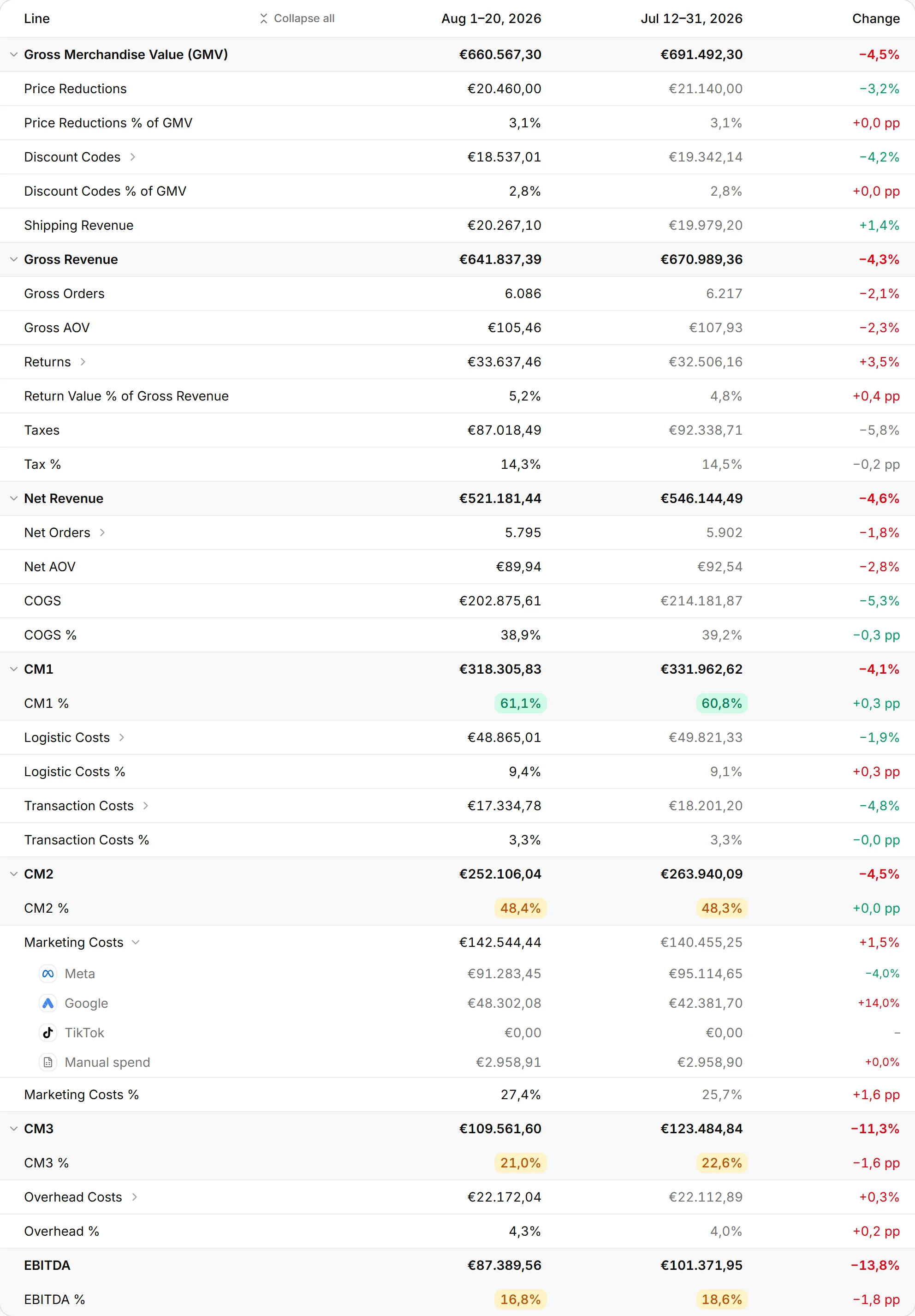
nouz takes VAT from Shopify rather than from a percentage. Every revenue line down to Taxes, line 12, includes VAT the way the shop prices; Taxes is the VAT Shopify recorded on each order minus the VAT handed back on refunds; and Net Revenue, line 14, and every line below it exclude VAT. A store selling into Germany at 19% and Austria at 20% therefore needs no setting: each order carries the tax Shopify charged on it. An order whose prices exclude tax, the norm in North America and for much B2B selling, is grossed up line by line at the rate Shopify actually charged, so it lands on the same basis as its tax-inclusive twin, and every margin below is a share of money the store keeps.
Klarna, iDEAL and the other EU payment methods
Profit Calc's article on transaction fees, last updated in March 2022, names four main gateways to set up: Shopify, PayPal, Stripe and Klarna, with a note that Klarna's fees vary by country. A list of further gateways is synced automatically at each provider's published rate, iDEAL, Bancontact and Sofort among them; EPS is not named. The article is more than four years old and quotes the Shopify plan prices of that time, so check the rates it shows inside the app before you trust a month's fees.
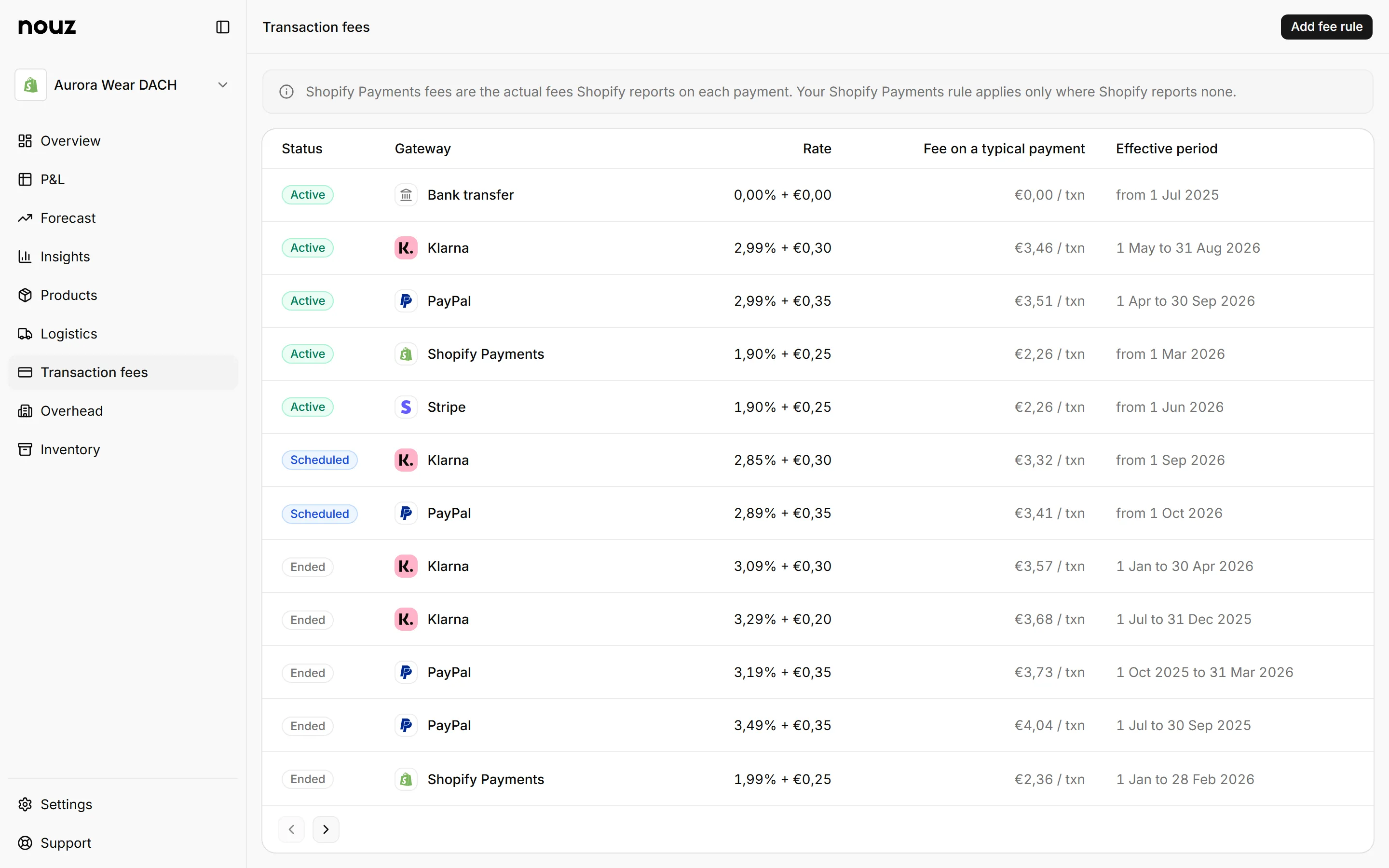
nouz reads the fee from the payment where it can. On Shopify Payments the fee is the one Shopify reports on each transaction, and Klarna, iDEAL, EPS and every other method Shopify Payments takes by name is a row of its own, such as Klarna via Shopify Payments, read from the rates Shopify reports. Any other gateway gets its own rule, a percentage plus a fixed fee, matched on the exact name Shopify records and dated like every other cost. A method that has no fee yet says so; nouz never guesses a rate and never stores a silent zero.
Costs that keep their date, and several stores
Profit Calc's listing names advanced COGS settings and integrations for product costs; a history of costs by date is not on its listing. nouz keeps every cost type as a dated rule: the unit cost of each variant, the five logistics components, the fee rule of each payment method and every overhead line. Saving a new cost closes the old rule the day before and opens the new one, each order is priced by the rule valid on its own day, and a closed month does not move when today's price changes. Logistics is priced per parcel: a rate card by zone and by weight or size, pick and pack, packaging, return processing on the day of the refund, and packaging EPR, the producer fees a country charges on packaging.
Both tools read several stores. Profit Calc lists multi-store reporting and converts currencies at real-time and historical rates, which suits a business that sells in more than one currency and wants one figure for it. nouz covers up to 5 stores on Pro and up to 10 stores on Scale, each with its own costs and statement, and adds stores up only when they share a currency, because a converted total mixes the exchange rate into the margin. An order Shopify stored in another currency is converted with Shopify's own figures, with the European Central Bank's reference rate as the fallback. The first sync backfills the store's entire order history on every plan.
Ad platforms and what sits around the statement
Profit Calc syncs the wider set of channels: Meta, Google, Microsoft's ad network, TikTok, Snapchat, Pinterest and AppLovin, with Klaviyo and GA4 beside them, and its dashboards show ROAS, AOV, refunds, chargebacks, VAT and fees. nouz syncs Meta, Google and TikTok, reads Shopify's Shop Campaigns, and takes any other spend by hand or from a CSV. It measures marketing blended, as MER, the revenue per ad euro, POAS, the profit per ad euro, ROAS, the return on ad spend, and CAC, the cost of winning a customer, with no tracking pixel and no attribution model. Around the statement sit Insights with the margin of every product and an LTV tab of cohorts and LTV:CAC, Inventory, a Forecast page that projects up to twelve months ahead, this one included, and the daily profit email.
Which one fits
Choose nouz when
you sell into EU markets and want VAT taken from Shopify's own tax lines, closed months that stay closed, shipping priced per parcel and the fees of Klarna or iDEAL as Shopify reports them, or when your store is past 1.500 orders a month and the bill should stop climbing.
Choose Profit Calc when
your store is up to 1.500 orders a month and the lower bill matters most, you advertise on Snapchat, Pinterest, AppLovin or Microsoft's network and want that spend synced, you sell in several currencies and want them converted into one, or you want the app itself in German.
Both read Shopify's orders and take costs off them; the difference is how much of the cost structure each one models and where the bills cross. Each of these claims about nouz is listed, with where to check it, on the nouz facts page.
Other comparisons on this site
nouz is set beside the other trackers that price by orders too. SimplyCost has two plans, the lower one under ten dollars, in nouz vs SimplyCost. GoProfit sells four order tiers with a hard limit on each, in nouz vs GoProfit, and Profitario adds a fee for every order past its tier and reports VAT country by country, in nouz vs Profitario. BeProfit and Lifetimely also step up by order count, in nouz vs BeProfit and nouz vs Lifetimely, with BeProfit's tiers set out in BeProfit pricing, and TrueProfit pricing explains the tier-plus-overage model in detail. Kleio and Bloom sell unlimited orders on every paid plan, in Kleio alternatives and Bloom alternatives, and the alternatives to the Munich platform cover the larger analytics platforms EU stores weigh. The best Shopify profit tracker apps compares the whole field by what each tool measures.
How this comparison was made
Profit Calc's plans, prices and features were checked 6 Nov 2026 on its Shopify App Store listing, and its VAT and fee settings in its help centre the same day, each article with the date it was last updated. nouz's prices and limits are read from the plans its checkout charges, as nouz's pricing shows them. No review figure is quoted for either tool, and nothing is scored. Where Profit Calc publishes nothing on a point, the tables say so rather than guess.